The early universe may chirp about unknown physics. A University of Helsinki research team has demonstrated how an early universe phase transition will lead to gravitational wave signals potentially visible in the upcoming satellite missions. The research results were recently published in the prestigious journal Physical Review Letters.
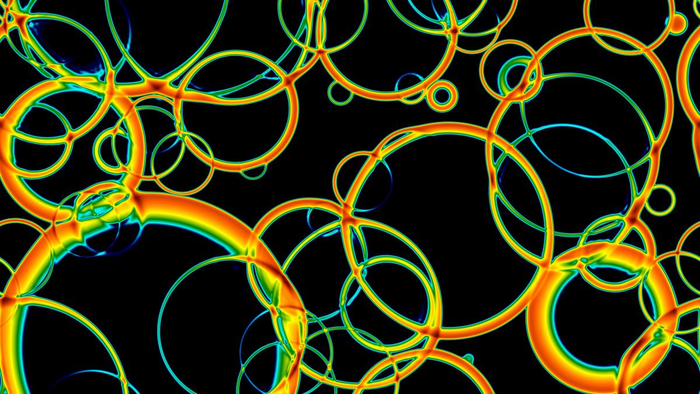
Credit: David Weir
The early universe may chirp about unknown physics. A University of Helsinki research team has demonstrated how an early universe phase transition will lead to gravitational wave signals potentially visible in the upcoming satellite missions. The research results were recently published in the prestigious journal Physical Review Letters.
Phase transitions, such as the boiling of water or the melting of a metal, are commonplace but fascinating phenomena that spur surprises decades after decades. They often occur as the temperature of a substance is changed, through the nucleation of bubbles of the new phase which then expands. In the end, the new phase has taken over the whole container.
The early universe was composed of a hot plasma whose temperature decreased as the universe expanded. It is speculated by many physicists that a phase transition may have occurred soon after the Big Bang. This would then had lead to nucleation of bubbles and their subsequent collisions. Such collisions would create powerful ripples in spacetime which could be observed in planned gravitational wave detectors. The Laser Interferometer Space Antenna (LISA), with a provisional launch date in 2037, is one such probe that may be able to detect these early Universe spacetime ripples.
However, to describe early universe phase transitions has been challenging. The University of Helsinki researchers Oscar Henriksson, Mark Hindmarsh, and Niko Jokela, together with colleagues at the U. of Oviedo and the U. of Sussex, attacked this problem using a technique from string theory known as holographic duality. They showed how the duality can be used to map the problem to a more tractable one, and how the important quantities describing the bubble nucleation and the associated gravitational wave signals can be extracted.
In the future these new methods can be applied directly in more realistic scenarios, where the starting point would be a possible extension of Standard Model of particle physics.
The results were published on 29.3.2022 in the prestigious journal Physical Review Letters. The group is also tackling the remaining obstacle, the computation of the bubble wall velocity, needed for the full first principles description of early universe phase transition and the imprint it makes on the gravitational wave spectrum.
Reference:
Gravitational Waves at Strong Coupling from an Effective Action, Fëanor Reuben Ares, Oscar Henriksson, Mark Hindmarsh, Carlos Hoyos, and Niko Jokela, Phys. Rev. Lett. 128, 131101 – Published 29 March 2022
Contact: Niko Jokela, University of Helsinki, [email protected]
Journal
Physical Review Letters
DOI
10.1103/PhysRevLett.128.131101
Method of Research
Computational simulation/modeling
Article Title
Gravitational Waves at Strong Coupling from an Effective Action
Article Publication Date
29-Mar-2022