Ikoma, Japan—DNA methylation is a major epigenetic modification that is crucial for mammalian development. For instance, DNA methylation is central to inexhaustible biological processes, such as gene regulation and cell fate decisions. In mammals, DNA methyltransferases are key for blastocysts to re-establish global DNA methylation patterns during implantation. This is critical for passing on epigenetic information to the next generation. On the other hand, the role of methyl-CpG binding proteins (MBPs) that bind methylated CpG as part of the DNA methylation processes is still unclear. However, a previous study conducted by researchers at Nara Institute of Science and Technology (NAIST), Japan, clarified that; Zbtb38, also known as CIBZ, is a zinc finger type of MBP that is pivotal for the growth of mouse embryonic stem (ES) cells. They further demonstrated that Zbtb38 facilitates the expression of Nanog, which is fundamental for the growth of ES cells. However, what Zbtb38 does in real life, is still a mystery.
Credit: Eishou Matsuda
Ikoma, Japan—DNA methylation is a major epigenetic modification that is crucial for mammalian development. For instance, DNA methylation is central to inexhaustible biological processes, such as gene regulation and cell fate decisions. In mammals, DNA methyltransferases are key for blastocysts to re-establish global DNA methylation patterns during implantation. This is critical for passing on epigenetic information to the next generation. On the other hand, the role of methyl-CpG binding proteins (MBPs) that bind methylated CpG as part of the DNA methylation processes is still unclear. However, a previous study conducted by researchers at Nara Institute of Science and Technology (NAIST), Japan, clarified that; Zbtb38, also known as CIBZ, is a zinc finger type of MBP that is pivotal for the growth of mouse embryonic stem (ES) cells. They further demonstrated that Zbtb38 facilitates the expression of Nanog, which is fundamental for the growth of ES cells. However, what Zbtb38 does in real life, is still a mystery.
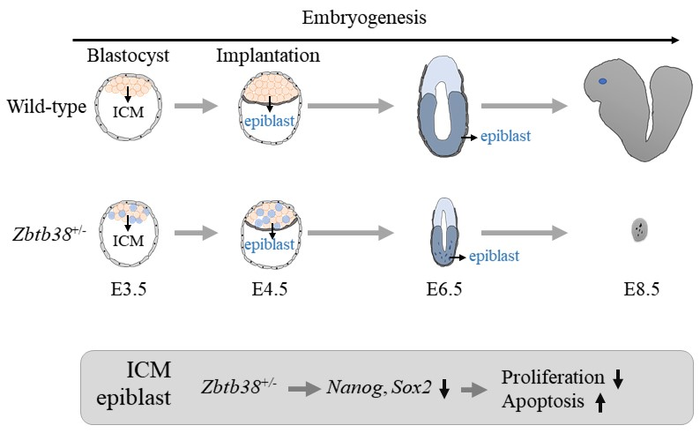
In a further quest to solve this mystery, the same scientists at NAIST, led by Eishou Matsuda, used Cre-loxP technology to make conditional Zbtb38 knockout mice. Their ground-breaking research revealed that a single Zbtb38 allele deletion in the germline led to a decrease in epiblast cell growth and an increase in apoptosis soon after implantation, which led to early embryonic death. Nanog, Sox2 and genes that control epiblast growth and differentiation became dysfunctional when Zbtb38 was lost in heterozygous embryos.
“Our findings indicate that germline loss of the Zbtb38 single allele reduces epiblast cell proliferation and increases apoptosis shortly after implantation, resulting in early embryonic lethality. Heterozygous Zbtb38 deficiency reduced the expression of Nanog, Sox2 and genes involved in epiblast proliferation, differentiation and cell viability. This finding shows that a methyl-CpG binding protein has a role in controlling embryonic phenotype,” explains Matsuda.
“For the first time we demonstrated a link to an embryonic function for a protein that has long been known to bind methyl-CpG,” says co-author Yasumasa Ishida. “This presents a huge opportunity for further research to find out how Zbtb38 works during embryogenesis. More research needs to be done to elucidate the specific molecular mechanisms. Zbtb38 is found in all tissues, and it is linked to height, cancers, neurodegenerative diseases and rheumatoid arthritis, etc. Thus, the creation and analysis of tissue-specific Cre-mediated knockout mice will help us understand Zbtb38’s physiological functions and Zbtb38-linked diseases,” concludes Matsuda.
The findings of this work will interest developmental biologists as it emphasizes the epigenetic significance of DNA methylation during the early stages of pregnancy.
###
Resource
Title: Heterozygous loss of Zbtb38 leads to early embryonic lethality via the suppression of Nanog and Sox2 expression
Authors: Miki Nishio, Takuya Matsuura, Shunya Hibi, Shiomi Ohta, Chio Oka, Noriaki Sasai, Yasumasa Ishida & Eishou Matsuda
Journal: Cell Proliferation
Information about the Functional Genomics and Medicine Laboratory can be found at the following website: https://bsw3.naist.jp/eng/courses/courses211.html
Journal
Cell Proliferation
DOI
10.1111/cpr.13215
Article Title
Heterozygous loss of Zbtb38 leads to early embryonic lethality via the suppression of Nanog and Sox2 expression