• HOME
  • NEWS
  • EXPLORE
    • CAREER
      • Companies
      • Jobs
    • EVENTS
    • iGEM
      • News
      • Team
    • PHOTOS
    • VIDEO
    • WIKI
  • BLOG
  • COMMUNITY
    • FACEBOOK
    • INSTAGRAM
    • TWITTER
Wednesday, June 24, 2026
BIOENGINEER.ORG
No Result
View All Result
  • Login
  • HOME
  • NEWS
  • EXPLORE
    • CAREER
      • Companies
      • Jobs
        • Lecturer
        • PhD Studentship
        • Postdoc
        • Research Assistant
    • EVENTS
    • iGEM
      • News
      • Team
    • PHOTOS
    • VIDEO
    • WIKI
  • BLOG
  • COMMUNITY
    • FACEBOOK
    • INSTAGRAM
    • TWITTER
  • HOME
  • NEWS
  • EXPLORE
    • CAREER
      • Companies
      • Jobs
        • Lecturer
        • PhD Studentship
        • Postdoc
        • Research Assistant
    • EVENTS
    • iGEM
      • News
      • Team
    • PHOTOS
    • VIDEO
    • WIKI
  • BLOG
  • COMMUNITY
    • FACEBOOK
    • INSTAGRAM
    • TWITTER
No Result
View All Result
Bioengineer.org
No Result
View All Result
Home NEWS Science News Biology

Breakthrough in cell research: Jacobs University scientists discover new method for drug delivery

Bioengineer by Bioengineer
March 24, 2022
in Biology
Reading Time: 2 mins read
0
Andrea Barba-Bon and Werner Nau
Share on FacebookShare on TwitterShare on LinkedinShare on RedditShare on Telegram

“Our method has potential for broad application,” said Werner Nau, Professor of Chemistry, in whose research group the method was developed. It is based on a new chemical concept that the researchers have been working on since 2015. Until now, complex and sometimes toxic formulations had to be used to overcome the cell walls. The Jacobs University researchers are achieving this effect by using water-soluble clusters based on the chemical element boron. In experiments, they demonstrated that there is an optimal size for these boron clusters at which the penetration process is particularly efficient. “If the molecules are too small, they don’t work. If they are too large, they have membrane-damaging properties,” reported Andrea Barba-Bon, the first author of the article in Nature and a post-doctoral researcher who carried out the first successful experiments.
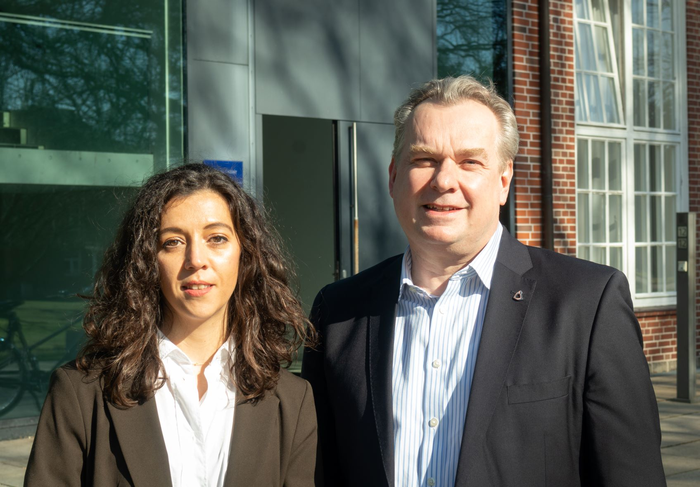
Andrea Barba-Bon and Werner Nau

Credit: Jacobs University Bremen

“Our method has potential for broad application,” said Werner Nau, Professor of Chemistry, in whose research group the method was developed. It is based on a new chemical concept that the researchers have been working on since 2015. Until now, complex and sometimes toxic formulations had to be used to overcome the cell walls. The Jacobs University researchers are achieving this effect by using water-soluble clusters based on the chemical element boron. In experiments, they demonstrated that there is an optimal size for these boron clusters at which the penetration process is particularly efficient. “If the molecules are too small, they don’t work. If they are too large, they have membrane-damaging properties,” reported Andrea Barba-Bon, the first author of the article in Nature and a post-doctoral researcher who carried out the first successful experiments.

The scientists succeeded in placing various bioactive substances in cells. Among them were those that successfully overcame antibiotic resistance. “There are many potential applications to be developed with this method, for example, for the delivery of the next generation of therapeutics such as short peptides or even protein-based drugs” said Javier Montenegro, in whose Spanish research group the cell biology experiments were conducted. Peptides are sought-after active ingredients. They are used, for example, in cancer therapies, antibiotics, vaccines, and numerous novel drugs. They are also used in the cosmetics industry.

The process also has the potential to give a boost to fundamental research in cell biology. It makes it much easier to transport positively charged and neutral drug molecules or fluorescent dyes into living cells, which previously could not be introduced.

“Boron clusters as broadband membrane transporters,” is the title of the article in Nature. The journal, first published in the United Kingdom in 1869, is one of the most influential and renowned publications in the field of natural sciences. “After several years of intensive basic research, it is now a great success for us to be able to publish the application potential of our research results there,” Professor Nau said.


Journal

Nature

Method of Research

Experimental study

Subject of Research

Cells

Article Title

Boron clusters as broadband membrane carriers

Article Publication Date

23-Mar-2022

Share12Tweet8Share2ShareShareShare2

Related Posts

Reevaluating the Impact of ‘Yo-Yo Dieting’: Is It Less Harmful Than Commonly Thought? — Biology

Reevaluating the Impact of ‘Yo-Yo Dieting’: Is It Less Harmful Than Commonly Thought?

June 24, 2026
Family Dogs: Science’s Unexpected Ally in Autism Research — Biology

Family Dogs: Science’s Unexpected Ally in Autism Research

June 24, 2026

Enhanced Riboflavin Production Achieved in Bacillus subtilis through Transporter Engineering

June 24, 2026

Scientists Discover Evolving Sperm Whale Dialects in the Mediterranean Sea

June 24, 2026

POPULAR NEWS

  • Saying Goodbye to PGY-6: Pediatric Fellowship Realities

    103 shares
    Share 41 Tweet 26
  • Multi-Hospital Study Reveals Long Covid Burden Is Twice as High as Current Estimates

    92 shares
    Share 36 Tweet 23
  • Detection of EDCs in Breast Milk and Infant Urine Up to Six Months Highlights Early Exposure Risks

    77 shares
    Share 31 Tweet 19
  • New Drug Candidate Developed at McMaster Shows Potential for Treating Brain Cancer

    58 shares
    Share 23 Tweet 15

About

We bring you the latest biotechnology news from best research centers and universities around the world. Check our website.

Follow us

Recent News

Immune Cell–Fibroblast Interaction: A Potential Trigger for Autoimmune Diseases

How Zebrafish Could Hold the Key to Developing Treatments for CADASIL

New Technology Uncovers How the Heart Produces Cells with Regenerative Potential

Subscribe to Blog via Email

Enter your email address to subscribe to this blog and receive notifications of new posts by email.

Join 82 other subscribers
  • Contact Us

Bioengineer.org © Copyright 2023 All Rights Reserved.

Welcome Back!

Login to your account below

Forgotten Password?

Retrieve your password

Please enter your username or email address to reset your password.

Log In
No Result
View All Result
  • Homepages
    • Home Page 1
    • Home Page 2
  • News
  • National
  • Business
  • Health
  • Lifestyle
  • Science

Bioengineer.org © Copyright 2023 All Rights Reserved.