A new study published in the journal BRAIN shows for the first time that neurons in the spinal cord process pain signals differently in women compared to men. The finding could lead to better and more personalized treatments for chronic pain, which are desperately needed, especially in light of the opioid epidemic.
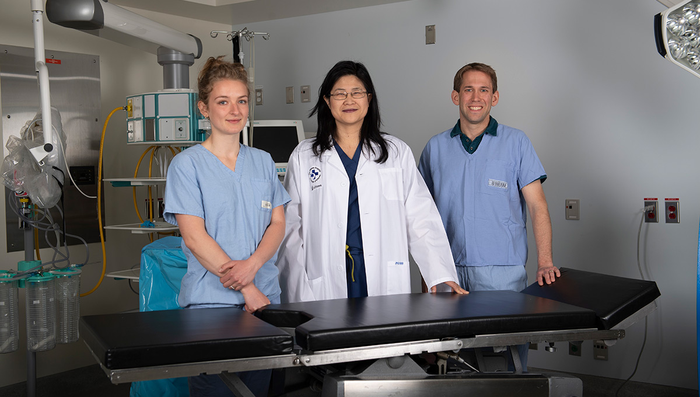
Credit: Justin Tang
A new study published in the journal BRAIN shows for the first time that neurons in the spinal cord process pain signals differently in women compared to men. The finding could lead to better and more personalized treatments for chronic pain, which are desperately needed, especially in light of the opioid epidemic.
Although it has long been known that women and men experience pain differently, most pain research uses male rodents. The new study is unique because it used female and male spinal cord tissue from both rats and humans (generously donated by deceased individuals and their families).
By examining the spinal cord tissue in the laboratory, the researchers were able to show that a neuronal growth factor called BDNF plays a major role in amplifying spinal cord pain signalling in male humans and male rats, but not in female humans or female rats. When female rats had their ovaries removed, the difference disappeared, pointing to a hormonal connection.
“Developing new pain drugs requires a detailed understanding of how pain is processed at the biological level,” said Dr. Annemarie Dedek, lead author of the study and now a MITACS- and Eli Lilly-funded industrial research fellow at Carleton University and The Ottawa Hospital. “This new discovery lays the foundation for the development of new treatments to help those suffering from chronic pain.”
This discovery was possible because of a unique collaboration between the research laboratories of:
- Dr. Mike Hildebrand, associate professor at Carleton University and affiliate investigator at The Ottawa Hospital
- Dr. Eve Tsai, neurosurgeon and Suruchi Bhargava Chair in Spinal Cord and Brain Regeneration Research at The Ottawa Hospital and associate professor at the University of Ottawa Brain and Mind Research Institute
- Dr. Yves De Koninck, Director of the CERVO Brain Research Center at Laval University
- Dr. Jian Xu, associate research scientist, Yale University
This is the first time a sex-related difference in pain signalling has been identified in human spinal cord tissue. Future studies are required to understand how this biological difference may contribute to differences in pain sensation between men and women.
Learn more about how this team is bridging the gap between animal studies and new treatments for chronic pain.
This research was supported by the Canada Foundation for Innovation, the Natural Sciences and Engineering Research Council of Canada, the International Association for the Study of Pain Medicine, the Canadian Pain Society, Pfizer Canada, Fonds de recherche du Quebec, Sentinel North and the Canadian Institutes of Health Research. All research at The Ottawa Hospital is also enabled by generous donors to The Ottawa Hospital Foundation.
Journal
Brain
DOI
10.1093/brain/awab408
Method of Research
Experimental study
Subject of Research
Human tissue samples
Article Title
A sexually dimorphic neuronal mechanism of spinal hyperexcitability in rodent and human pain models
Article Publication Date
22-Mar-2022
COI Statement
The authors report no competing interests.