By filtering waste products and toxins from the urine, the kidney is one of the most important players in human metabolism. It is estimated that several million patients worldwide die each year from renal disease. When a patient reaches the stage of end-stage renal disease (ESRD), only organ transplantation or regular dialysis can keep them alive. However, the availability of donor kidneys is very low and both treatments severely limit the patient’s quality of life.
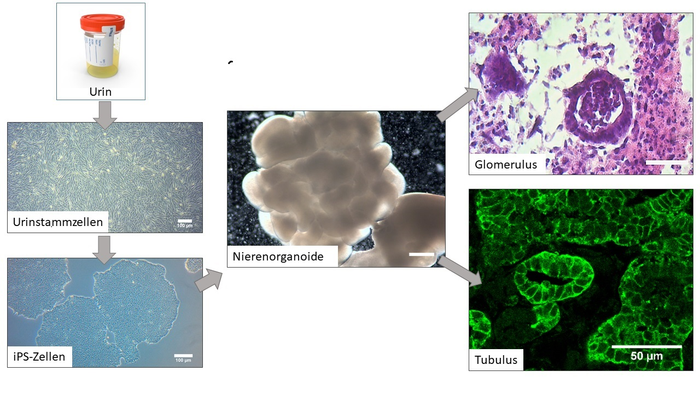
Credit: Adjaye, James; Nguyen, Lisa
By filtering waste products and toxins from the urine, the kidney is one of the most important players in human metabolism. It is estimated that several million patients worldwide die each year from renal disease. When a patient reaches the stage of end-stage renal disease (ESRD), only organ transplantation or regular dialysis can keep them alive. However, the availability of donor kidneys is very low and both treatments severely limit the patient’s quality of life.
Scientists at the Institute for Stem Cell Research and Regenerative Medicine at the University Hospital Düsseldorf in Germany are contributing to a better understanding of the causes of acute kidney injury (AKI) and other kidney diseases with the aim of developing drug and therapy alternatives. They have developed a laboratory-based model of acute kidney injury (AKI) by treating three-dimensional kidney organoids with a toxic substance (nephrotoxin aminonucleoside puromycin-PAN) known to cause kidney injury at high doses. Prof. Dr. James Adjaye is the senior author of this study, published in the journal Cells1. Biologist Lisa Nguyen is the first author of the publication.
Organoids are three-dimensional cell aggregates that mimic the structural and functional properties of the corresponding organ. For this work, the researchers isolated cells from urine and generated three-dimensional kidneys through several steps.
“It’s fascinating how much potential there is in the waste product urine. We started with isolated cells from urine and ended up with kidney organoids,” says Prof. Adjaye. “You can see that the structures are very similar to those of kidneys,” Lisa Nguyen adds. Aside from generating kidney organoids in the Petri dish, the researchers additionally simulated AKI using the nephrotoxin PAN.
“Many kidney problems are triggered by high doses of drugs, and parts of the kidney that are important for blood filtration are particularly susceptible,” Prof. Adjaye explains. Triggers can be commonly prescribed drugs such as aspirin, ibuprofen, cisplatin and cardiovascular drugs such as angiotensin-converting enzyme inhibitors (ACEi) and angiotensin receptor inhibitors (ARBs) in a subset of patients.
The experiments of the Düsseldorf scientists* were able to replicate these processes, including inflammation, DNA damage and cell death, which were particularly striking,” says biologist Lisa Nguyen. “Understanding how the basic mechanisms of these diseases work at the level of each individual is the first step to effectively discover and develop therapies and drugs,” explains Prof. Adjaye.
Journal
Cells
DOI
10.3390/cells11040635
Method of Research
Experimental study
Subject of Research
Cells
Article Title
The Nephrotoxin Puromycin Aminonucleoside Induces Injury in Kidney Organoids Differentiated from Induced Pluripotent Stem Cells.
Article Publication Date
11-Feb-2022
COI Statement
No conflict