• HOME
  • NEWS
  • EXPLORE
    • CAREER
      • Companies
      • Jobs
    • EVENTS
    • iGEM
      • News
      • Team
    • PHOTOS
    • VIDEO
    • WIKI
  • BLOG
  • COMMUNITY
    • FACEBOOK
    • INSTAGRAM
    • TWITTER
Sunday, February 8, 2026
BIOENGINEER.ORG
No Result
View All Result
  • Login
  • HOME
  • NEWS
  • EXPLORE
    • CAREER
      • Companies
      • Jobs
        • Lecturer
        • PhD Studentship
        • Postdoc
        • Research Assistant
    • EVENTS
    • iGEM
      • News
      • Team
    • PHOTOS
    • VIDEO
    • WIKI
  • BLOG
  • COMMUNITY
    • FACEBOOK
    • INSTAGRAM
    • TWITTER
  • HOME
  • NEWS
  • EXPLORE
    • CAREER
      • Companies
      • Jobs
        • Lecturer
        • PhD Studentship
        • Postdoc
        • Research Assistant
    • EVENTS
    • iGEM
      • News
      • Team
    • PHOTOS
    • VIDEO
    • WIKI
  • BLOG
  • COMMUNITY
    • FACEBOOK
    • INSTAGRAM
    • TWITTER
No Result
View All Result
Bioengineer.org
No Result
View All Result
Home NEWS Science News Biology

Rare monkey adapts to fragmented habitat by dieting and reducing activity

Bioengineer by Bioengineer
March 17, 2022
in Biology
Reading Time: 2 mins read
0
Olalla’s titi monkey
Share on FacebookShare on TwitterShare on LinkedinShare on RedditShare on Telegram

A team of scientists with the Wildlife Conservation Society (WCS) and Oxford Brookes University found that a rare species of monkey in Bolivia has adapted to living in a fragmented forest by dieting and moving less during lean times.
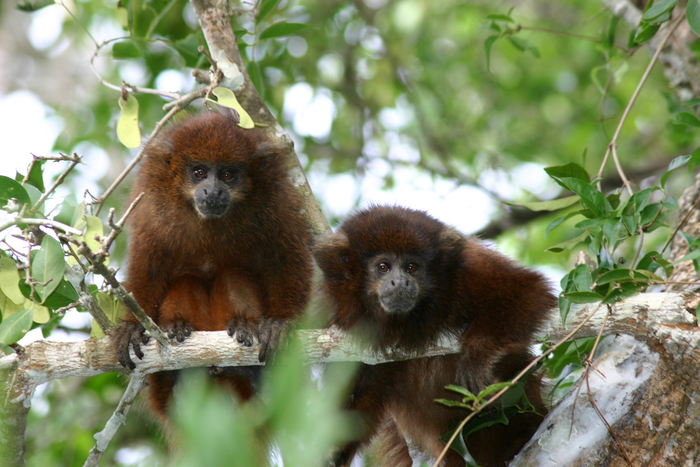
Olalla’s titi monkey

Credit: Jesus Martinez/WCS Bolivia

A team of scientists with the Wildlife Conservation Society (WCS) and Oxford Brookes University found that a rare species of monkey in Bolivia has adapted to living in a fragmented forest by dieting and moving less during lean times.

Publishing their results in the International Journal of Primatology, the team say that Olalla’s titi monkey (Plecturocebus olallae), follows an energy–area minimizing strategy that may enable it to inhabit a forest-savanna landscape in the southwestern portion of the Llanos de Moxos – the largest wetland in the Amazon.

The team observed a shift in diet away from fruits during the dry season toward alternative foods such as seeds, lichens, and fungi. In addition, the monkeys reduced movement instead of expanding ranging behavior to look for fruits and other higher quality foods.

Nevertheless, the authors say that deforestation and further fragmentation in the range of these endemic and Critically Endangered primates must be addressed, as they represent significant threats to the severely range-restricted populations.

Said Rob Wallace, Director of WCS’s Greater Madidi-Tambopata Landscape Program, and a co-author of the study: “The study illustrates the relevance of understanding primate ecological flexibility in response to food reductions to the development of conservation actions, especially in the light of increasing forest degradation and loss in the study region.”

In December 2021, WCS Bolivia won the National Biodiversity Science Prize for its work over the last two decades studying and developing conservation actions for the endemic titi monkeys in the Greater Madidi-Tambopata Landscape. In 2020, WCS began a second landscape-scale program in the Llanos de Moxos of Beni.

###


Journal

International Journal of Primatology

DOI

10.1007/s10764-021-00276-6

Method of Research

Observational study

Subject of Research

Animals

Article Title

Seasonal Ecological Flexibility of a Threatened Bolivian Endemic: Olalla’s Titi Monkey (Plecturocebus olallae)

Article Publication Date

1-Mar-2022

COI Statement

none

Share12Tweet8Share2ShareShareShare2

Related Posts

Florida Cane Toad: Complex Spread and Selective Evolution

Florida Cane Toad: Complex Spread and Selective Evolution

February 7, 2026
New Study Uncovers Mechanism Behind Burn Pit Particulate Matter–Induced Lung Inflammation

New Study Uncovers Mechanism Behind Burn Pit Particulate Matter–Induced Lung Inflammation

February 6, 2026

DeepBlastoid: Advancing Automated and Efficient Evaluation of Human Blastoids with Deep Learning

February 6, 2026

Navigating the Gut: The Role of Formic Acid in the Microbiome

February 6, 2026

POPULAR NEWS

  • Robotic Ureteral Reconstruction: A Novel Approach

    Robotic Ureteral Reconstruction: A Novel Approach

    82 shares
    Share 33 Tweet 21
  • Digital Privacy: Health Data Control in Incarceration

    63 shares
    Share 25 Tweet 16
  • Breakthrough in RNA Research Accelerates Medical Innovations Timeline

    53 shares
    Share 21 Tweet 13
  • Mapping Tertiary Lymphoid Structures for Kidney Cancer Biomarkers

    50 shares
    Share 20 Tweet 13

About

We bring you the latest biotechnology news from best research centers and universities around the world. Check our website.

Follow us

Recent News

Anesthesia Method’s Impact on Elderly Hip Fracture Recovery

Menopause Care: Insights from Workforce Review and Consultation

LRRK2R1627P Mutation Boosts Gut Inflammation, α-Synuclein

Subscribe to Blog via Email

Enter your email address to subscribe to this blog and receive notifications of new posts by email.

Join 73 other subscribers
  • Contact Us

Bioengineer.org © Copyright 2023 All Rights Reserved.

Welcome Back!

Login to your account below

Forgotten Password?

Retrieve your password

Please enter your username or email address to reset your password.

Log In
No Result
View All Result
  • Homepages
    • Home Page 1
    • Home Page 2
  • News
  • National
  • Business
  • Health
  • Lifestyle
  • Science

Bioengineer.org © Copyright 2023 All Rights Reserved.