How the lower jaw — mandible — develops and consequently how and why some developmental birth defects occur is the focus of a five-year, $2.8 million grant to Joan Richtsmeier, distinguished professor of anthropology, Penn State, from the National Institutes of Health’s National Institute of Dental & Craniofacial Research.
Credit: Joan T. Richtsmeier, Penn State
How the lower jaw — mandible — develops and consequently how and why some developmental birth defects occur is the focus of a five-year, $2.8 million grant to Joan Richtsmeier, distinguished professor of anthropology, Penn State, from the National Institutes of Health’s National Institute of Dental & Craniofacial Research.
“Mandibular disorders, often resulting in small jaws, are among the most common human birth defects,” said Richtsmeier. “These disorders can dramatically affect quality of life and are often associated with or compound problems with airway obstruction, speech and feeding.”
As an embryo develops, a tubular cartilage rod called Meckel’s cartilage precedes development of the mandible. This cartilage rod is not only involved with development of the mandible, but also with bones in the middle ear and some ligaments.
Throughout the body, cartilage is often a precursor to bone both before and after birth. Cartilage mineralizes to form the long bones of the arms and legs as they grow, as well as certain bones that support the brain.
Meckel’s cartilage is assumed to be the template for the lower jaw, however, evidence of this is lacking and little is known of the relationship between the middle portion of Meckel’s cartilage and mandibular mineralization, size and shape, according to Richtsmeier.
She suggests that Meckel’s cartilage does not function as a template for the mandible as previously assumed and that there is a novel role for the mid portion of the cartilage that her team hopes to reveal.
Richtsmeier and her team that includes Susan Motch Perrine and Kazuhiko Kawasakai, associate research professors, Penn State and a group of collaborators from the Department of Genetics and Genomic Sciences, Icahn School of Medicine at Mount Sinai, hypothesize that the mid portion of Meckel’s cartilage may function to determine mandibular length, mineralization of the perichondrium — a fibrous tissue covering cartilage — and mineralization of the mandible.
“Because our findings challenge the traditional role of Meckel’s cartilage, we have designed this project to validate the developmental events that take place as the midportion of Meckel’s cartilage disappears,” said Richtsmeier.
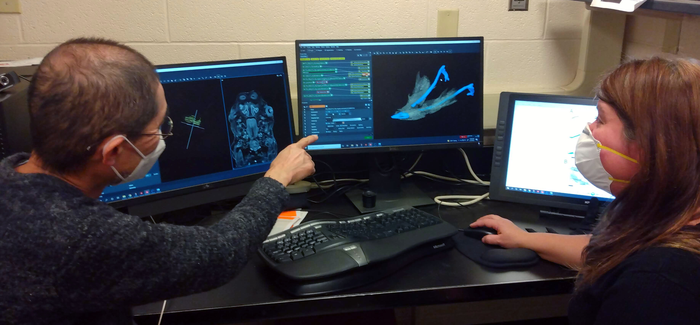
The researchers will examine four processes — initiation and growth of Meckel’s cartilage, mineralization of Meckel’s cartilage perichondrium, mineralization of the mandible and disappearance of Meckel’s cartilage. They will use 3D imaging of embryonic mice to determine the changing cellular dynamics of the lower jaw. They will also use RNA sequencing analysis and cell tracing analysis to determine the fate of cells from the intermediate region of Meckel’s cartilage, which is currently unknown.
“Our project is designed to bring new understanding to lower jaw development and open novel research areas to advance strategies for bone repair, regeneration and prevention in mandibular disease,” said Richtsmeier.