• HOME
  • NEWS
  • EXPLORE
    • CAREER
      • Companies
      • Jobs
    • EVENTS
    • iGEM
      • News
      • Team
    • PHOTOS
    • VIDEO
    • WIKI
  • BLOG
  • COMMUNITY
    • FACEBOOK
    • INSTAGRAM
    • TWITTER
Saturday, February 7, 2026
BIOENGINEER.ORG
No Result
View All Result
  • Login
  • HOME
  • NEWS
  • EXPLORE
    • CAREER
      • Companies
      • Jobs
        • Lecturer
        • PhD Studentship
        • Postdoc
        • Research Assistant
    • EVENTS
    • iGEM
      • News
      • Team
    • PHOTOS
    • VIDEO
    • WIKI
  • BLOG
  • COMMUNITY
    • FACEBOOK
    • INSTAGRAM
    • TWITTER
  • HOME
  • NEWS
  • EXPLORE
    • CAREER
      • Companies
      • Jobs
        • Lecturer
        • PhD Studentship
        • Postdoc
        • Research Assistant
    • EVENTS
    • iGEM
      • News
      • Team
    • PHOTOS
    • VIDEO
    • WIKI
  • BLOG
  • COMMUNITY
    • FACEBOOK
    • INSTAGRAM
    • TWITTER
No Result
View All Result
Bioengineer.org
No Result
View All Result
Home NEWS Science News Biology

Voles cut grass to watch flying predators

Bioengineer by Bioengineer
March 11, 2022
in Biology
Reading Time: 2 mins read
0
A Brandt’s vole
Share on FacebookShare on TwitterShare on LinkedinShare on RedditShare on Telegram

A tiny rodent trims tall grasses so it can watch the skies for flying predators, new research shows.
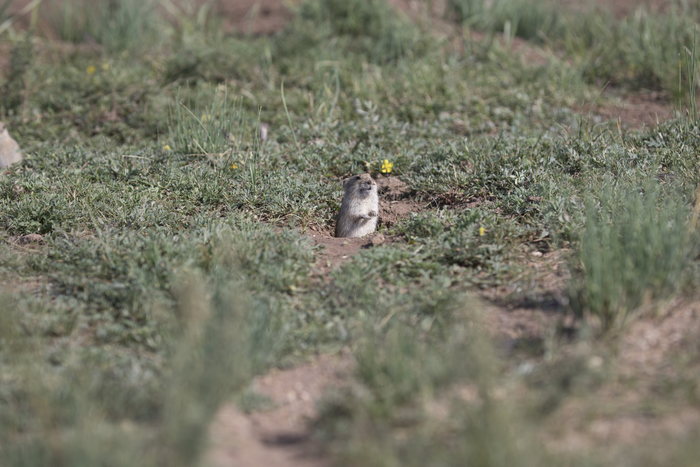
A Brandt’s vole

Credit: Guoliang Li

A tiny rodent trims tall grasses so it can watch the skies for flying predators, new research shows.

Brandt’s voles live in grassland in Inner Mongolia, China, where they are hunted by birds called shrikes.

The new study – by the Institute of Zoology, Chinese Academy of Sciences; Northeast Normal University of China and the universities of Exeter and Florida – found that the voles cut tall bunchgrass when shrikes are nearby.

The voles don’t eat or use the bunchgrass – they cut it to keep themselves safe, an example of “ecosystem engineering”.

“When shrikes were present, the voles dramatically decreased the volume of bunchgrass,” said Dr Dirk Sanders, of the Environment and Sustainability Institute on Exeter’s Penryn Campus in Cornwall.

“This led to fewer visits from shrikes – which apparently recognise cut-grass areas as poor hunting grounds.

“An activity like this is costly for the voles in terms of energy, so there must be high ‘selection pressure’ to do it – cutting the grass must significantly improve their chances of survival.”

The researchers also tested the impact of keeping birds away, by putting up nets over certain areas.

With no shrikes overhead, the voles stopped cutting the bunchgrass.

“We sometimes underestimate the ability of wild animals to react to changes in their environment,” Dr Sanders said.

“In this case, the voles were able to change their behaviour in response to the removal of predators.”

He added: “Our findings are a reminder that species show remarkable adaptations. It also underlines that the loss of even a single species in a food web can result in unexpected changes to an entire habitat.”

“This study provides a good example that animals can actively modify their habitat to reduce predation risk,” said Dr Zhibin Zhang, from the State Key Laboratory of Integrated Management of Pest Insects and Rodents, Institute of Zoology, Chinese Academy of Sciences.

Dr Zhiwei Zhong, from Northeast Normal University, added: “The finding would have some implications in rodent management in pasture land. Keeping or planting these large bunchgrasses may help to attract shrikes, and then to reduce the population density of voles”.

The paper, published in the journal Current Biology, is entitled: “A rodent herbivore reduces its predation risk.”


Journal

Current Biology

DOI

10.1016/j.cub.2022.02.074

Method of Research

Observational study

Subject of Research

Animals

Article Title

A rodent herbivore reduces its predation risk.

Article Publication Date

11-Mar-2022

Share12Tweet8Share2ShareShareShare2

Related Posts

Florida Cane Toad: Complex Spread and Selective Evolution

Florida Cane Toad: Complex Spread and Selective Evolution

February 7, 2026
New Study Uncovers Mechanism Behind Burn Pit Particulate Matter–Induced Lung Inflammation

New Study Uncovers Mechanism Behind Burn Pit Particulate Matter–Induced Lung Inflammation

February 6, 2026

DeepBlastoid: Advancing Automated and Efficient Evaluation of Human Blastoids with Deep Learning

February 6, 2026

Navigating the Gut: The Role of Formic Acid in the Microbiome

February 6, 2026

POPULAR NEWS

  • Robotic Ureteral Reconstruction: A Novel Approach

    Robotic Ureteral Reconstruction: A Novel Approach

    82 shares
    Share 33 Tweet 21
  • Digital Privacy: Health Data Control in Incarceration

    63 shares
    Share 25 Tweet 16
  • Study Reveals Lipid Accumulation in ME/CFS Cells

    57 shares
    Share 23 Tweet 14
  • Breakthrough in RNA Research Accelerates Medical Innovations Timeline

    53 shares
    Share 21 Tweet 13

About

We bring you the latest biotechnology news from best research centers and universities around the world. Check our website.

Follow us

Recent News

Phage-Antibiotic Combo Beats Resistant Peritoneal Infection

Boosting Remote Healthcare: Stepped-Wedge Trial Insights

Barriers and Boosters of Seniors’ Physical Activity in Karachi

Subscribe to Blog via Email

Enter your email address to subscribe to this blog and receive notifications of new posts by email.

Join 73 other subscribers
  • Contact Us

Bioengineer.org © Copyright 2023 All Rights Reserved.

Welcome Back!

Login to your account below

Forgotten Password?

Retrieve your password

Please enter your username or email address to reset your password.

Log In
No Result
View All Result
  • Homepages
    • Home Page 1
    • Home Page 2
  • News
  • National
  • Business
  • Health
  • Lifestyle
  • Science

Bioengineer.org © Copyright 2023 All Rights Reserved.