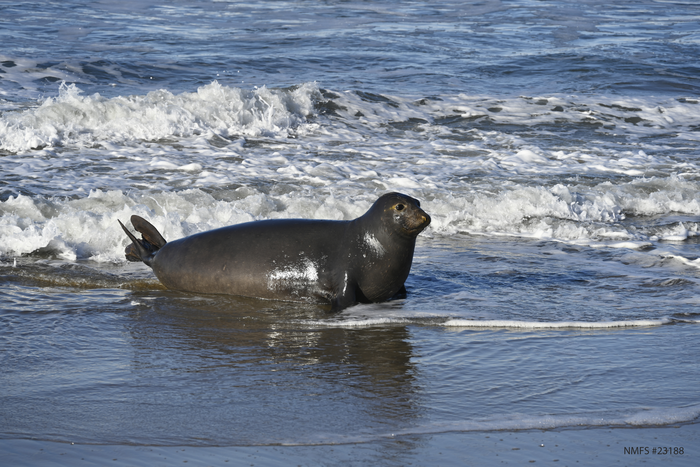
Each year, pregnant female elephant seals take an approximately 240-day trek over 10,000 kilometers across the Eastern North Pacific Ocean before returning to their breeding beaches to give birth within five days of their arrival. Now, a study appearing February 28 in the journal biology Current Biology finds that this impressive navigation ability depends on an internal map sense, which functions much like a built-in GPS.
Credit: Dan Costa
Each year, pregnant female elephant seals take an approximately 240-day trek over 10,000 kilometers across the Eastern North Pacific Ocean before returning to their breeding beaches to give birth within five days of their arrival. Now, a study appearing February 28 in the journal biology Current Biology finds that this impressive navigation ability depends on an internal map sense, which functions much like a built-in GPS.
“We found that migrating elephant seals know how far they are from their breeding beach thousands of kilometers away,” said Roxanne Beltran of the University of California Santa Cruz. “They also know approximately how long it will take them to get back.”
Beltran and her colleagues, including Dan Costa, knew that elephant seals are expert navigators. What they didn’t know was how the seals manage to make it back to the beach just in time for the breeding season.
In the new study, the researchers used satellite tracking data collected from more than 100 adult female seals. They figured out when each of them turned around to head back to the beach where they started from.
The data revealed that seals decided to turn around based strongly on how far away they were from where they needed to go. Their decisions to turn around weren’t related to their body condition, measured as amount of body fat.
“We were surprised that foraging success or percent body fat was not more strongly related to when seals begin the return portion of the migration,” Beltran said. “We expected that highly successful (i.e. fatter) seals might end their foraging trips earlier, but that was not the case; instead, it seems like they are well programmed to turn around strategically based on where they are and in turn how long it will take them to get back.”
The researchers don’t yet know what sensory cues the elephant seals depend on to keep track of where they are and head in the right direction at the right time, but it’s clear that they can adjust the timing of their travels based on an internal perception of time and space.
The results help to better understand elephant seals, with important implications for their conservation, the researchers say. In future studies, they hope to quantify exactly how precise the seals’ navigation ability is and determine which cues are most important.
###
The work was funded by the Office of Naval Research, the E&P Sound and Marine Life Joint Industry Project of the International Association of Oil and Gas Producers, and the National Science Foundation.
Current Biology, Beltran et al.: “Evidence of a map sense: elephant seals account for time and space during long-distance migrations,” https://www.cell.com/current-biology/fulltext/S0960-9822(22)00042-2
Current Biology (@CurrentBiology), published by Cell Press, is a bimonthly journal that features papers across all areas of biology. Current Biology strives to foster communication across fields of biology, both by publishing important findings of general interest and through highly accessible front matter for non-specialists. Visit: http://www.cell.com/current-biology. To receive Cell Press media alerts, contact [email protected].
Journal
Current Biology
DOI
10.1016/j.cub.2022.01.031
Method of Research
Observational study
Subject of Research
Animals
Article Title
Evidence of a map sense: elephant seals account for time and space during long-distance migrations
Article Publication Date
28-Feb-2022