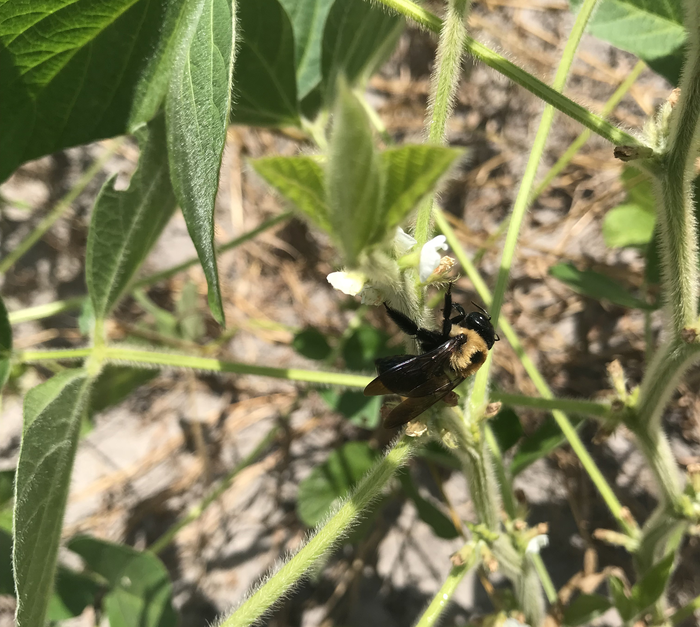
Researchers at North Carolina State University have found that soybean crops planted near pollinator habitat produce larger soybeans than soybean crops that are not planted near pollinator habitat.
Credit: Hannah Levenson, NC State University
Researchers at North Carolina State University have found that soybean crops planted near pollinator habitat produce larger soybeans than soybean crops that are not planted near pollinator habitat.
“Even though soybeans are not thought of as being dependent on pollinators, we found that soybean plants are still attractive to bees,” says Hannah Levenson, a postdoctoral research scholar at NC State and corresponding author of a paper on the work. “And we found that the presence of pollinators was associated with larger soybeans.
“There’s been a lot of work on how planting pollinator habitat near crop fields can affect crops that are considered pollinator dependent, such as blueberries or strawberries,” Levenson says. “But there’s been relatively little work on crops that aren’t considered pollinator dependent. We wanted to know how having pollinator habitat near soybean fields would affect both bee species and crop yields for the soybeans.”
The researchers chose to focus on soybeans because they are an economically important crop that is grown in dozens of states.
For the study, researchers worked at eight research stations across North Carolina. At each station, the researchers evaluated two soybean fields: one that was adjacent to an established area of pollinator habitat, and one that was as far away as possible – generally just under a kilometer away.
The pollinator habitat was created by planting wildflower seed mixes in unused land near fields. The habitat could be grown in areas that aren’t amenable to crop cultivation, or on land that can be used to grow crops but had not been cultivated that season due to crop rotation or other factors.
To assess impact on bees, the researchers did two things. First, they surveyed bee communities in both soybean fields and the pollinator habitat at each research station. The surveys consisted of a detailed visual assessment to establish the overall abundance of bees, as well as which species were present at each location. The researchers also collected samples of individual bees to confirm their identifications.
The research team also collected pollen samples from three of the most common bee species, allowing them to determine which plants the bees were visiting.
“From the survey, we found that the bee communities in the pollinator habitats were completely distinct from the bee communities in the distant soybean fields,” Levenson says. “The bee communities in the soybean fields adjacent to pollinator habitats were something of a mixture, including elements of both of the other groups. The habitat-adjacent fields were fairly similar to the distant soybean fields, but had bee communities that were clearly influenced by the nearby pollinator habitat.”
“From the pollen samples, we learned that all of the bees we found in any of the soybean fields were actively visiting soybean flowers,” says April Sharp, co-author of the paper and a graduate student at NC State who worked on the project as an undergraduate. “The evidence suggests that some of the bees in the pollinator habitat itself were also visiting the soybean flowers, though that was less pronounced.”
The researchers also found that bees in the soybean fields located far from pollinator habitats were often leaving the soybean fields to visit flowers completely outside of the study area. Bees in soybean fields that were adjacent to the pollinator habitat were less likely to leave the study area.
“This suggests that having pollinator habitat nearby is beneficial to bees in the soybean fields,” Levenson says.
To assess the impact on crop yields, researchers collected 30 soybean plants from each of the fields at harvesting time. They then counted the number of seeds – or soybeans – per pod, the total number of seeds per plant, and the weight of those seeds.
“We found that the number of seeds was similar for fields near pollinator habitat and fields that were far away,” Levenson says. “However, plants in fields that were adjacent to pollinator habitat produced seeds that were 6.5% heavier than the seeds from plants in distant fields.”
“That’s a substantial difference in the size of soybeans,” says David Tarpy, co-author of the paper and a professor of applied ecology at NC State. “Given that soybean farmers sell their crop by weight, it could make a meaningful difference in a grower’s profit margin.”
“Our findings are very applicable for soybean growers across the Southeast,” Levenson says. “Other regions, such as the Midwest, have different cropping systems, so it’s not clear the extent to which these findings would apply there – that’s an interesting area for future study. This work also raises questions about the role that pollinators might play in affecting other crops that aren’t considered pollinator dependent. That’s another area that is worth exploring.”
The paper, “Evaluating the impact of increased pollinator habitat on bee visitation and yield metrics in soybean crops,” is published in the journal Agriculture, Ecosystems & Environment. The work was done with support from the North Carolina Department of Agriculture & Consumer Services, the Syngenta Pollinator and IPM Stewardship program, and Southern SARE, under grant number GS19-215.
Journal
Agriculture Ecosystems & Environment
DOI
10.1016/j.agee.2022.107901
Method of Research
Observational study
Subject of Research
Animals
Article Title
Evaluating the impact of increased pollinator habitat on bee visitation and yield metrics in soybean crops
Article Publication Date
17-Feb-2022
COI Statement
none