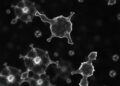
Researchers at Uppsala University have discovered that the ancestors of legionella bacteria infected eukaryotic cells as early as two billion years ago. It happened soon after eukaryotes began to feed on bacteria. These results, described in a new study published in Molecular Biology and Evolution, also contributes to the chicken-or-egg debate about whether mitochondria or phagocytosis came first.

Credit: Sanna Dovat Guy
Researchers at Uppsala University have discovered that the ancestors of legionella bacteria infected eukaryotic cells as early as two billion years ago. It happened soon after eukaryotes began to feed on bacteria. These results, described in a new study published in Molecular Biology and Evolution, also contributes to the chicken-or-egg debate about whether mitochondria or phagocytosis came first.
“Our study can help us understand how harmful bacteria arise and how complex cells evolved from simpler cells,” says Lionel Guy, associate professor of evolutionary microbiology at the Department of Medical Biochemistry and Microbiology, who headed the study.
Two billion years ago, ancestors of legionella bacteria already had the ability to avoid being digested by eukaryotes. Instead, they began using eukaryotic cells – complex cells with a nucleus that make up amoebas, fungi and human beings – to multiply.
The legionella bacterium, which causes Legionnaires’ disease, belongs to a large group of bacteria called Legionellales. All Legionellales bacteria can infect eukaryotic hosts: amoebas, insects or our own cells.
“We discovered that the ancestor of the whole group lived about two billion years ago, at a time when eukaryotes were still in the making, evolving from simpler cells to the complex cell structure they have now,” says Andrei Guliaev, a researcher at the Department of Medical Biochemistry and Microbiology. “We believe Legionellales were among the first to infect eukaryotic cells.”
The first step in an infection with legionella bacteria is for a eukaryotic host, such as an amoeba, to bring the bacterium into its cell through a process called phagocytosis. The next step for the amoeba would be to digest the bacterium and use its parts as an energy source. But legionella bacteria have molecular tools that keep them from being digested and allow them to instead use the amoeba as an energy source so they can multiply.
In the study, the researchers show that all Legionellales have the same kind of molecular tools as legionella. That suggests that the ability to infect eukaryotes already existed in the ancestor of all Legionellales. This means that phagocytosis is at least as old as Legionellales – two billion years old – when eukaryotes were in the early stages of their evolution.
Which has implications for a hot chicken-or-egg debate in evolutionary biology about how eukaryotes came into being. Which came first? Was it the mitochondria, which originated from another group of bacteria and became our cells’ own energy factories? Or was it phagocytosis, which is considered necessary to absorb mitochondria but is very costly from an energy standpoint?
“Some researchers believe that mitochondria were required to deliver enough energy for phagocytosis to work. But our results suggest that phagocytosis came first – two billion years ago – while mitochondria came later,” says Lionel Guy.
Article: Eric Hugoson, Andrei Guliaev, Tea Ammunét, and Lionel Guy; Host-adaptation in Legionellales is 1.9 Ga, coincident with eukaryogenesis. Molecular Biology and Evolution, 2022, DOI: 10.1093; 10.1093/molbev/msac037
Further information:
Lionel Guy, associate professor of evolutionary microbiology at the Department of Medical Biochemistry and Microbiology, Uppsala University and Scilifelab, +46-73-976 0618, [email protected]
Journal
Molecular Biology and Evolution
DOI
10.1093/molbev/msac037
Article Title
Host-adaptation in Legionellales is 1.9 Ga, coincident with eukaryogenesis
Article Publication Date
15-Feb-2022