Researchers report that the immune cells responsible for clearing away a key protein that builds up in the brains of patients with Alzheimer’s disease operate according to daily circadian rhythms. The discovery, reported by Jennifer Hurley of Rensselaer Polytechnic Institute and colleagues in a new study publishing February 10th in the journal PLOS Genetics, provides a potential explanation for the link between Alzheimer’s disease and disruptions to a person’s sleep cycle.
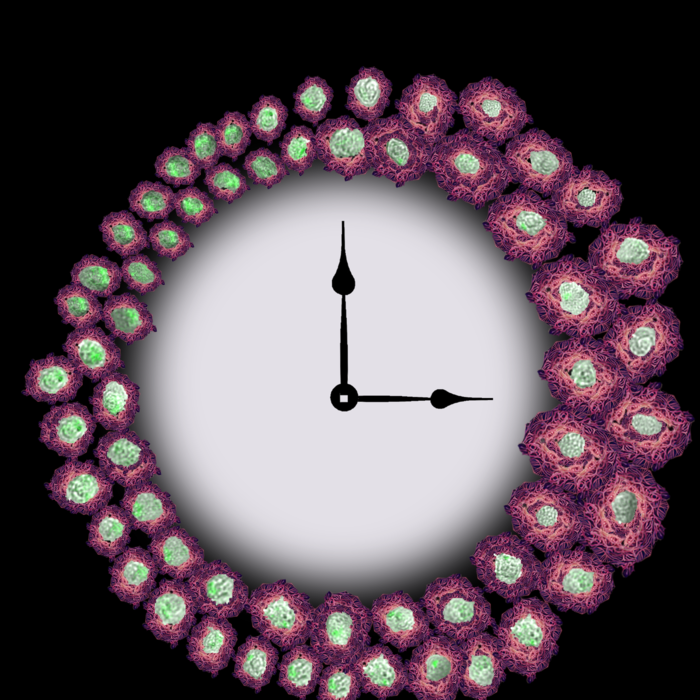
Credit: Gretchen Clark, made using Wombo (CC-BY 4.0, https://creativecommons.org/licenses/by/4.0/)
Researchers report that the immune cells responsible for clearing away a key protein that builds up in the brains of patients with Alzheimer’s disease operate according to daily circadian rhythms. The discovery, reported by Jennifer Hurley of Rensselaer Polytechnic Institute and colleagues in a new study publishing February 10th in the journal PLOS Genetics, provides a potential explanation for the link between Alzheimer’s disease and disruptions to a person’s sleep cycle.
Alzheimer’s disease is known to be associated with disruptions in circadian rhythms, the 24-hour cycle that controls many aspects of human behavior and physiology. For example, sleep disruptions begin years before symptoms of Alzheimer’s disease appear and are linked to more severe symptoms and a higher risk of developing the disease.
In the new paper, researchers investigated a molecular mechanism potentially responsible for the connection between Alzheimer’s disease and circadian rhythms. They measured the activity of immune cells responsible for clearing away proteins called amyloid-beta that build up as plaques in the brains of people with Alzheimer’s disease. Using cultures of these cells grown in the lab, they discovered that the immune cells clear away the amyloid-beta on an oscillating daily cycle controlled by circadian rhythms. However, when cells lost that rhythm, the daily cycle disappeared. They further established that the underlying cause of this oscillation was changes in the number of molecules of a certain protein, heparan, on the cell’s surface. The protein they identified responds to circadian rhythms and previously had been shown to play a role in clearing amyloid-beta proteins.
The new findings uncover a mechanism that links the disruption of circadian rhythms to Alzheimer’s disease. The study further highlights the role of immune cells in this relationship. While more studies will be necessary, the new findings present the possibility that, if the daily clearance of amyloid-beta proteins through this mechanism can be maintained, patients may be less likely to develop Alzheimer’s disease and to exhibit less severe symptoms.
Hurley adds, “Understanding how our circadian rhythms can regulate cell-surface heparan levels to control the build-up of amyloid-beta may lead to the development of chronotherapeutics that alleviate the symptoms of Alzheimer’s Disease as well as other inflammatory diseases.”
#####
In your coverage, please use this URL to provide access to the freely available article in PLOS Genetics:
http://journals.plos.org/plosgenetics/article?id=10.1371/journal.pgen.1009994
Citation: Clark GT, Yu Y, Urban CA, Fu G, Wang C, Zhang F, et al. (2022) Circadian control of heparan sulfate levels times phagocytosis of amyloid beta aggregates. PLoS Genet 18(2): e1009994. https://doi.org/10.1371/journal.pgen.1009994
Author Countries: United States, China
Funding: This work was supported by an NIH-National Institute of Biomedical Imaging and Bioengineering Grant U01EB022546 (to J.M.H) (https://www.nibib.nih.gov/), an NIH-National Institute of General Medical Sciences Grant R35GM128687 (to J.M.H.) (https://www.nigms.nih.gov/), an National Science Foundation CAREER Award 2045674 (to J.M.H.) (https://www.nsf.gov/), National Institutes of Health grants 1RF1AG069039 (to C.W.), DK111958 and CA231074 (to R.J.L.) (https://www.nih.gov/), Rensselaer Polytechnic Startup funds (to J.M.H.) (https://www.rpi.edu/), a gift from the Warren Alpert Foundation (to J.M.H.) (https://warrenalpert.org/), and a NIH-National Institute of Aging T32 Fellowship AG057464 (to G.T.C.) (https://www.nia.nih.gov/). The funders had no role in study design, data collection and analysis, decision to publish, or preparation of the manuscript.
Journal
PLoS Genetics
DOI
10.1371/journal.pgen.1009994
Method of Research
Experimental study
Subject of Research
Cells
COI Statement
Competing interests: The authors have declared that no competing interests exist.