• HOME
  • NEWS
  • EXPLORE
    • CAREER
      • Companies
      • Jobs
    • EVENTS
    • iGEM
      • News
      • Team
    • PHOTOS
    • VIDEO
    • WIKI
  • BLOG
  • COMMUNITY
    • FACEBOOK
    • INSTAGRAM
    • TWITTER
Saturday, February 7, 2026
BIOENGINEER.ORG
No Result
View All Result
  • Login
  • HOME
  • NEWS
  • EXPLORE
    • CAREER
      • Companies
      • Jobs
        • Lecturer
        • PhD Studentship
        • Postdoc
        • Research Assistant
    • EVENTS
    • iGEM
      • News
      • Team
    • PHOTOS
    • VIDEO
    • WIKI
  • BLOG
  • COMMUNITY
    • FACEBOOK
    • INSTAGRAM
    • TWITTER
  • HOME
  • NEWS
  • EXPLORE
    • CAREER
      • Companies
      • Jobs
        • Lecturer
        • PhD Studentship
        • Postdoc
        • Research Assistant
    • EVENTS
    • iGEM
      • News
      • Team
    • PHOTOS
    • VIDEO
    • WIKI
  • BLOG
  • COMMUNITY
    • FACEBOOK
    • INSTAGRAM
    • TWITTER
No Result
View All Result
Bioengineer.org
No Result
View All Result
Home NEWS Science News Biology

Cutting off liver cancer’s nutrient supply chain

Bioengineer by Bioengineer
February 3, 2022
in Biology
Reading Time: 3 mins read
0
Mouse liver tissue with tumor
Share on FacebookShare on TwitterShare on LinkedinShare on RedditShare on Telegram

The World Health Organization projects that starting in 2030, over a million people will die each year from liver cancer. Cold Spring Harbor Laboratory (CSHL) Professor Adrian Krainer, former postdoc Wai Kit Ma, and Dillon Voss, a Stony Brook University M.D.-Ph.D. student-in-residence in Krainer’s lab, have come up with a way to interfere with the energy pathway that allows this cancer to grow and spread. They recently published their work, which was a collaboration with Ionis Pharmaceuticals, in the journal Cancer Research.
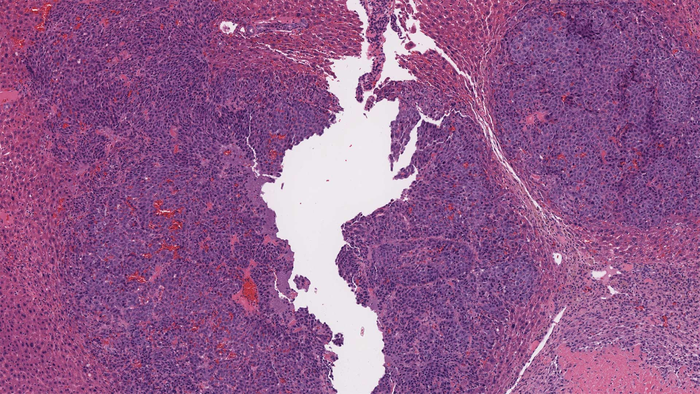
Mouse liver tissue with tumor

Credit: Dillon Voss/Krainer lab/CSHL, 2021

The World Health Organization projects that starting in 2030, over a million people will die each year from liver cancer. Cold Spring Harbor Laboratory (CSHL) Professor Adrian Krainer, former postdoc Wai Kit Ma, and Dillon Voss, a Stony Brook University M.D.-Ph.D. student-in-residence in Krainer’s lab, have come up with a way to interfere with the energy pathway that allows this cancer to grow and spread. They recently published their work, which was a collaboration with Ionis Pharmaceuticals, in the journal Cancer Research.

The CSHL scientists used antisense oligonucleotides (ASOs), which are synthetic combinations of genetic code that bind to RNA and alter the way cells build proteins. These molecules switch the enzyme that liver cancer cells use from one type of pyruvate kinase protein (PKM2), which is normally expressed in embryonic and cancer cells, to another form of pyruvate kinase protein (PKM1), which enhances tumor-suppressing behavior. Changing the function of this protein affects the way cancer cells use nutrients, which can limit their growth. As Krainer explains, “What’s unique about our approach is that we are doing two things at the same time: we’re turning down PKM2 and increasing PKM1. And we think both of those are important.”

ASOs are promising for this type of cancer because after injecting them under the skin, the body would send them directly to the liver. The liver cancer would be prevented from growing and spreading to other organs. The researchers saw a significant reduction in the development of tumors in the two mouse models they studied. This study builds on earlier research in Krainer’s lab in which they switched PKM2 to PKM1 in cultured cells from an aggressive type of brain cancer called glioblastoma.

This strategy also has another benefit, as healthy liver cells do not make the same RNA that ASOs would target in liver cancer cells. That reduces the likelihood of any off-target effects. Voss says, “Being able to deliver this therapy directly to the liver, without impacting normal liver cells, could provide a more effective, safer option to treat liver cancer in the future.”

Krainer, who is working with antisense oligonucleotides in other diseases including cystic fibrosis and spinal muscular atrophy, plans to continue to use these therapeutic tools to search for ways to treat liver cancer. Among other questions, the researchers hope to explore whether the RNA molecules can help contain the metastasis of cancer to the liver from other organs.


DOI

10.1158/0008-5472.CAN-20-0948

Article Title

ASO-based PKM Splice-switching Therapy Inhibits Hepatocellular Carcinoma Cell Growth

Article Publication Date

17-Dec-2021
Share12Tweet8Share2ShareShareShare2

Related Posts

Florida Cane Toad: Complex Spread and Selective Evolution

Florida Cane Toad: Complex Spread and Selective Evolution

February 7, 2026
New Study Uncovers Mechanism Behind Burn Pit Particulate Matter–Induced Lung Inflammation

New Study Uncovers Mechanism Behind Burn Pit Particulate Matter–Induced Lung Inflammation

February 6, 2026

DeepBlastoid: Advancing Automated and Efficient Evaluation of Human Blastoids with Deep Learning

February 6, 2026

Navigating the Gut: The Role of Formic Acid in the Microbiome

February 6, 2026

POPULAR NEWS

  • Robotic Ureteral Reconstruction: A Novel Approach

    Robotic Ureteral Reconstruction: A Novel Approach

    82 shares
    Share 33 Tweet 21
  • Digital Privacy: Health Data Control in Incarceration

    63 shares
    Share 25 Tweet 16
  • Study Reveals Lipid Accumulation in ME/CFS Cells

    57 shares
    Share 23 Tweet 14
  • Breakthrough in RNA Research Accelerates Medical Innovations Timeline

    53 shares
    Share 21 Tweet 13

About

We bring you the latest biotechnology news from best research centers and universities around the world. Check our website.

Follow us

Recent News

Decoding Prostate Cancer Origins via snFLARE-seq, mxFRIZNGRND

Digital Health Perspectives from Baltic Sea Experts

Florida Cane Toad: Complex Spread and Selective Evolution

Subscribe to Blog via Email

Enter your email address to subscribe to this blog and receive notifications of new posts by email.

Join 73 other subscribers
  • Contact Us

Bioengineer.org © Copyright 2023 All Rights Reserved.

Welcome Back!

Login to your account below

Forgotten Password?

Retrieve your password

Please enter your username or email address to reset your password.

Log In
No Result
View All Result
  • Homepages
    • Home Page 1
    • Home Page 2
  • News
  • National
  • Business
  • Health
  • Lifestyle
  • Science

Bioengineer.org © Copyright 2023 All Rights Reserved.