Ithaca, NY—At night, hummingbirds lower their body temperature and metabolism drastically by dropping into an energy-saving state of inactivity called torpor. Scientists from multiple universities now find there’s more than one level of torpor: shallow and deep, plus the transition stage between levels of torpor and the normal sleep state. Their findings have been published in the Journal of Experimental Biology.
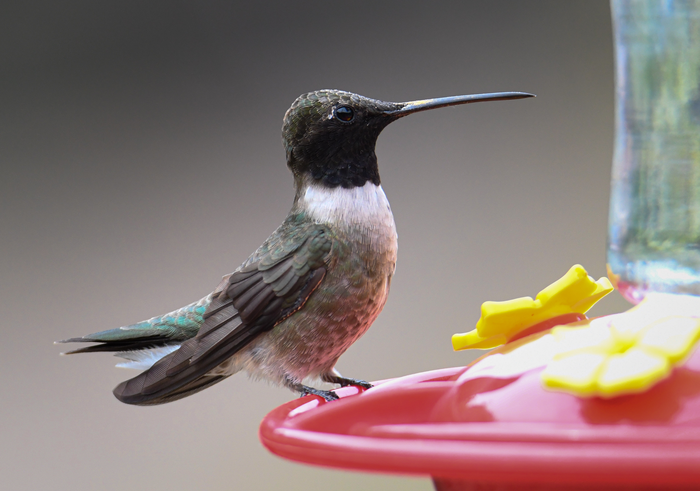
Credit: Trevor Ambrico
Ithaca, NY—At night, hummingbirds lower their body temperature and metabolism drastically by dropping into an energy-saving state of inactivity called torpor. Scientists from multiple universities now find there’s more than one level of torpor: shallow and deep, plus the transition stage between levels of torpor and the normal sleep state. Their findings have been published in the Journal of Experimental Biology.
“There have been a few hints that this ability to fine-tune thermoregulation was possible,” said lead author Anusha Shankar, currently a Rose Postdoctoral Fellow at the Cornell Lab of Ornithology. “But the studies were done under laboratory conditions, not the conditions a bird would encounter in the wild. It was really exciting to see that hummingbird torpor could be variable and flexible.”
Shankar and colleagues from Stony Brook University, the Swiss Federal Research Institute, and George Fox University, used infra-red thermal imaging to track the body temperatures of three hummingbird species in Arizona: Blue-throated Mountain-gem, Rivoli’s Hummingbird, and Black-chinned Hummingbird. They measured the temperature emitted from the skin around the eyes of the birds. The differences in heat generation at various stages are stark.
The normal daytime body temperature of a hummingbird is more than 100 degrees Fahrenheit, even in colder weather. During shallow torpor, their body temperature drops by about 20 degrees Fahrenheit. In deep torpor, the bird maintains a body temperature 50 degrees Fahrenheit below its normal daytime temperature. If human body temperature were to drop a mere 3 degrees from the standard 98.6 degrees Fahrenheit, we’d be in a state of hypothermia and, unlike hummingbirds, would need outside help to get warm again. Size also matters.
“In this study we found that the smallest bird used deep torpor every night,” said Shankar. “The bigger birds sometimes use deep torpor and sometimes shallow torpor, and sometimes no torpor at all!”
Shallow torpor may have developed to balance energy-saving with the costs of deep torpor. In deep torpor a hummingbird is probably more vulnerable to disease because its immune system shuts down, plus it is vulnerable to predation and sleep deprivation. This ability to use torpor at varying depths indicates that at least some birds are capable of fine-tuning how cold they get in torpor, and how they manage saving energy with the potential costs of dropping way down into deep torpor.
Torpor is not the same as sleep. Sleep uses much more energy and serves many restorative functions. Daily torpor also differs from hibernation. Hibernating animals enter a low-energy state for weeks or months at time while hummingbirds can enter torpor every night.
Many questions remain about what is taking place in the brain during torpor, how levels of body fat may trigger torpor, and how the hummingbirds can generate the heat to warm up again—a process that can take up to 30 minutes.
“At least 42 bird species use torpor,” said Shankar, “But only hummingbirds, nightjars, and one species of mousebird go into deep torpor. Studying the range of torpor could help us understand the evolution of thermoregulation in birds.”
Support for this research comes from NASA, the Tinker Foundation, National Geographic Society, American Philosophical Society, European Research Council, the Swiss Federal Research Institute for Forest, Snow, and Landscape Research, George Fox University, the Swiss National Science Foundation, and two crowd-funded grants from experiment.com.
Reference:
Anusha Shankar, Isabelle N.H., Sarah Thompson, Catherine H. Graham and Donald R. Powers. A heterothermic spectrum in hummingbirds. (2022) Journal of Experimental Biology. 225: 2. DOI: 10.1242/jeb.243208
Editors: Download images. Some of this material is protected by copyright. Use is permitted only within stories about the content of this release. Redistribution or any other use is prohibited without express written permission of the Cornell Lab of Ornithology or the copyright owner.
Journal
Journal of Experimental Biology
DOI
10.1242/jeb.243208
Method of Research
Experimental study
Subject of Research
Animals
Article Title
A heterothermic spectrum in hummingbirds.
Article Publication Date
27-Jan-2022