• HOME
  • NEWS
  • EXPLORE
    • CAREER
      • Companies
      • Jobs
    • EVENTS
    • iGEM
      • News
      • Team
    • PHOTOS
    • VIDEO
    • WIKI
  • BLOG
  • COMMUNITY
    • FACEBOOK
    • INSTAGRAM
    • TWITTER
Sunday, August 23, 2026
BIOENGINEER.ORG
No Result
View All Result
  • Login
  • HOME
  • NEWS
  • EXPLORE
    • CAREER
      • Companies
      • Jobs
        • Lecturer
        • PhD Studentship
        • Postdoc
        • Research Assistant
    • EVENTS
    • iGEM
      • News
      • Team
    • PHOTOS
    • VIDEO
    • WIKI
  • BLOG
  • COMMUNITY
    • FACEBOOK
    • INSTAGRAM
    • TWITTER
  • HOME
  • NEWS
  • EXPLORE
    • CAREER
      • Companies
      • Jobs
        • Lecturer
        • PhD Studentship
        • Postdoc
        • Research Assistant
    • EVENTS
    • iGEM
      • News
      • Team
    • PHOTOS
    • VIDEO
    • WIKI
  • BLOG
  • COMMUNITY
    • FACEBOOK
    • INSTAGRAM
    • TWITTER
No Result
View All Result
Bioengineer.org
No Result
View All Result
Home NEWS Science News Biology

Extreme marine heat has become the “new normal”, in analysis of data from 1870 onwards – with 57% of the ocean surface recording 2019 temperatures once considered extreme
Bioengineer by Bioengineer
February 1, 2022
in Biology
Reading Time: 1 min read
0
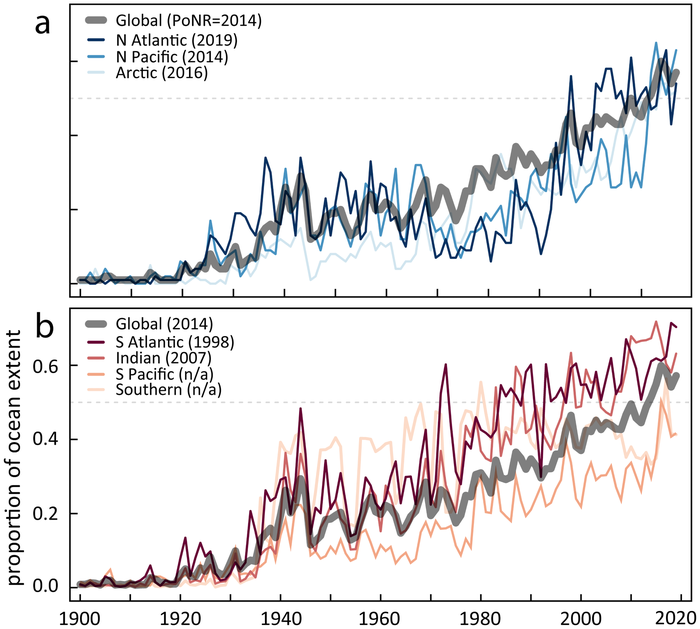
Synoptic frequency of extreme marine heat across ocean basins from 1900–2019
Share on FacebookShare on TwitterShare on LinkedinShare on RedditShare on Telegram

Extreme marine heat has become the “new normal”, in analysis of data from 1870 onwards – with 57% of the ocean surface recording 2019 temperatures once considered extreme

Synoptic frequency of extreme marine heat across ocean basins from 1900–2019

Credit: Tanaka and Van Houtan, 2022, CC-BY 4.0 (https://creativecommons.org/licenses/by/4.0/)

Extreme marine heat has become the “new normal”, in analysis of data from 1870 onwards – with 57% of the ocean surface recording 2019 temperatures once considered extreme

###

Article URL: https://journals.plos.org/climate/article?id=10.1371/journal.pclm.0000007   

Article Title: The recent normalization of historical marine heat extremes

Author Countries: U.S.A.

Funding: This study was supported by the generous contributions of members, visitors, and donors to the Monterey Bay Aquarium. The funders had no role in study design, data collection and analysis, decision to publish, or preparation of the manuscript.


DOI

10.1371/journal.pclm.0000007

Article Title

The recent normalization of historical marine heat extremes

Article Publication Date

1-Feb-2022

COI Statement

The authors declare no competing interests.
Share12Tweet8Share2ShareShareShare2

Related Posts

Delayed antiviral response in alveolar type 2 cells heightens influenza susceptibility

Delayed antiviral response in alveolar type 2 cells heightens influenza susceptibility

August 22, 2026
Genetic evidence links sleep disruption to hemorrhoidal disease, revealing a hidden connection

Genetic evidence links sleep disruption to hemorrhoidal disease, revealing a hidden connection

August 22, 2026

LASIK Versus Contact Lenses for Correcting Myopia

August 22, 2026

New Advances in Minimally Invasive Laryngeal Surgery

August 22, 2026

POPULAR NEWS

  • Blocking glucosylceramide production kills cancer cells via lysosomal dysfunction, not ceramide buildup

    29 shares
    Share 12 Tweet 7
  • ZCCHC4 boosts replication-dependent histone mRNA translation by interacting with eIF3

    29 shares
    Share 12 Tweet 7
  • KAIST Surface Defects Boost Droplet Formation, Removal, and Heat Transfer by 5.5-Fold

    29 shares
    Share 12 Tweet 7
  • Dual-oxygen pancreatic cancer organoids mirror basal-classical diversity, spatial transcriptomics confirms

    29 shares
    Share 12 Tweet 7

About

We bring you the latest biotechnology news from best research centers and universities around the world. Check our website.

Follow us

Recent News

Blocking glucosylceramide production kills cancer cells via lysosomal dysfunction, not ceramide buildup

ZCCHC4 boosts replication-dependent histone mRNA translation by interacting with eIF3

KAIST Surface Defects Boost Droplet Formation, Removal, and Heat Transfer by 5.5-Fold

Subscribe to Blog via Email

Enter your email address to subscribe to this blog and receive notifications of new posts by email.

Join 85 other subscribers
  • Contact Us

Bioengineer.org © Copyright 2023 All Rights Reserved.

Welcome Back!

Login to your account below

Forgotten Password?

Retrieve your password

Please enter your username or email address to reset your password.

Log In
No Result
View All Result
  • Homepages
    • Home Page 1
    • Home Page 2
  • News
  • National
  • Business
  • Health
  • Lifestyle
  • Science

Bioengineer.org © Copyright 2023 All Rights Reserved.