• HOME
  • NEWS
  • EXPLORE
    • CAREER
      • Companies
      • Jobs
    • EVENTS
    • iGEM
      • News
      • Team
    • PHOTOS
    • VIDEO
    • WIKI
  • BLOG
  • COMMUNITY
    • FACEBOOK
    • INSTAGRAM
    • TWITTER
Wednesday, June 24, 2026
BIOENGINEER.ORG
No Result
View All Result
  • Login
  • HOME
  • NEWS
  • EXPLORE
    • CAREER
      • Companies
      • Jobs
        • Lecturer
        • PhD Studentship
        • Postdoc
        • Research Assistant
    • EVENTS
    • iGEM
      • News
      • Team
    • PHOTOS
    • VIDEO
    • WIKI
  • BLOG
  • COMMUNITY
    • FACEBOOK
    • INSTAGRAM
    • TWITTER
  • HOME
  • NEWS
  • EXPLORE
    • CAREER
      • Companies
      • Jobs
        • Lecturer
        • PhD Studentship
        • Postdoc
        • Research Assistant
    • EVENTS
    • iGEM
      • News
      • Team
    • PHOTOS
    • VIDEO
    • WIKI
  • BLOG
  • COMMUNITY
    • FACEBOOK
    • INSTAGRAM
    • TWITTER
No Result
View All Result
Bioengineer.org
No Result
View All Result
Home NEWS Science News Biology

A link between early maturation and better aerobic performance identified in juvenile salmon

Bioengineer by Bioengineer
January 28, 2022
in Biology
Reading Time: 2 mins read
0
Juvenile salmon
Share on FacebookShare on TwitterShare on LinkedinShare on RedditShare on Telegram

A study conducted at the University of Helsinki indicates that early sexual maturation and high aerobic performance in salmon have a genetic link that is already evident in juvenile salmon.
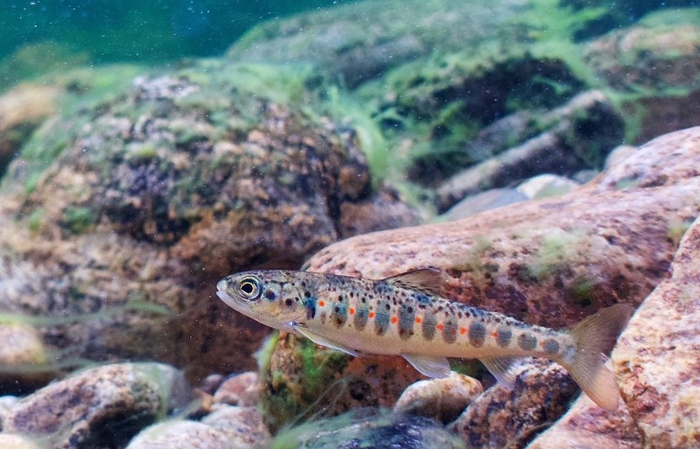
Juvenile salmon

Credit: Mikko Kytökorpi

A study conducted at the University of Helsinki indicates that early sexual maturation and high aerobic performance in salmon have a genetic link that is already evident in juvenile salmon.

Salmon are born in rivers, migrate to the sea to reach maturity and return to spawn in their native river. While the salmon that reach their maturity at an early age return from the sea after a single year, the individuals that are slower to develop can spend two years or an even longer time at sea.

Genomic regions have been identified in the salmon genome that heavily regulate the number of years spent at sea. Under the direction of Academy of Finland Research Fellow Tutku Aykanat, researchers from the University of Helsinki bred a large number of young salmon that differed on the basis of two such regions.

The researchers measured the basal metabolism and aerobic performance of the juvenile salmon before the onset of their maturation process. Carriers of gene variants associated with early sexual maturation were found to have better aerobic performance than those whose variants were associated with the late onset of sexual maturity. Aerobic performance denotes the metabolic capacity to produce energy through aerobic cellular respiration, for example, in muscles.

 “Greater aerobic performance can promote early maturation, since growth, food supply and reproduction require energy produced through aerobic metabolism,” says Postdoctoral Researcher Jenni Prokkola from the Faculty of Biological and Environmental Sciences, University of Helsinki.

The genetic coupling of age-at-maturity and performance did not depend on the amount of food available to the salmon, which indicates that the finding could be generalisable to both wild salmon populations and fish farming conditions.

“Salmon that have spent several years at sea and mature at a later date are considerably larger and produce a larger number of offspring when they return to spawn compared to salmon that spawn after only one year at sea. Now, it would be important to determine whether these salmon are more susceptible to global warming due to their poorer aerobic performance. Higher water temperatures increase the energy needs of fish, but the limitations of aerobic performance make adaptation to high temperatures challenging. Aerobic performance can become an increasingly important factor for salmon in warming habitats,” Prokkola says.


Investigating the genetic and physiological factors that affect age at sexual maturity is important for understanding changes taking place in salmon populations.


Journal

Proceedings of the Royal Society of London B Biological Sciences

DOI

10.1098/rspb.2021.2500

Subject of Research

Animals

Article Title

Genetic coupling of life-history and aerobic performance in Atlantic salmon

Article Publication Date

26-Jan-2022

Share12Tweet8Share2ShareShareShare2

Related Posts

Copal Tree Genetics Reveal Tropical Forest Connectivity — Biology

Copal Tree Genetics Reveal Tropical Forest Connectivity

June 24, 2026
How Intestinal Mucus Influences Klebsiella pneumoniae Colonization and Antibiotic Effectiveness — Biology

How Intestinal Mucus Influences Klebsiella pneumoniae Colonization and Antibiotic Effectiveness

June 24, 2026

From Darkness to Light: How Blind Mexican Cavefish Reveal Brain Evolution

June 24, 2026

Reevaluating the Impact of ‘Yo-Yo Dieting’: Is It Less Harmful Than Commonly Thought?

June 24, 2026

POPULAR NEWS

  • Saying Goodbye to PGY-6: Pediatric Fellowship Realities

    103 shares
    Share 41 Tweet 26
  • Multi-Hospital Study Reveals Long Covid Burden Is Twice as High as Current Estimates

    92 shares
    Share 36 Tweet 23
  • Detection of EDCs in Breast Milk and Infant Urine Up to Six Months Highlights Early Exposure Risks

    77 shares
    Share 31 Tweet 19
  • New Drug Candidate Developed at McMaster Shows Potential for Treating Brain Cancer

    58 shares
    Share 23 Tweet 15

About

We bring you the latest biotechnology news from best research centers and universities around the world. Check our website.

Follow us

Recent News

Epiblast Diversification Fuels Early Blood Formation

Neutrophil S100A8/A9 Hinders Megakaryocyte Maturation

Robotic Hand That “Feels” Motion: International Study Uncovers How the Brain Detects Movement

Subscribe to Blog via Email

Enter your email address to subscribe to this blog and receive notifications of new posts by email.

Join 82 other subscribers
  • Contact Us

Bioengineer.org © Copyright 2023 All Rights Reserved.

Welcome Back!

Login to your account below

Forgotten Password?

Retrieve your password

Please enter your username or email address to reset your password.

Log In
No Result
View All Result
  • Homepages
    • Home Page 1
    • Home Page 2
  • News
  • National
  • Business
  • Health
  • Lifestyle
  • Science

Bioengineer.org © Copyright 2023 All Rights Reserved.