Philadelphia, January 24, 2022 – In a natural setting, cows and nursing calves together set the feeding schedule for the calf, and calves wean gradually, completing weaning at varying ages. By contrast, in artificial rearing systems with minimal cow-calf contact, the weaning schedule may be strictly determined, with reductions of milk intake based solely on the calf’s age. But how well do different calves thrive under different feeding and weaning systems? The majority of research on calf personality and feeding behaviors has been performed with single-purpose dairy breeds, mainly Holsteins. In a new report published in the February 2022 issue of the Journal of Dairy Science®, an international team of researchers turned their focus on the dual-purpose Norwegian Red, bred for both dairy and meat, to examine the influence of personality and weaning method on calves’ early feeding behavior and growth.
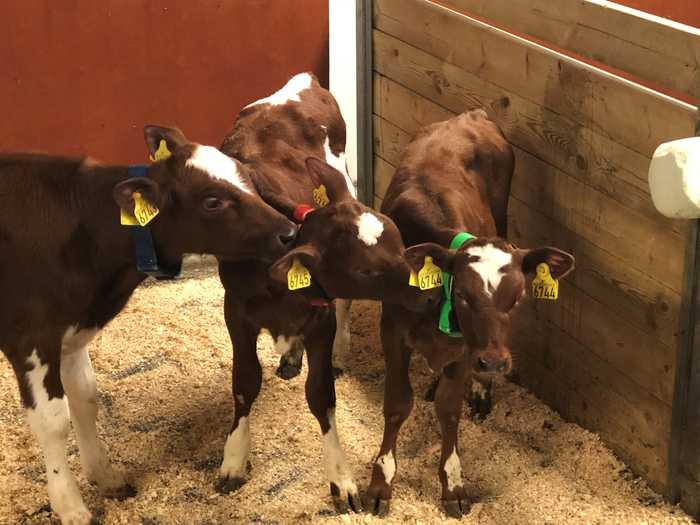
Credit: Kristian Ellingsen-Dalskau
Philadelphia, January 24, 2022 – In a natural setting, cows and nursing calves together set the feeding schedule for the calf, and calves wean gradually, completing weaning at varying ages. By contrast, in artificial rearing systems with minimal cow-calf contact, the weaning schedule may be strictly determined, with reductions of milk intake based solely on the calf’s age. But how well do different calves thrive under different feeding and weaning systems? The majority of research on calf personality and feeding behaviors has been performed with single-purpose dairy breeds, mainly Holsteins. In a new report published in the February 2022 issue of the Journal of Dairy Science®, an international team of researchers turned their focus on the dual-purpose Norwegian Red, bred for both dairy and meat, to examine the influence of personality and weaning method on calves’ early feeding behavior and growth.
Lead investigator Laura Whalin, PhD, conducting the research at the Norwegian Veterinary Institute, Ås, Norway, explains, “Our objective was to determine whether personality traits, especially sociability, are associated with differences in feeding behavior and growth in Norwegian Red calves.” The team’s secondary objective was to assess the interaction between personality traits and weaning method (by age or by amount of solid feed intake) on the behavior and growth of calves.
Novel environment and novel object tests were selected to characterize calves’ responses to new situations and to target personality traits of exploration or fearfulness. A social motivation test was chosen to better understand individual sociability. Finally, a group novel object test measured the responses of individual calves toward novelty when in a group with other calves. Whalin says, “Principal component analysis revealed three factors interpreted as personality traits –- playful/exploratory, vocal/active (interpreted as a type of sociability trait where vocalizations and pacing serve to communicate with other calves when isolated from the herd), and interactive in a group – that, together, explained more than half of the variance in calf outcomes.”
The researchers found that calves that were more exploratory consumed more milk per day preweaning and more concentrate per day over the experimental period. Calves that were more vocal and active had lower preweaning milk intakes and lower concentrate intakes over the experimental period. Calves that were more interactive in the group test had lower preweaning and weaning concentrate intakes. These associations did not vary with weaning method; however, the team determined that calves weaned based on concentrate intake had higher average daily gains postweaning, likely due to consuming more concentrate per day over the entire experiment, than calves that were weaned by age.
The team concluded that the sociability traits of Norwegian Red calves were related to individual differences in milk and concentrate intake. “Although the relationship between personality and feeding behavior and growth did not depend on weaning method,” observes Whalin, “gradual weaning based on individual concentrate intake provides an opportunity for calves to wean at a pace that fits the needs of each individual calf, contributing to better calf health and overall welfare.”
Journal
Journal of Dairy Science
DOI
10.3168/jds.2021-20871
Method of Research
Experimental study
Subject of Research
Animals
Article Title
The influence of personality and weaning method on early feeding behavior and growth of Norwegian Red calves