• HOME
  • NEWS
  • EXPLORE
    • CAREER
      • Companies
      • Jobs
    • EVENTS
    • iGEM
      • News
      • Team
    • PHOTOS
    • VIDEO
    • WIKI
  • BLOG
  • COMMUNITY
    • FACEBOOK
    • INSTAGRAM
    • TWITTER
Sunday, August 23, 2026
BIOENGINEER.ORG
No Result
View All Result
  • Login
  • HOME
  • NEWS
  • EXPLORE
    • CAREER
      • Companies
      • Jobs
        • Lecturer
        • PhD Studentship
        • Postdoc
        • Research Assistant
    • EVENTS
    • iGEM
      • News
      • Team
    • PHOTOS
    • VIDEO
    • WIKI
  • BLOG
  • COMMUNITY
    • FACEBOOK
    • INSTAGRAM
    • TWITTER
  • HOME
  • NEWS
  • EXPLORE
    • CAREER
      • Companies
      • Jobs
        • Lecturer
        • PhD Studentship
        • Postdoc
        • Research Assistant
    • EVENTS
    • iGEM
      • News
      • Team
    • PHOTOS
    • VIDEO
    • WIKI
  • BLOG
  • COMMUNITY
    • FACEBOOK
    • INSTAGRAM
    • TWITTER
No Result
View All Result
Bioengineer.org
No Result
View All Result
Home NEWS Science News Biology

Hostile takeover in the cell

Bioengineer by Bioengineer
January 14, 2022
in Biology
Reading Time: 2 mins read
0
Hostile takeover in the cell
Share on FacebookShare on TwitterShare on LinkedinShare on RedditShare on Telegram

Mitochondria are known as energy suppliers for our cells, but they also play an important role in the defense against pathogens. They can initiate immune responses, and deprive pathogens of the nutrients they need to grow. A research team led by Lena Pernas of the Max Planck Institute for Biology of Ageing in Cologne, Germany, has now shown that pathogens can turn off mitochondrial defense mechanisms by hijacking a normal cellular response to stress.
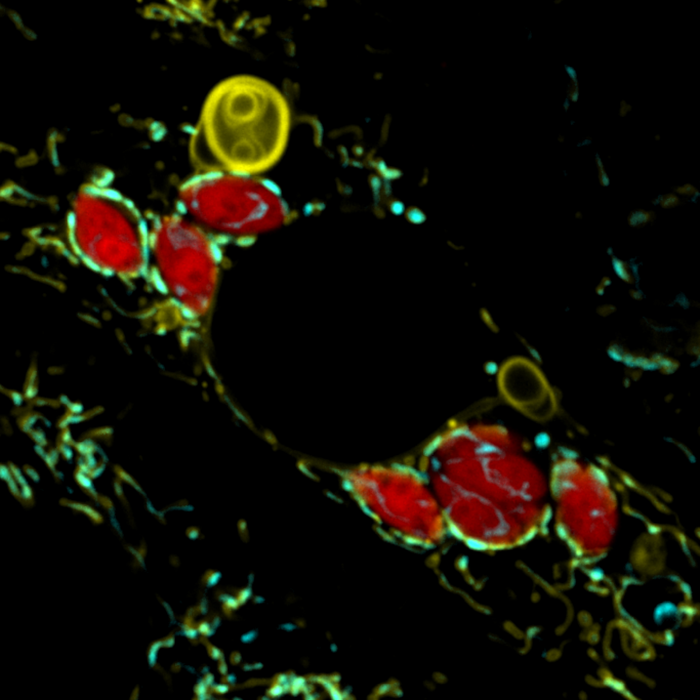
Hostile takeover in the cell

Credit: Xianhe Li/ Max Planck Institute for Biology of Ageing

Mitochondria are known as energy suppliers for our cells, but they also play an important role in the defense against pathogens. They can initiate immune responses, and deprive pathogens of the nutrients they need to grow. A research team led by Lena Pernas of the Max Planck Institute for Biology of Ageing in Cologne, Germany, has now shown that pathogens can turn off mitochondrial defense mechanisms by hijacking a normal cellular response to stress.

To survive, pathogens need to acquire nutrients from their host and counter host defenses. One such defense comes from host mitochondria, which can deprive them of nutrients they need and thus restrict their growth. “We wanted to know how else mitochondrial behaviour changes when mitochondria and pathogens meet in cells. Because the outer membrane of these organelles is the first point of contact with the pathogens, we took a closer look at it,” explains Lena Pernas, research group leader at the Max Planck Institute for Biology of Ageing.

Mitochondria shed their ´skin`

The researchers infected cells with the human parasite Toxoplasma gondii and observed live under the microscope what happens to the outer compartment of mitochondria. “We saw that mitochondria in contact with the parasite started shedding large structures from their outer membrane. This was so puzzling to us. Why would mitochondria shed what is essentially the gateway between them and the rest of the cell?” says Xianhe Li, first author of the study.

Hostile takeover

But how does the parasite get the mitochondria to do it? The research team was able to show that the pathogen has a protein that functionally mimics a host mitochondrial protein. It binds to a receptor on the outer membrane of mitochondria, to gain access to the machinery that ensures proteins are transported inside the mitochondria. “In doing so, the parasite hijacks a normal host response to mitochondrial stress that, in the context of infection, effectively disarms the mitochondria” Pernas said. “Other researchers have shown that a SARS-CoV-2 virus protein also binds to this transport receptor. This suggests the receptor plays an important role in the host-pathogen interaction. But further investigation is needed to better understand its role during different infections.”

Lena Pernas is also a group leader at the CECAD Cluster of Excellence in Aging Research at the University of Cologne.


Journal

Science

Method of Research

Experimental study

Subject of Research

Cells

Article Title

Mitochondria shed their outer membrane in response to infection-induced stress

Article Publication Date

14-Jan-2022
Share12Tweet8Share2ShareShareShare2

Related Posts

Delayed antiviral response in alveolar type 2 cells heightens influenza susceptibility

Delayed antiviral response in alveolar type 2 cells heightens influenza susceptibility

August 22, 2026
Genetic evidence links sleep disruption to hemorrhoidal disease, revealing a hidden connection

Genetic evidence links sleep disruption to hemorrhoidal disease, revealing a hidden connection

August 22, 2026

LASIK Versus Contact Lenses for Correcting Myopia

August 22, 2026

New Advances in Minimally Invasive Laryngeal Surgery

August 22, 2026

POPULAR NEWS

  • Blocking glucosylceramide production kills cancer cells via lysosomal dysfunction, not ceramide buildup

    29 shares
    Share 12 Tweet 7
  • ZCCHC4 boosts replication-dependent histone mRNA translation by interacting with eIF3

    29 shares
    Share 12 Tweet 7
  • KAIST Surface Defects Boost Droplet Formation, Removal, and Heat Transfer by 5.5-Fold

    29 shares
    Share 12 Tweet 7
  • Dual-oxygen pancreatic cancer organoids mirror basal-classical diversity, spatial transcriptomics confirms

    29 shares
    Share 12 Tweet 7

About

We bring you the latest biotechnology news from best research centers and universities around the world. Check our website.

Follow us

Recent News

Blocking glucosylceramide production kills cancer cells via lysosomal dysfunction, not ceramide buildup

ZCCHC4 boosts replication-dependent histone mRNA translation by interacting with eIF3

KAIST Surface Defects Boost Droplet Formation, Removal, and Heat Transfer by 5.5-Fold

Subscribe to Blog via Email

Success! An email was just sent to confirm your subscription. Please find the email now and click 'Confirm' to start subscribing.

Join 85 other subscribers
  • Contact Us

Bioengineer.org © Copyright 2023 All Rights Reserved.

Welcome Back!

Login to your account below

Forgotten Password?

Retrieve your password

Please enter your username or email address to reset your password.

Log In
No Result
View All Result
  • Homepages
    • Home Page 1
    • Home Page 2
  • News
  • National
  • Business
  • Health
  • Lifestyle
  • Science

Bioengineer.org © Copyright 2023 All Rights Reserved.