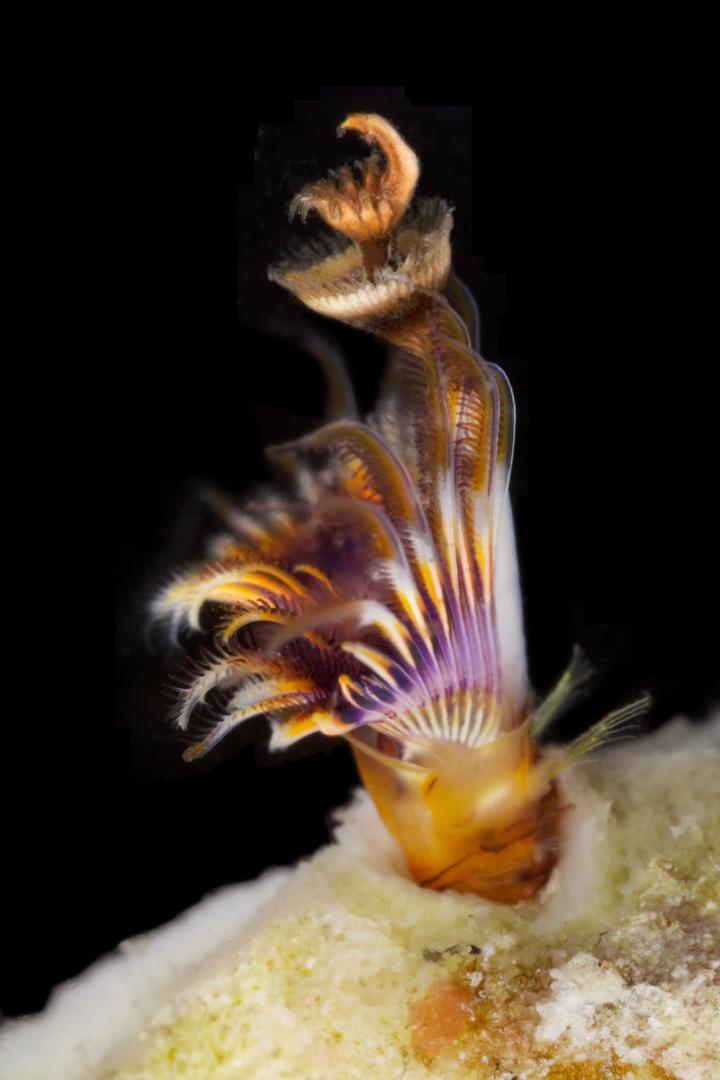
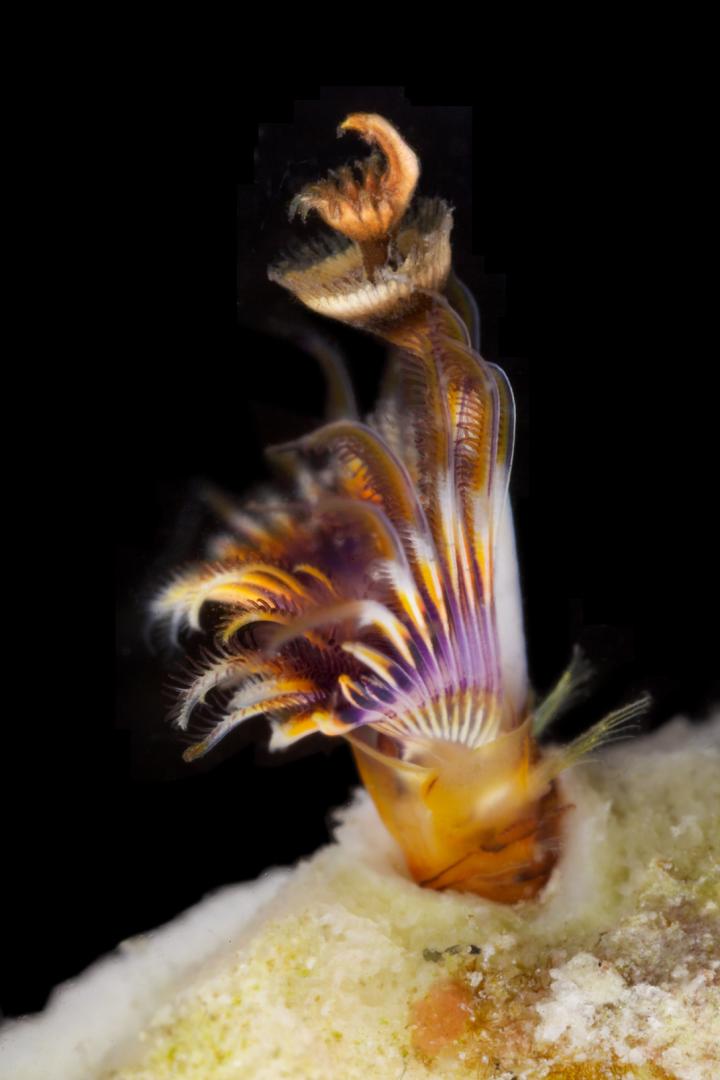
Credit: Alexander Semenov
The largest group of fanworm species with rigid chalky (calcareous) tubes belong to the Hydroides genus, and are easily recognised thanks to the shape of their beautifully ornate tube plugs. Hydroides is economically important as its members have the potential to cover immersed marine structures with massive nuisance settlements of chalky biofouling. The best-known example is Hydroides elegans, which settles on boat hulls so readily that colonies of it are perpetually in transit around the world, hitch-hiking to new places.
Latin names of animals mostly do not change over the decades because they are kept stable by a code book of naming rules. However, a mistake has recently been discovered regarding Hydroides. It turns out that it is a feminine genus rather than masculine, thus requiring each of the 107 Hydroides species names, described since 1768, to be re-examined so that the appropriate spelling, determined by the derivation of each name, can be used consistently by all biologists in future.
Scientists Geoffrey Read, National Institute of Water and Atmospheric Research, New Zealand, Harry ten Hove, Naturalis Biodiversity Center, the Netherlands, Yanan Sun and Elena Kupriyanova, Australian Museum, have carefully compiled the data on original Hydroides names, and published a checklist paper in the open access journal ZooKeys.
'Detective' work has often been required to get the details, as early biologists have been remarkably vague about the names they created and where their worms had come from. Fortunately, the Biodiversity Heritage Library has digitised many of the legacy taxonomic works required and it was possible to find out some unexpected information such as that species H. floridana actually did not come from Florida, although its name suggests it did.
Some Hydroides names have a descriptive basis that fits how the worms look, such as H. bulbosa, H. elegantula and H. longispinosa, others are named after people or places, for example, H. dafnii (after its collector, Yaacob Dafni) and H. sanctaecrucis (after Saint Croix Island). Yet, there are others, whose names are of quite tricky origin. It turns out that H. dianthus was actually named after a group of popular garden flowers, and H. euplaeana and H. stoichadon commemorate the long-forgotten names of tiny Mediterranean islands.
A few 19th century Hydroides descriptions are so bad that taxonomists have given up on using the names. However, one of these discarded names was revived last century by American biologists and was then used in often-cited research on sperm biology. Now, we can only guess what the actual species was.
Hydroides itself is a very old name, but it arose in a somewhat accidental and misleading way (in a letter to Linnaeus), because the worms have absolutely no connection to true hydroids, the well-known group of colonial animals related to corals.
The Hydroides species original descriptions are mostly accessible via the checklist because one third of the reports cited in the checklist are linked to the open access Biodiversity Heritage Library, and a large proportion are matched to an online source. While in the past one could only expect to find recorded the geolocations (the latitudes and longitudes) of worms collected during ship voyages, now the original localities of all the Hydroides are finally mapped. Further information on the taxonomy of all Hydroides, including many now regarded as synonyms, is available via links to the World Register of Marine Species Polychaeta web pages.
###
Original source:
Read GB, ten Hove HA, Yanan Sun Y, Kupriyanova EK (2017) Hydroides Gunnerus, 1768 (Annelida, Serpulidae) is feminine: a nomenclatural checklist of updated names. ZooKeys 642: 1-52. https://doi.org/10.3897/zookeys.642.10443
Media Contact
Dr. Geoffrey Read
[email protected]
@Pensoft
http://www.pensoft.net
############
Story Source: Materials provided by Scienmag