Colonizing Mars is no longer solely the work of science fiction but a potential future option for people who desire to live among the weightless. For headline grabbers like Jeff Bezos, NASA and Elon Musk, space colonization — or space settlement, a preferred term recommended by Bill Nye — is a big goal for the 21st century.
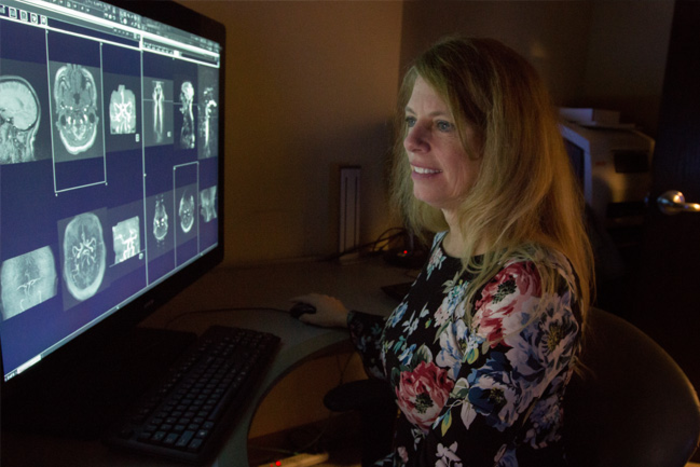
Credit: Sarah Pack
Colonizing Mars is no longer solely the work of science fiction but a potential future option for people who desire to live among the weightless. For headline grabbers like Jeff Bezos, NASA and Elon Musk, space colonization — or space settlement, a preferred term recommended by Bill Nye — is a big goal for the 21st century.
The long-term risks of living in space include bone loss, cosmic radiation and muscle weakness, just to name a few, so leaving gravity behind certainly has its obstacles. Some of these potential hurdles have already been studied extensively or are currently being investigated, but researchers at MUSC Health have found an important but underserved area of space to study: the brain and gravity’s effect on eyesight.
In a recent paper in JAMA Network Open, researchers look at Spaceflight-Associated Neuro-Ocular Syndrome (SANS) and compare brain scans before and after spaceflight.
The longer astronauts stay in space, the more they’ve reported blurry vision and eyesight problems when they return to earth, according to Mark Rosenberg, M.D., a neurology resident at MUSC Health and a researcher on the paper.
“It’s gotten to the point where astronauts actually carry extra pairs of glasses when they go into space,” said Rosenberg. “They know that their vision is going to be deteriorating up there, and they’ve even started calling them Space Anticipation Glasses. And, in fact, depending on how you define it, it affects about 70% of astronauts.”
With SANS, astronauts return to earth with altered visual acuity and struggle to distinguish between shapes at a distance. The globes of their eyes flatten, parts of their retinas show injury and their optic disks swell. Some astronauts recover from these changes in a few weeks, while others can take months or even years. There are also some who never fully recover.
In addition to preparing for space colonization, Donna Roberts, M.D., an MUSC Health neuro-radiologist and the primary investigator for this research paper, says studies like this one also help doctors learn more about conditions that affect people on earth generally. “We can learn more about the role gravity plays on fluid around the brain, for instance,” she said. “And it gives us insight into how disorders of cerebrospinal fluid circulation affect patients not just in space but also here on earth.”
Roberts and her team found that astronauts with SANS had increased intracranial dural venous volumes compared to their MRI scans taken just before flight. As large veins that take blood from the brain to the heart, the dural venous sinuses serve a vital role in blood circulation and shouldn’t stretch or change. But with SANS, blood volume increases, and the dural venous sinuses enlarge. These findings suggest that there is an association between intracranial venous congestion and the development of SANS.
NASA has deemed SANS one of its highest research priorities, according to Roberts, and the results of this paper move that research forward by providing insight into what happens to the brain and eyesight in space. Much research focuses on muscle loss in space, but rarely does it look at the brain specifically.
“If we’re planning on setting up a colony in space, we’re going to have to understand how gravity affects the entire human body,” Roberts said. “And that includes the brain.”
Rosenberg agrees. “As clinicians, one of the things we do is treat the human body,” he said. “And that’s not just now but in the future as well. So really understanding these conditions as a whole, before they start to affect colonists already on a foreign planet where everything wants to kill them, is probably one of the best ways we can apply this research.”
Next, Roberts and Rosenberg will look at the ways SANS may differ between genders. Without being able to perform an MRI in space, Roberts says it’s difficult to pinpoint when exactly the change in the dural venous sinuses occurs — it could be during flight takeoff, in space or while acclimating to earth upon return — so she is also looking into a mobile MRI machine to perform scans in space to better understand how the condition develops.
“As we head into this new era of human spaceflight, SANS remains one of our biggest problems and obstacles,” Roberts said. “But we are making progress in understanding the condition.”
###
Founded in 1824 in Charleston, MUSC is home to the oldest medical school in the South as well as the state’s only integrated academic health sciences center, with a unique charge to serve the state through education, research and patient care. Each year, MUSC educates and trains more than 3,000 students and nearly 800 residents in six colleges: Dental Medicine, Graduate Studies, Health Professions, Medicine, Nursing and Pharmacy. MUSC brought in more than $271 million in biomedical research funds in fiscal year 2020, continuing to lead the state in obtaining National Institutes of Health funding, with more than $129.9 million. For information on academic programs, visit musc.edu.
Journal
JAMA Network Open
DOI
10.1001/jamanetworkopen.2021.31465
Article Title
Comparison of Dural Venous Sinus Volumes Before and After Flight in Astronauts With and Without Spaceflight-Associated Neuro-Ocular Syndrome
Article Publication Date
27-Oct-2021