Most of us are familiar with “spinach teeth,” the harmless but gritty-chalky mouthfeel caused by the vegetable.
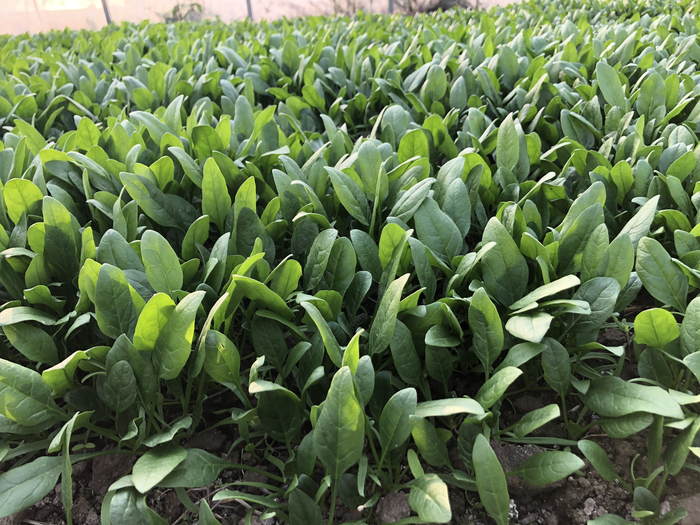
Credit: Image credit: Xiaofeng Cai.
Most of us are familiar with “spinach teeth,” the harmless but gritty-chalky mouthfeel caused by the vegetable.
A team of researchers from Boyce Thompson Institute (BTI) and six Chinese universities has identified genes in spinach that regulate its concentration of oxalate, which is responsible for “spinach teeth,” as well as genes that help the plant combat downy mildew, a major disease of commercial crops.
The findings, described in a paper published December 13 in Nature Communications, could allow breeders to produce disease-resistant varieties of spinach with more consumer appeal.
“I think more consumers would be willing to buy spinach that has less oxalate,” said BTI faculty member Zhangjun Fei, who co-led the study and is a co-corresponding author of the paper. “Dietary oxalate can interfere with mineral absorption and may lead to kidney stones, and less oxalate would also make spinach more palatable to a wider market.”
The research included contributors from BTI, Cornell, the U.S. Department of Agriculture (USDA), Shanghai Normal University, Zhejiang University, Zhejiang A&F University, Qinghai University, Qingdao Agricultural University and Harbin Normal University.
The study compared the genomes of cultivated spinach (Spinacia oleracea) and two of its wild relatives (S. turkestanica and S. tetranda) to identify genes linked to traits of interest to plant breeders, farmers and consumers.
“Our results provide rich resources for the spinach community, especially those working on increasing downy mildew resistance, improving leaf texture and reducing oxalate content,” said co-corresponding author Chen Jiao, a former postdoctoral researcher in Fei’s group who is now a professor in the College of Agriculture and Biotechnology at Zhejiang University.
Improving on the draft
In 2017, Fei’s lab reported a draft spinach genome, whose quality was not high due to technical limitations in the assembly process. The new study utilized the Monoe-Viroflay cultivated variety of spinach, which is highly inbred, combined with the advanced sequencing and assembly technologies, making the assembly of its genome much easier and of higher quality than the varieties used in the earlier study.
The team also sequenced the genomes of 295 cultivated varieties of S. oleracea and 10 accessions of the two wild relatives. Next, they conducted comparative genomic analyses and genome-wide association studies (GWAS) to probe the plant’s evolutionary history and look for genes associated with specific traits.
Most of the genetic differences between wild and cultivated spinach result from the plant’s adaptation to new environments as it spread from its origins in Persia (modern-day Iran) across Asia and Europe, with other variations reflecting the local preferences for traits such as flat or wrinkled leaves.
“I think our most interesting finding is that the genetic diversity between Asian and European spinach is higher than it is between cultivated and wild spinaches, which is not very common in other crops,” Jiao said. “This increases our knowledge of how human selection diversifies crop plants.”
The GWAS confirmed the known role for the NBR-LRR family of genes in spinach downy mildew resistance. It also identified other locations on the genome with lesser but still important roles in resistance, such as a promoter region in WSD6, which encodes an enzyme that may reinforce the physical barrier of spinach upon pathogen invasion.
“Like most plants, disease resistance in spinach is controlled by a network of genetic regions,” said Fei, who is also an adjunct professor in Cornell University’s School of Integrative Plant Science. “If you can ‘stack’ disease-resistant gene variants into one variety then you will get better resistance than with just one gene variant.”
Down with oxalates
The team also found two genes encoding metal and metal ion transporters that may regulate oxalates in spinach. Although more research is needed to understand their full function, modulating these genes to reduce oxalates could help boost the market with cultivars that are better for human health and appeal to consumers who dislike the vegetable because of “spinach teeth”.
However, oxalates probably play important roles in spinach survival, such as warding off pests and pathogens, Fei speculated. If so, reducing oxalates would also require identifying and modifying other genes to maintain the plant’s protective mechanisms.
“Plants usually depend on networks of genetic factors to defend themselves; removing one means findings the right balance among the others,” Fei said.
###
Citation: Cai, X., Sun, X., Xu, C. et al. Genomic analyses provide insights into spinach domestication and the genetic basis of agronomic traits. Nat Commun 12, 7246 (2021). https://doi.org/10.1038/s41467-021-27432-z
About Boyce Thompson Institute:
Opened in 1924, Boyce Thompson Institute is a premier life sciences research institution located in Ithaca, New York. BTI scientists conduct investigations into fundamental plant and life sciences research with the goals of increasing food security, improving environmental sustainability in agriculture, and making basic discoveries that will enhance human health. Throughout this work, BTI is committed to inspiring and educating students and to providing advanced training for the next generation of scientists. BTI is an independent nonprofit research institute that is also affiliated with Cornell University. For more information, please visit BTIscience.org.
Journal
Nature Communications
DOI
10.1038/s41467-021-27432-z
Method of Research
Experimental study
Subject of Research
Not applicable
Article Title
Genomic analyses provide insights into spinach domestication and the genetic basis of agronomic traits
COI Statement
The authors declare no competing interests.