Theropod dinosaurs evolved more robust jaws through time allowing them to consume tougher food, a new study reveals.
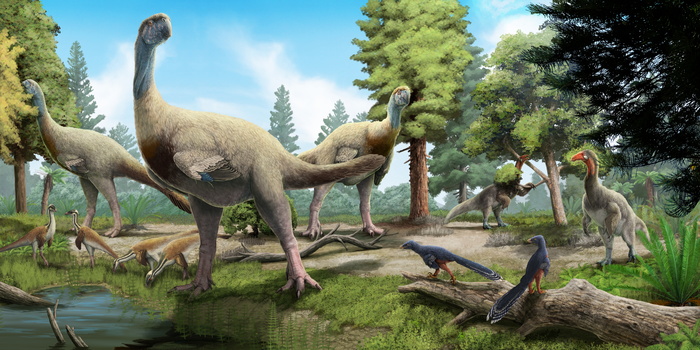
Credit: Gabriel Ugueto.
Theropod dinosaurs evolved more robust jaws through time allowing them to consume tougher food, a new study reveals.
Researchers used digital modelling and computer simulation to uncover a common trend of jaw strengthening in theropods – expanding the rear jaw portion in all groups, as well as evolving an upturned jaw in carnivores and a downturned jaw in herbivores.
Publishing their findings today in Current Biology, scientists revealed that biomechanical analysis showed these form changes made jaws mechanically more stable when biting – minimising the chance of bone fracture.
The international team, led by scientists at the University of Birmingham, created digital models of more than 40 lower jaws from five different theropod dinosaur groups, including typical carnivores like Tyrannosaurus and Velociraptor, and lesser-known herbivores like ornithomimosaurs, therizinosaurs and oviraptorosaurs.
Fion Waisum Ma, PhD researcher at the University of Birmingham, who led the study, said: “Although theropod dinosaurs are always depicted as fearsome predators in popular culture, they are in fact very diverse in terms of diets. It is interesting to observe the jaws becoming structurally stronger over time, in both carnivores and herbivores. This gives them the capacity to exploit a wider range of food items.
“Theropod dinosaurs underwent extreme dietary changes during their evolutionary history of 165 million years. They started off as carnivores, later on evolved into more specialised carnivores, omnivores and herbivores. Studying how their feeding mechanics changed is key to understanding the dietary transitions in other vertebrate animals too.”
For example, in carnivores like tyrannosauroids, an early form like Guanlong had a relatively slender and straight jaw. But later forms such as Tarbosaurus and Tyrannosaurus evolved deeper jaws with the front portion bending upward, which increase jaw strength.
Having a strengthened jaw is especially important to herbivorous theropods, as their jaws experience considerable stress from repetitive plant cropping. Herbivores like Erlikosaurus and Caudipteryx have extremely downward-bending jaws that could help dissipate such stress.
Dr Stephan Lautenschlager, Senior Lecturer at the University of Birmingham and senior author of the study, said: “It is fascinating to see how theropod dinosaurs had evolved different strategies to increase jaw stability depending on their diet. This was achieved through bone remodelling – a mechanism where bone is deposited in regions of the jaw that experience high stresses during feeding.”
The researchers studied the feeding mechanics of tyrannosaurids through growth and observed that the deeper and more upturned jaws of adult theropods, such as Tyrannosaurus and Tarbosaurus, are structurally stronger compared to those of their juvenile forms.
Dr Lautenschlager further explained: “The similarity between jaw strengthening through growth and through time suggests that developmental patterns in juvenile dinosaurs ultimately affected the evolution of the whole group. This likely facilitated the jaw evolution of theropod dinosaurs and their overall success for over 150 million years.”
ENDS
For more information interviews or an embargoed copy of the research paper, please contact Tony Moran, International Communications Manager, University of Birmingham on +44 (0)782 783 2312 or [email protected]. For out-of-hours enquiries, please call +44 (0) 7789 921 165.
Photo caption:
- Figure 1. Life reconstruction of the Late Cretaceous Iren Dabasu Formation fauna, showing theropod dinosaurs of various diets. Such dietary niche partitioning could have contributed to the diversification of theropod dinosaurs, which eventually led to the evolution of modern birds. Depicted species: Gigantoraptor, Garudimimus, Neimongosaurus and Velociraptor. Image credit: Gabriel Ugueto.
Notes for editors
- The University of Birmingham is ranked amongst the world’s top 100 institutions. Its work brings people from across the world to Birmingham, including researchers, teachers and more than 6,500 international students from over 150 countries.
- ‘Macroevolutionary trends in theropod dinosaur feeding mechanics’ by Waisum Ma, Michael Pittman, Richard Butler, Stephan Lautenschlager is published in Current Biology.
- Scientists at the University of Birmingham worked with counterparts at the University of Hong Kong.
Journal
Current Biology
Method of Research
Computational simulation/modeling
Subject of Research
Animals
Article Title
‘Macroevolutionary trends in theropod dinosaur feeding mechanics’
Article Publication Date
16-Dec-2021