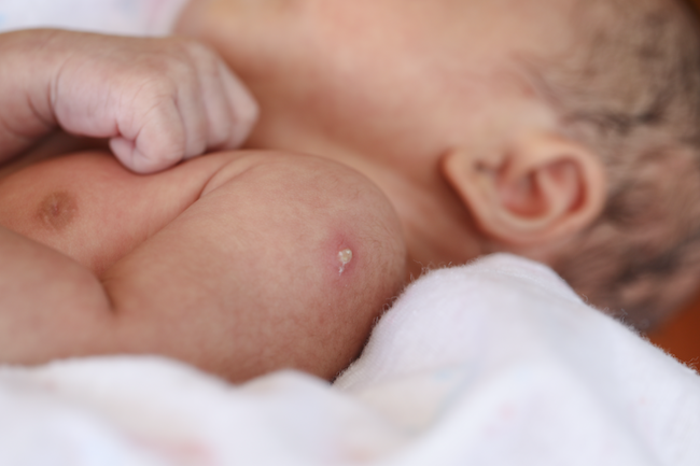
LA JOLLA—A long, long time ago, the BCG vaccine was approved for use against tuberculosis (TB), and it’s still given to infants today. For generations, the vaccine has saved lives and prevented untold suffering. And yet TB still kills around 1.5 million people every year. The problem is that the BCG vaccine was the first—and the last—vaccine approved to prevent tuberculosis.
Credit: La Jolla Institute for Immunology
LA JOLLA—A long, long time ago, the BCG vaccine was approved for use against tuberculosis (TB), and it’s still given to infants today. For generations, the vaccine has saved lives and prevented untold suffering. And yet TB still kills around 1.5 million people every year. The problem is that the BCG vaccine was the first—and the last—vaccine approved to prevent tuberculosis.
“This vaccine is 100 years old. The first dose was given one hundred years ago this year,” says La Jolla Institute for Immunology (LJI) Research Assistant Professor Cecilia Lindestam Arlehamn, Ph.D. “Technology has moved on since then, but not the tuberculosis vaccine, although there are many promising candidates in the pipeline.”
Lindestam Arlehamn and her colleagues at LJI, Linköping University, Murdoch University and Vanderbilt University recently set out to finally uncover exactly how the BCG vaccine works. A better understanding of BCG vaccination could serve as a foundation for designing more effective TB vaccines.
“About a quarter of the world’s population is infected with Mycobacterium tuberculosis,” adds Lindestam Arlehamn. “We have to do more.”
The researchers wanted to know which kinds of immune cells respond to the BCG vaccine and “remember” the vaccine well enough to fight the Mycobacterium tuberculosis bacterium that causes TB. Their findings, published in eBiomedicine, point to a particularly important subset of T cells called Th1* cells.
These Th1* cells are a key marker in the body’s “immune signature” following BCG vaccination. By looking at this immune signature, vaccine developers can make sure their TB vaccine candidates are enlisting the right kinds of immune cells.
For the study, Lindestam Arlehamn and her colleagues followed a group of 17 adults in Sweden who had never received a BCG vaccine or contracted tuberculosis. The researchers took a blood sample before the participants received a BCG vaccine. The researchers took another sample eight months after vaccination. This time jump allowed the researchers to see which kinds of immune cells would remember the BCG vaccine and jump into action to help prevent tuberculosis.
The researchers looked at the immune cells in these samples using tools such as flow cytometry, RNA sequencing and DNA methylome analysis. The Th1* cells stood out.
After 100 years, the researchers had uncovered a clue to the very workings of BCG vaccination.
The researchers also found more MAIT cells in the vaccinated participants. MAIT cells are important players in the intersection between the innate and adaptive arms of the immune system.
This was not the first time TB researchers took note of Th1* cells and MAIT cells. These are the same cells shown to respond to natural Mycobacterium tuberculosis infections. Now Lindestam Arlehamn could see that Th1* and MAIT cells were key players after BCG vaccination as well.
Going forward, scientists can compare the entire T cell repertoire, or TCR, described in this study to their own vaccine data. “Now we can look at whether we want to trigger these immune cells using novel vaccines,” says Lindestam Arlehamn. “How can we get these immune cells to increase and do what they’re born to do, so to speak?”
Of course, the new study gives scientists just a snapshot of BCG vaccine responses. Lindestam Arlehamn says it will be important to compare the results to immune responses in younger subjects in different parts of the world. Kids typically have a better response to BCG vaccination which prevents more severe TB cases.
“Kids have a different immune system. They’re not as developed, and there are differences compared to adults,” she says. “So it would be interesting to look at the immune signature in kids.”
Additional authors of the study, “CD4+CCR6+ T cells dominate the BCG-induced transcriptional signature,” include Akul Singhania, Paige Dubelko, Rebecca Kuan, William D. Chronister, Kaylin Muskat, Jyotirmoy Das, Elizabeth J. Phillips, Simon A. Mallal, Grégory Seumois, Pandurangan Vijayanand, Alessandro Sette, Maria Lerm and Bjoern Peters.
The study was supported by the National Institutes of Health (grants U19 AI118626, S10 RR027366, and S10 OD016262).
DOI: 10.1016/j.ebiom.2021.103746
###
About La Jolla Institute for Immunology
The La Jolla Institute for Immunology is dedicated to understanding the intricacies and power of the immune system so that we may apply that knowledge to promote human health and prevent a wide range of diseases. Since its founding in 1988 as an independent, nonprofit research organization, the Institute has made numerous advances leading toward its goal: life without disease.
Journal
EBioMedicine
DOI
10.1016/j.ebiom.2021.103746
Method of Research
Experimental study
Subject of Research
People
Article Title
CD4+CCR6+ T cells dominate the BCG-induced transcriptional signature
Article Publication Date
10-Dec-2021