• HOME
  • NEWS
  • EXPLORE
    • CAREER
      • Companies
      • Jobs
    • EVENTS
    • iGEM
      • News
      • Team
    • PHOTOS
    • VIDEO
    • WIKI
  • BLOG
  • COMMUNITY
    • FACEBOOK
    • INSTAGRAM
    • TWITTER
Friday, May 1, 2026
BIOENGINEER.ORG
No Result
View All Result
  • Login
  • HOME
  • NEWS
  • EXPLORE
    • CAREER
      • Companies
      • Jobs
        • Lecturer
        • PhD Studentship
        • Postdoc
        • Research Assistant
    • EVENTS
    • iGEM
      • News
      • Team
    • PHOTOS
    • VIDEO
    • WIKI
  • BLOG
  • COMMUNITY
    • FACEBOOK
    • INSTAGRAM
    • TWITTER
  • HOME
  • NEWS
  • EXPLORE
    • CAREER
      • Companies
      • Jobs
        • Lecturer
        • PhD Studentship
        • Postdoc
        • Research Assistant
    • EVENTS
    • iGEM
      • News
      • Team
    • PHOTOS
    • VIDEO
    • WIKI
  • BLOG
  • COMMUNITY
    • FACEBOOK
    • INSTAGRAM
    • TWITTER
No Result
View All Result
Bioengineer.org
No Result
View All Result
Home NEWS Science News Biology

How can our brain still perceive familiar objects even when they become indistinct?

Bioengineer by Bioengineer
November 26, 2021
in Biology
Reading Time: 2 mins read
0
Figure
Share on FacebookShare on TwitterShare on LinkedinShare on RedditShare on Telegram

The appearance of objects can often change. For example, in dim evenings or fog, the contrast of the objects decreases, making it difficult to distinguish them. However, after repeatedly encountering specific objects, the brain can identify them even if they become indistinct. The exact mechanism contributing to the perception of low-contrast familiar objects remains unknown.
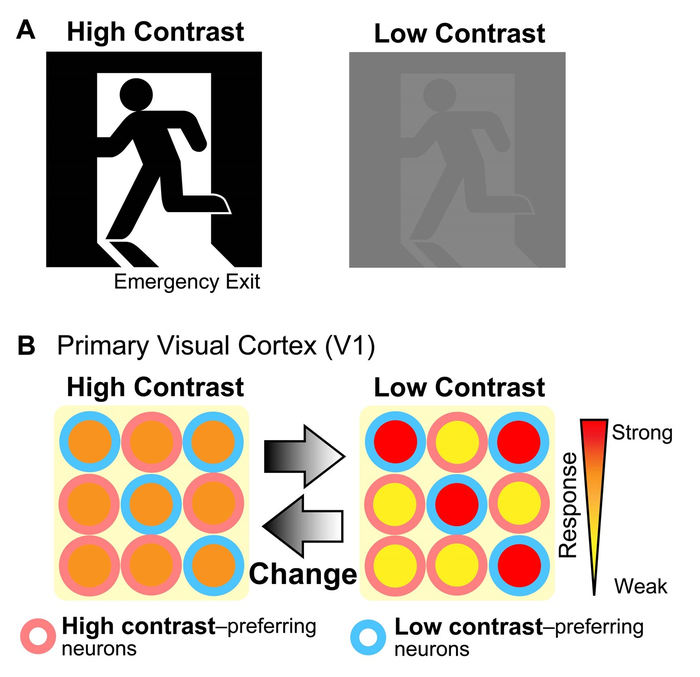
Figure

Credit: Rie Kimura

The appearance of objects can often change. For example, in dim evenings or fog, the contrast of the objects decreases, making it difficult to distinguish them. However, after repeatedly encountering specific objects, the brain can identify them even if they become indistinct. The exact mechanism contributing to the perception of low-contrast familiar objects remains unknown.

In the primary visual cortex (V1), the area of the cerebral cortex dedicated to processing basic visual information, the visual responses have been considered to reflect directly the strength of external inputs. Thus, high-contrast visual stimuli elicit strong responses and vice versa.

In this study, Rie Kimura and Yumiko Yoshimura found that in rats, the number of V1 neurons preferentially responding to low-contrast stimuli increases after repeated experiences. In these neurons, low-contrast visual stimuli elicit stronger responses, and high-contrast stimuli elicit weaker responses. These low contrast–preferring neurons show a more evident activity when rats correctly perceive a low-contrast familiar object. It was first reported in Science Advances that low-contrast preference in V1 is strengthened in an experience-dependent manner to represent low-contrast visual information well. This mechanism may contribute to the perception of familiar objects, even when they are indistinct.

“This flexible information representation may enable a consistent perception of familiar objects with any contrast,” Kimura says. “The flexibility of our brain makes our sensation effective, although you may not be aware of it. An artificial neural network model may reproduce the human sensation by incorporating not only high contrast–preferring neurons, generally considered until now, but also low contrast–preferring neurons, the main focus of this research.”


Journal

Science Advances

Method of Research

Experimental study

Subject of Research

Animals

Article Title

The contribution of low contrast–preferring neurons to information representation in the primary visual cortex after learning

Article Publication Date

26-Nov-2021
Share12Tweet8Share2ShareShareShare2

Related Posts

Viruses Develop Virulence in Mice Based on Genetics and Sex — Biology

Viruses Develop Virulence in Mice Based on Genetics and Sex

April 30, 2026
New Report Warns: Nature Loss Poses Catastrophic Risks — Biology

New Report Warns: Nature Loss Poses Catastrophic Risks

April 30, 2026

Kangaroos Reveal ‘Upside-Down’ Evolution in Australia

April 30, 2026

Study Reveals Evolution Has Reused the Same Genes for 120 Million Years

April 30, 2026

POPULAR NEWS

  • Research Indicates Potential Connection Between Prenatal Medication Exposure and Elevated Autism Risk

    830 shares
    Share 332 Tweet 208
  • New Study Reveals Plants Can Detect the Sound of Rain

    712 shares
    Share 284 Tweet 178
  • Scientists Investigate Possible Connection Between COVID-19 and Increased Lung Cancer Risk

    67 shares
    Share 27 Tweet 17
  • Salmonella Haem Blocks Macrophages, Boosts Infection

    60 shares
    Share 24 Tweet 15

About

We bring you the latest biotechnology news from best research centers and universities around the world. Check our website.

Follow us

Recent News

Teaching Older Adults Tech for Health in Communities

EHMT2 Drives Vascular Remodeling by Repressing GADD45G

Mothers Lacking Specific Fatty Acid in Blood More Likely to Have Children with Asthma

Subscribe to Blog via Email

Enter your email address to subscribe to this blog and receive notifications of new posts by email.

Join 82 other subscribers
  • Contact Us

Bioengineer.org © Copyright 2023 All Rights Reserved.

Welcome Back!

Login to your account below

Forgotten Password?

Retrieve your password

Please enter your username or email address to reset your password.

Log In
No Result
View All Result
  • Homepages
    • Home Page 1
    • Home Page 2
  • News
  • National
  • Business
  • Health
  • Lifestyle
  • Science

Bioengineer.org © Copyright 2023 All Rights Reserved.