Upon their dispersals in Central and Western Europe by around 42,000 years ago, groups of Homo sapiens started to manipulate mammoth tusks for the production of pendants and mobiliary objects, like carved statuettes, at times decorated with geometric motifs. In addition to lines, crosses and hashtags, a new type of decoration – the alignment of punctuations – appeared in some ornaments in south-western France and figurines in Swabian Jura in Germany. Until now, most of these adornments were discovered from older excavations, and their chronological attributions remain uncertain. Hence, questions regarding the emergence of human body augmentation and the diffusion of mobiliary art in Europe remained strongly debated.
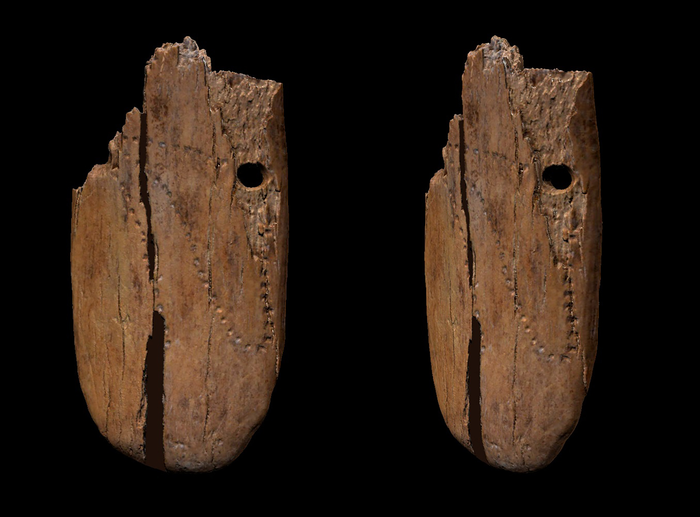
Credit: © Antonino Vazzana – BONES Lab
Upon their dispersals in Central and Western Europe by around 42,000 years ago, groups of Homo sapiens started to manipulate mammoth tusks for the production of pendants and mobiliary objects, like carved statuettes, at times decorated with geometric motifs. In addition to lines, crosses and hashtags, a new type of decoration – the alignment of punctuations – appeared in some ornaments in south-western France and figurines in Swabian Jura in Germany. Until now, most of these adornments were discovered from older excavations, and their chronological attributions remain uncertain. Hence, questions regarding the emergence of human body augmentation and the diffusion of mobiliary art in Europe remained strongly debated.
A new study, led by researchers of the Max Planck Institute for Evolutionary Anthropology in Germany, the University of Bologna in Italy, Wrocław University in Poland, the Polish Geological Institute-National Research Institute, Warsaw, Poland, and the Institute of Systematics and Evolution of Animals Polish Academy of Sciences, reports the oldest known punctate ivory pendant found in Eurasia. Its age of 41,500 years places this personal ornament from Stajnia Cave within the record of the earliest dispersals of Homo sapiens in Europe.
Methodological advances in radiocarbon dating
“Determining the exact age of this jewellery was fundamental for its cultural attribution, and we are thrilled of the result. This work demonstrates that using the most recent methodological advances in the radiocarbon method enables us to minimise the amount of sampling and achieve highly precise dates with a very small error range. If we want to seriously solve the debate on when mobiliary art emerged in Palaeolithic groups, we need to radiocarbon date these ornaments, especially those found during past fieldwork or in complex stratigraphic sequences”, says Sahra Talamo, lead author of the study and director of the BRAVHO radiocarbon lab at the Department of Chemistry G. Ciamician of Bologna University.
The study of the pendant and the awl was also carried out through digital methodologies starting from the micro-tomographic scans of the finds. “Through 3D modeling techniques, the finds were virtually reconstructed and the pendant appropriately restored, allowing detailed measurements and supporting the description of the decorations,” notes co-author Stefano Benazzi, director of the Osteoarchaeology and Paleoanthropology Laboratory (BONES Lab) at the Department of Cultural Heritage, University of Bologna.
The personal ornament was discovered in 2010 during fieldwork directed by co-author Mikołaj Urbanowski among animal bones and a few Upper Palaeolithic stone tools. Separate short term occupations by Neanderthals and Homo sapiens groups have been identified from the cave’s archaeological record. The disposal of the pendant is probably occurred duringa hunting expedition into the Kraków-Częstochowa Upland where the pendant broke and was left behind in the cave.
Similar decorations appeared independently across Europe
“This piece of jewellery shows the great creativity and extraordinary manual skills of members of the group of Homo sapiens that occupied the site. The thickness of the plate is about 3.7 millimetres showing an astonishing precision on carving the punctures and the two holes for wearing it”, says co-author Wioletta Nowaczewska of Wrocław University. “If the Stajnia pendant’s looping curve indicates a lunar analemma or kill scores will remain an open question. However, it is fascinating that similar decorations appeared independently across Europe”, remarks co-author Adam Nadachowski from the Institute of Systematics and Evolution of Animals Polish Academy of Sciences.
In broad-scale scenarios on the earliest expansion of Homo sapiens in Europe, the territory of Poland is often excluded suggesting that it remained deserted for several millennia after the demise of Neanderthals. “The ages of the ivory pendant and the bone awl found at Stajnia Cave finally demonstrate that the dispersal of Homo sapiens in Poland took place as early as in Central and Western Europe. This remarkable result will change the perspective on how adaptable these early groups were and call into question the monocentric model of diffusion of the artistic innovation in the Aurignacian”, says co-athor Andrea Picin from the Max Planck Institute for Evolutionary Anthropology in Leipzig.
Further detailed analyses on the ivory assemblages of Stajnia Cave and other sites in Poland are currently underway and promise to yield more insights into the strategies of production of personal ornaments in Central-Eastern Europe.
Journal
Scientific Reports
DOI
10.1038/s41598-021-01221-6
Article Title
A 41,500 year‑old decorated ivory pendant from Stajnia Cave (Poland)
Article Publication Date
25-Nov-2021