Cells can produce unique electrical signals. These signals can be linked to various cancers, such as the breast, lung, liver, brain, pancreas and prostate cancers, meaning that they can be used as indicators for early cancer diagnosis. Thus, using electrical signals as indicators and targets for cancer treatments could potentially improve the outcome for cancer patients. A team of researchers from SUTD and A*STAR Bioinformatics Institute were developing a sensor for the detection of breast cancer cells as strong electrical signals can be found in these cells.
Credit: SUTD
Cells can produce unique electrical signals. These signals can be linked to various cancers, such as the breast, lung, liver, brain, pancreas and prostate cancers, meaning that they can be used as indicators for early cancer diagnosis. Thus, using electrical signals as indicators and targets for cancer treatments could potentially improve the outcome for cancer patients. A team of researchers from SUTD and A*STAR Bioinformatics Institute were developing a sensor for the detection of breast cancer cells as strong electrical signals can be found in these cells.
Breast cancer is a leading cause of death globally. The risk of breast cancer can be reduced by making healthy choices like eating right, staying active and not smoking. It is vital to identify those at risk as early as possible in order to administer the relevant therapies and medical treatment. As a result, detecting signals from breast cancer cells has drawn the attention of the biomedical community leading to the research and development of a wide range of sensing methods such as electronic biosensors. Current traditional biosensing methods may require a high number of cancer cells for successful detection to occur. Hence, a low-cancer-cell-number sensing process for early diagnosis of breast cancer is needed.
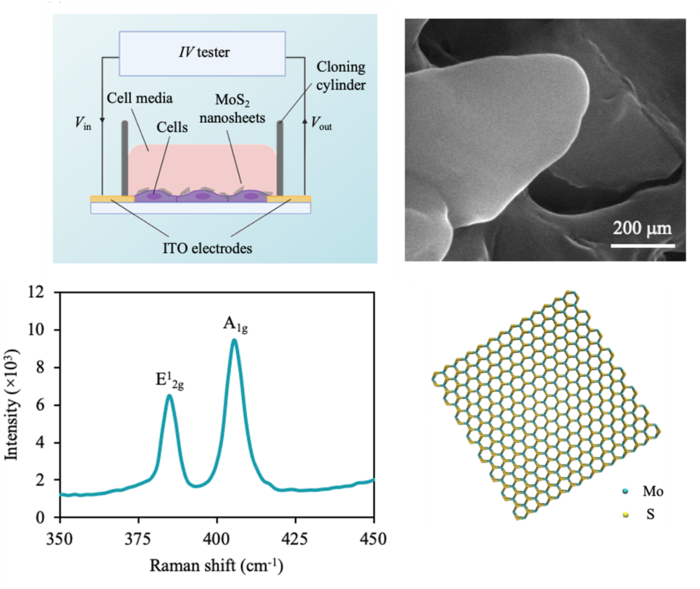
The Singapore research team developed a combined electric current 2D material sensor for the detection of breast cancer cells. This ultra-sensitive sensor was able to detect electrical signals from a record low number of cancer cells.
This is the first time that 2D materials were used to identify electrical signals of breast cancer cells. Two dimensional materials belong to a class of nanomaterials that consists of a few layers of atoms. They have attracted much excitement in various fields due to their unique electronic properties.
Principal investigator, SUTD assistant professor Dr Desmond Loke said: “2D materials have been the subject of recent active research and is used in a wide range of applications, including biosensing. In this work, we have combined the molybdenum disulfide (MoS2) nanosheets with an electric current, leading to a new range of possibilities in the field of biosensing.”
Based on the results of computer simulations, the researchers found that the disruption of the cancer cell membrane – resulting from the embedded 2D material – and the final angle of the 2D material sheet contributed to the increase in resistance. Since current flows along the 2D material sheet, the tilt of the 2D material sheet disrupts the current flow along the cell membrane. Moreover, the extracted cell membrane components could have increased the resistance between the nanosheet and the cell membrane, acting as an insulator and impeding current flow.
“We found that the sensor can detect electrical signals with about 70% less cancer cells than traditional electronic sensors.” Loke commented.
“Our study provides a way for developing new sensors for the detection of breast cancer cells. Moreover, this sensitive detection method could boost the chances of breast cancer patient survival” Dr. Loke added.
The other researchers involved in this work are Sophia Chan, Denise Lee, Maria Meivita, Lunna Li and Natasa Bajalovic from SUTD and Yaw-Sing Tan from A*STAR Bioinformatics Institute.
Journal
Nanoscale Advances
DOI
10.1039/D1NA00614B
Article Title
Ultrasensitive two-dimensional material-based MCF-7 cancer cell sensor driven by perturbation processes
Article Publication Date
25-Oct-2021