Ithaca, NY—Study of a perky little bird suggests there may be far more avian species in the tropics than those identified so far. After a genetic study of the White-crowned Manakin, scientists say it’s not just one species and one of the main drivers of its diversity is the South American landscape and its history of change. These results are published in the journal Molecular Phylogenetics and Evolution.
“We found that the White-crowned Manakin probably originated in the highland forests of the Andes Mountains in northern Peru,” explains lead author Jacob Berv. “Today, this bird is also found across the Amazon Basin, in the lowland rainforests of Brazil, Peru, and many other countries, including parts of Central America.” Berv conducted this research while a Ph.D. student at the Cornell Lab of Ornithology and is currently a Life Sciences Fellow at the University of Michigan.
“This study shows that there is a lot of evolutionary history embedded in what is commonly referred to as a ‘single widespread’ species in Amazonia,” says co-author Camila Ribas at Brazil’s National Institute of Amazonian Research. “The White-crowned Manakin is an example of a phenomenon that is probably more the rule than the exception in Amazonia—diversity is vastly underestimated by the current taxonomy.”
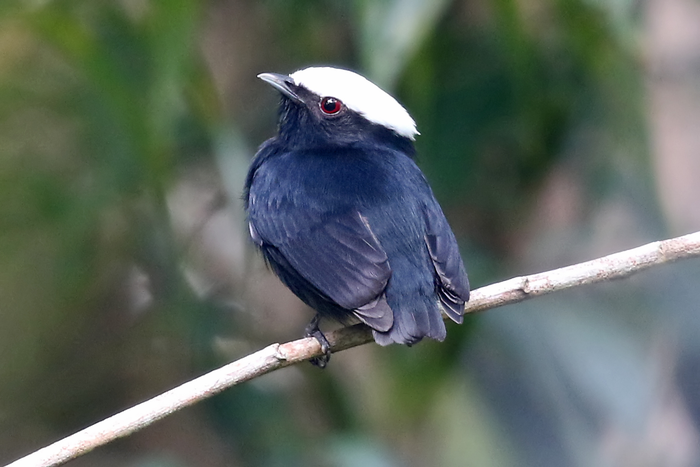
Credit: Photo by Phillip Edwards, Macaulay Library, Cornell Lab of ornithology.
Ithaca, NY—Study of a perky little bird suggests there may be far more avian species in the tropics than those identified so far. After a genetic study of the White-crowned Manakin, scientists say it’s not just one species and one of the main drivers of its diversity is the South American landscape and its history of change. These results are published in the journal Molecular Phylogenetics and Evolution.
“We found that the White-crowned Manakin probably originated in the highland forests of the Andes Mountains in northern Peru,” explains lead author Jacob Berv. “Today, this bird is also found across the Amazon Basin, in the lowland rainforests of Brazil, Peru, and many other countries, including parts of Central America.” Berv conducted this research while a Ph.D. student at the Cornell Lab of Ornithology and is currently a Life Sciences Fellow at the University of Michigan.
“This study shows that there is a lot of evolutionary history embedded in what is commonly referred to as a ‘single widespread’ species in Amazonia,” says co-author Camila Ribas at Brazil’s National Institute of Amazonian Research. “The White-crowned Manakin is an example of a phenomenon that is probably more the rule than the exception in Amazonia—diversity is vastly underestimated by the current taxonomy.”
Around 2.5 million years ago, populations of this manakin species expanded out of the Andes, though many populations remain there today. Those that moved eventually became isolated in pockets of habitat defined by mountains, plains, rivers, and climate. Over the course of time, White-crowned Manakin populations evolved independently, accumulating differences in their songs and plumage patterns. Study authors suggest many of these pocket populations are now different enough from one another that they should be recognized as separate species. This is especially true if the variations in song make it unlikely that isolated populations would be able to recognize one another and breed—the biological definition of a species.
“In order to understand evolutionary processes in Amazonia we need many more studies like this one, with dense geographical sampling,” Ribas says. “For this we need to support biological collections that are able to accumulate samples through time.”
Study authors say underestimating the number of species in South America has important consequences for conservation, especially for endemic species threatened by ongoing loss of habitat.
“We’ve basically just scratched the surface,” notes Berv. “If what holds true for this species is indicative of what’s taking place in other poorly studied species, then we have hugely underestimated the amount of biodiversity in the South American tropics.”
This research was supported by a National Science Foundation (NSF) Graduate Research Fellowship to the lead author, and several NSF grants to other co-authors, as well as by the W. R. Coe Fund of Yale University. Data collection was paid for by Athena Funds from the Cornell of Ornithology and W. R. Coe Fund from Yale University. This work was also supported in part by the facilities and staff of the Yale University Faculty of Arts and Sciences High Performance Computing Center, and with the resources of the Cornell University BRC Bioinformatics Facility, which is partially funded by Microsoft Corporation.
Reference:
Jacob S. Berv, Leonardo Campagna, Teresa J. Feo, Ivandy Castro-Astor, Camila C. Ribas, Richard O. Prum, Irby J. Lovette. Genomic phylogeography of the White-crowned Manakin Pseudopipra pipra (Aves: Pipridae) illuminates a continental scale radiation out of the Andes. 2021. Molecular Phylogenetics and Evolution. https://doi.org/10.1016/j.ympev.2021.107205
###
Editors: Download images, map graphic, and sounds to embed. The use of this material is protected by copyright. Use is permitted only within stories about the content of this release. Redistribution or any other use is prohibited without express written permission of the Cornell Lab of Ornithology or the copyright owner.
Journal
Molecular Phylogenetics and Evolution
DOI
10.1016/j.ympev.2021.107205
Subject of Research
Animals
Article Title
Genomic phylogeography of the White-crowned Manakin Pseudopipra pipra (Aves: Pipridae) illuminates a continental scale radiation out of the Andes
Article Publication Date
1-Nov-2021