It’s an environmental success story that feels like a parable—the reintroduction of wolves in Yellowstone National Park in the mid-1990s triggered a cascade of effects that ultimately restored the ecosystem, including the recovery of aspen trees. But like many stories based on ecological realities, it’s more complex than at first glance—aspen recovery in the park is not as robust as generally believed, according to new research.
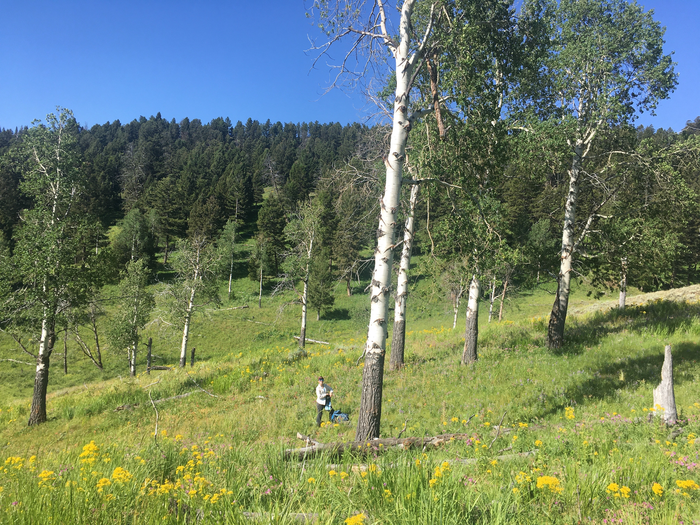
Credit: Photo Courtesy Lainie Brice
It’s an environmental success story that feels like a parable—the reintroduction of wolves in Yellowstone National Park in the mid-1990s triggered a cascade of effects that ultimately restored the ecosystem, including the recovery of aspen trees. But like many stories based on ecological realities, it’s more complex than at first glance—aspen recovery in the park is not as robust as generally believed, according to new research.
The Yellowstone story is a textbook example of a trophic cascade, in which predators help plants grow by eating or scaring away herbivores that eat the plants. When wolves were reintroduced into the Yellowstone food chain, they helped to reduce numbers of elk, which had been consuming young aspen trees. Previous research showed strong positive growth in young aspen as the elk populations decreased—a welcome result, as aspen forests have been vanishing from the northern Yellowstone landscape for the last century.
But new research from Elaine Brice and Dan MacNulty, from Utah State University’s Department of Wildland Resources and Ecology Center, and Eric Larsen, from the University of Wisconsin Stevens Point’s Department of Geography and Geology, shows that the effect of wolves on the recovery of aspen has been exaggerated by how it was measured.
Previous studies evaluated aspen recovery in Yellowstone by measuring the five tallest young aspen within a stand. The reasoning was that the tallest young aspen trees represent a ‘leading edge’ indicator of the future recovery of the entire aspen population. But this is not the case—sampling only the tallest young aspen estimated a rate of recovery that was significantly faster than was estimated by random sampling of all young aspen within the stand, according to the research.
“These are extremely complex systems, and understanding them is a major challenge because they are difficult to properly sample,” said Brice. “The traditional method of sampling by only using the tallest young aspen plants to measure growth—which most research currently relies on—doesn’t capture the entire picture.”
For one, elk are picky about the aspen they consume. They tend to eat plants at shoulder height for which they don’t have to crane their necks. As the leader stem (main trunk) of a young aspen grows past the shoulder height of adult elk, it is decreasingly likely to be eaten as it grows taller, said MacNulty. “This means that the tallest young aspen grow faster because they are taller, not because wolves reduce elk browsing,” said MacNulty. This finding highlights the complicating fact that height of young aspen is both a cause and an effect of reduced elk browsing.
Taller aspen also thrive because they tend to have the best growing conditions (sunlight, moisture, soil quality). Measuring just the tallest young trees downplays the role of these other factors that have nothing to do with elk or wolf populations. And measuring just the tallest aspen also overlooks the failure of some young aspen to regenerate in the first place.
“That’s like calculating a team’s batting average without the player who always strikes out,” said Brice. Random sampling from the research showed an absence of aspen regeneration in some places, a vital piece missing from the initial measurements.
Understanding how ecosystems respond to changes in large predator populations is vital to resolving broader debates about the structure of food webs, determining species abundance and delivering ecosystem services, said the authors. This study demonstrates how deviations from basic sampling principles can distort this understanding. Non-random sampling overestimated the strength of a trophic cascade in this case, but it may underestimate cascading effects in other situations. Randomization is one of the few protections against unreliable inferences and the misguided management decisions they may inspire, they said.
“The bottom line is that ecologists must stick to classic principles of sampling design, like randomization, to fully understand trophic cascades in complex wildlife systems like Yellowstone,” said MacNulty.
###
Journal
Ecology Letters
DOI
10.1111/ele.13915
Subject of Research
Not applicable
Article Title
Sampling bias exaggerates a textbook example of a trophic cascade
Article Publication Date
8-Nov-2021