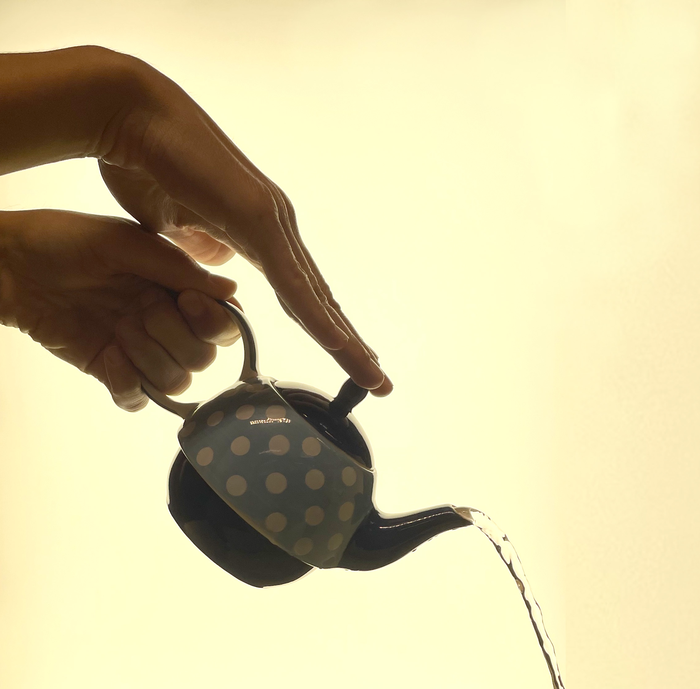
The “teapot effect” has been threatening spotless white tablecloths for ages: if a liquid is poured out of a teapot too slowly, then the flow of liquid sometimes does not detach itself from the teapot, finding its way into the cup, but dribbles down at the outside of the teapot.
Credit: TU Wien
The “teapot effect” has been threatening spotless white tablecloths for ages: if a liquid is poured out of a teapot too slowly, then the flow of liquid sometimes does not detach itself from the teapot, finding its way into the cup, but dribbles down at the outside of the teapot.
This phenomenon has been studied scientifically for decades – now a research team at TU Wien has succeeded in describing the “teapot effect” completely and in detail with an elaborate theoretical analysis and numerous experiments: An interplay of different forces keeps a tiny amount of liquid directly at the edge, and this is sufficient to redirect the flow of liquid under certain conditions.
An effect with a long history
The “teapot effect” was first described by Markus Reiner in 1956. Reiner earned his doctorate at TU Wien in 1913 and then emigrated to the USA, where he became an important pioneer of rheology – the science of flow behaviour. Again and again, scientists have tried to explain this effect precisely. Work on this topic was awarded the satirical “IG Nobel Prize” in 1999. Now, research on the teapot effect has come full circle, as it was studied at Reiner’s alma mater, the TU Wien, by a team around Dr. Bernhard Scheichl, lecturer at the Institute of Fluid Mechanics and Heat Transfer and Key Scientist at the Austrian Centre of Excellence for Tribology (AC2T research GmbH), in cooperation with the Department of Mathematics at the University College London.
“Although this is a very common and seemingly simple effect, it is remarkably difficult to explain it exactly within the framework of fluid mechanics,” says Bernhard Scheichl. The sharp edge on the underside of the teapot beak plays the most important role: a drop forms, the area directly below the edge always remains wet. The size of this drop depends on the speed at which the liquid flows out of the teapot. If the speed is lower than a critical threshold, this drop can direct the entire flow around the edge and dribbles down on the outside wall of the teapot.
“We have now succeeded for the first time in providing a complete theoretical explanation of why this drop forms and why the underside of the edge always remains wetted,” says Bernhard Scheichl. The mathematics behind it is complicated – it is an interplay of inertia, viscous and capillary forces. The inertial force ensures that the fluid tends to maintain its original direction, while the capillary forces slow the fluid down right at the beak. The interaction of these forces is the basis of the teapot effect. However, the capillary forces ensure that the effect only starts at a very specific contact angle between the wall and the liquid surface. The smaller this angle is or the more hydrophilic (i.e. wettable) the material of the teapot is, the more the detachment of the liquid from the teapot is slowed down.
Tea in space
Interestingly, the strength of gravity in relation to the other forces that occur does not play a decisive role. Gravity merely determines the direction in which the jet is directed, but its strength is not decisive for the teapot effect. The teapot effect would therefore also be observed when drinking tea on a moon base, but not on a space station with no gravity at all.
The theoretical calculations on the teapot effect were published by the research team in September 2021 in the Journal of Fluid Mechanics. Now experiments were also carried out: Water was poured from an inclined teapot at different flow rates and filmed with high speed cameras. In this way, it was possible to show exactly how the wetting of the edge below a critical pouring rate leads to the “teapot effect”, thus confirming the theory.
Journal
Journal of Fluid Mechanics
DOI
10.1017/jfm.2021.612
Method of Research
Experimental study
Subject of Research
Not applicable
Article Title
Developed liquid film passing a smoothed and wedge-shaped trailing edge: small-scale analysis and the ‘teapot effect’ at large Reynolds numbers
Article Publication Date
8-Sep-2021