A new study published today by journal PloS One, has revealed that mountaintop removal mining poses a more serious and widespread threat to endangered species and people than was previously understood. The researchers from Defenders of Wildlife’s Center for Conservation Innovation (CCI), and conservation technology nonprofit SkyTruth, combines water-quality data with satellite imagery of mountaintop removal mining activity to estimate the full extent of water-quality degradation attributable to the practice at the landscape level.
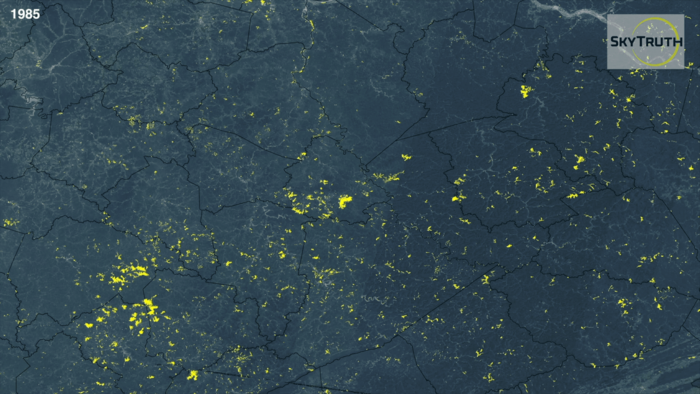
Credit: Image provided by SkyTruth (c) 2021
A new study published today by journal PloS One, has revealed that mountaintop removal mining poses a more serious and widespread threat to endangered species and people than was previously understood. The researchers from Defenders of Wildlife’s Center for Conservation Innovation (CCI), and conservation technology nonprofit SkyTruth, combines water-quality data with satellite imagery of mountaintop removal mining activity to estimate the full extent of water-quality degradation attributable to the practice at the landscape level.
“This research really emphasizes the interconnectedness of ecosystems and how distant human activity can have ripple effects that aren’t immediately apparent,” said CCI’s Senior Conservation Data Scientist Mike Evans. “Being able to assess impacts at a landscape scale opens a completely new door for conservation.”
Mountaintop removal is a coal-mining method that clearcuts forests and then uses explosives to remove top soil and bedrock, which is often dumped in nearby valleys. The method’s negative impacts on water quality is well known, but this research is now revealing the extent of the damage.
The research found that chronic and acute toxicity thresholds for chemicals like aluminum, copper, lead and manganese as well as acidity levels in streams were exceeded thousands of times—including in areas of critical habitat—far removed from where the mines actually are. Previously, it was thought impacts were contained to the immediate area around mines.
The study combined 30 years of satellite imagery data that mapped large surface mines in central Appalachia and water-quality measurements from more than 4,000 monitoring sites across different watersheds.
“We have been watching mountaintop removal mining expand across the Appalachian landscape for years using satellite imagery,” said Christian Thomas, geospatial engineer with SkyTruth. “By combining our imagery with water-quality data, we have finally revealed how profoundly this activity harms sensitive aquatic species.”
Central Appalachia is a highly biodiverse region and the streams impacted by these mines contain many threatened and endangered species, including 39 mollusk species, 12 fish, as well as crustacean and snail species. The region includes parts of Kentucky, Tennessee, Virginia, and West Virginia where this mining often occurs.
“More than 50 federally protected species inhabit the streams of this region, and we haven’t historically known the full impact of these mines, until now,” said Evans. “This research expands the ability for state and federal agencies to make better decisions that directly affect vulnerable people and wildlife.”
The results of this study and the same methods can now be used to improve protections for imperiled species and provide a more rigorous scientific standard for mine permitting practices going forward by representing “best-available science,” the legal standard required under the Endangered Species Act.
Journal
PLoS ONE
DOI
10.1371/journal.pone.0239691
Article Title
Linking mountaintop removal mining to water quality for imperiled species using satellite data
Article Publication Date
4-Nov-2021