• HOME
  • NEWS
  • EXPLORE
    • CAREER
      • Companies
      • Jobs
    • EVENTS
    • iGEM
      • News
      • Team
    • PHOTOS
    • VIDEO
    • WIKI
  • BLOG
  • COMMUNITY
    • FACEBOOK
    • INSTAGRAM
    • TWITTER
Saturday, February 7, 2026
BIOENGINEER.ORG
No Result
View All Result
  • Login
  • HOME
  • NEWS
  • EXPLORE
    • CAREER
      • Companies
      • Jobs
        • Lecturer
        • PhD Studentship
        • Postdoc
        • Research Assistant
    • EVENTS
    • iGEM
      • News
      • Team
    • PHOTOS
    • VIDEO
    • WIKI
  • BLOG
  • COMMUNITY
    • FACEBOOK
    • INSTAGRAM
    • TWITTER
  • HOME
  • NEWS
  • EXPLORE
    • CAREER
      • Companies
      • Jobs
        • Lecturer
        • PhD Studentship
        • Postdoc
        • Research Assistant
    • EVENTS
    • iGEM
      • News
      • Team
    • PHOTOS
    • VIDEO
    • WIKI
  • BLOG
  • COMMUNITY
    • FACEBOOK
    • INSTAGRAM
    • TWITTER
No Result
View All Result
Bioengineer.org
No Result
View All Result
Home NEWS Science News Biology

History of insect invasions offer insight into the future

Bioengineer by Bioengineer
November 3, 2021
in Biology
Reading Time: 3 mins read
0
Adult spotted lanternfly
Share on FacebookShare on TwitterShare on LinkedinShare on RedditShare on Telegram

Over the past two centuries, thousands of non-native insects have hitchhiked to the United States in packing material, on live plants, and in passenger baggage. Scientists with two U.S. Department of Agriculture (USDA) agencies and their partners used the history of live plant imports and invasion by a common group of insects to estimate the rate at which new insects are arriving and how many new insect species may yet be in store for U.S.  forests and agricultural fields.
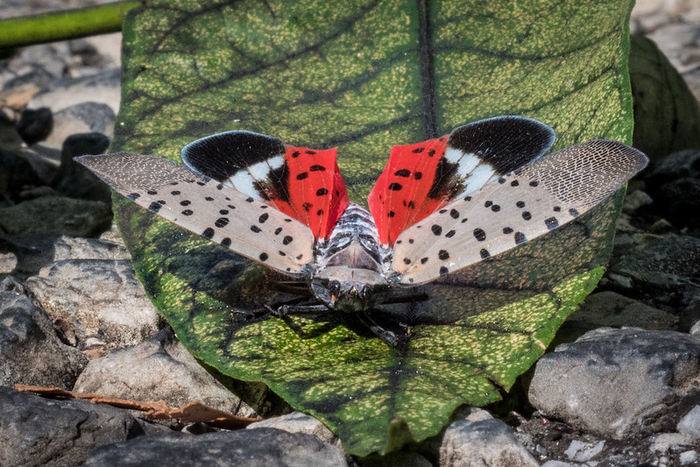
Adult spotted lanternfly

Credit: USDA Photo by Lance Cheung.

Over the past two centuries, thousands of non-native insects have hitchhiked to the United States in packing material, on live plants, and in passenger baggage. Scientists with two U.S. Department of Agriculture (USDA) agencies and their partners used the history of live plant imports and invasion by a common group of insects to estimate the rate at which new insects are arriving and how many new insect species may yet be in store for U.S.  forests and agricultural fields.

Findings suggest that efforts to reduce biological hitchhiking on live plant imports, often referred to as “biosecurity,” are working. However, more than a century of invasion by Hemiptera insects also suggests that increased trade might offset the effects of improved biosecurity. As many as 25 percent of invading Hemiptera insects may have yet to be detected in the nation’s forests and agricultural fields.

The study, “Hidden patterns of insect establishment risk revealed from two centuries of alien species discoveries,” was published recently in the journal Science Advances. The study’s lead author, Matthew MacLachlan, a research economist with the USDA Economic Research Service, and co-author Andrew Liebhold, a research entomologist with the USDA Forest Service, examined records from 1854 to 2012; they found that 930 non-native species of plant-feeding insects in the Hemipter order have invaded the United States. The research team was able to identify the origins of 770 of those species.

“Our work quantifying the establishment risk posed by imports from distinct regions and how these risks have changed with the accumulation of trade history and time gives policy-makers a better picture of the risks of insect invasion per unit of import and region,” MacLachlan said.

Hemiptera are small, plant-feeding insects (the order includes true bugs, aphids, and scales), and many of these species cause considerable damage to agricultural and forest plants. The Hemiptera order includes more than 80,000 insect species, and accidental transport of live plants or plant products is the main pathway by which most Hemiptera move among continents.

“Data on historical discoveries of non-native Hemiptera in the United States helped us estimate rates of new species establishments that may occur as a result of plant imports from various world regions today,” Liebhold said.

Co-authors include Takehiko Yamanaka of the Institute for Agro-Environmental Sciences, NARO (NIAES) in Japan and Michael R. Springborn of the University of California, Davis.


Journal

Science Advances

Method of Research

Data/statistical analysis

Subject of Research

Animals

Article Title

Hidden patterns of insect establishment risk revealed from two centuries of alien species discoveries

Article Publication Date

29-Sep-2021

Share12Tweet8Share2ShareShareShare2

Related Posts

Florida Cane Toad: Complex Spread and Selective Evolution

Florida Cane Toad: Complex Spread and Selective Evolution

February 7, 2026
New Study Uncovers Mechanism Behind Burn Pit Particulate Matter–Induced Lung Inflammation

New Study Uncovers Mechanism Behind Burn Pit Particulate Matter–Induced Lung Inflammation

February 6, 2026

DeepBlastoid: Advancing Automated and Efficient Evaluation of Human Blastoids with Deep Learning

February 6, 2026

Navigating the Gut: The Role of Formic Acid in the Microbiome

February 6, 2026

POPULAR NEWS

  • Robotic Ureteral Reconstruction: A Novel Approach

    Robotic Ureteral Reconstruction: A Novel Approach

    82 shares
    Share 33 Tweet 21
  • Digital Privacy: Health Data Control in Incarceration

    63 shares
    Share 25 Tweet 16
  • Study Reveals Lipid Accumulation in ME/CFS Cells

    57 shares
    Share 23 Tweet 14
  • Breakthrough in RNA Research Accelerates Medical Innovations Timeline

    53 shares
    Share 21 Tweet 13

About

We bring you the latest biotechnology news from best research centers and universities around the world. Check our website.

Follow us

Recent News

TPMT Expression Predictions Linked to Azathioprine Side Effects

Improving Dementia Care with Enhanced Activity Kits

Decoding Prostate Cancer Origins via snFLARE-seq, mxFRIZNGRND

Subscribe to Blog via Email

Enter your email address to subscribe to this blog and receive notifications of new posts by email.

Join 73 other subscribers
  • Contact Us

Bioengineer.org © Copyright 2023 All Rights Reserved.

Welcome Back!

Login to your account below

Forgotten Password?

Retrieve your password

Please enter your username or email address to reset your password.

Log In
No Result
View All Result
  • Homepages
    • Home Page 1
    • Home Page 2
  • News
  • National
  • Business
  • Health
  • Lifestyle
  • Science

Bioengineer.org © Copyright 2023 All Rights Reserved.