June 2021 saw the start of the United Nations Decade on Ecosystem Restoration. A total of 115 countries have committed themselves to restoring up to a billion hectares of nature worldwide.
Credit: Camilla Fløjgaard, Aarhus University
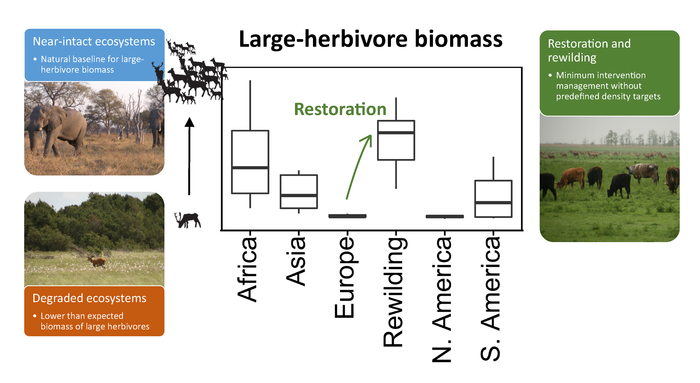
Biological research has repeatedly demonstrated that the relationship between the producer and the consumer is governed by a scaling law. An international research team has now looked into whether this law of nature can be reproduced in the relationship between the production of plants in an area and the number of large herbivores that graze on them. The study reveals that Africa is the only continent where the scaling law holds true.
June 2021 saw the start of the United Nations Decade on Ecosystem Restoration. A total of 115 countries have committed themselves to restoring up to a billion hectares of nature worldwide.
According to a group of researchers from Aarhus University and the University of Sussex, one of biggest challenges will be restoring the historical and prehistoric grazing of large mammals. What level of restoration should we aim for? How many large herbivores will we need? And how are we going to co-exist with these large animals?
A baseline in Africa
The researchers examined the current low densities of large herbivores in a scientific article in the Journal of Applied Ecology. In the article, they calculated a baseline for large animals based on the ratio between producer and consumer, i.e. plants and herbivores, in nature reserves in Africa.
They stress that this relationship between producers and consumers applies across ecosystems and biomes implying a close correlation between the biomass produced and the biomass of dependent consumers.
However, after investigating the density of large herbivores in nature reserves throughout the world, the researchers were only able to find such a close correlation on one continent: Africa. On the other continents, they found strong indications of impoverished fauna, even in protected natural areas.
“African ecosystems have species-rich mammal fauna and a large biomass of big herbivores that are significantly linked to plant productivity,” says Camilla Fløjgaard from the Department of Ecoscience at Aarhus University and head of the research group.
“But we can’t find this pattern on other continents, and in general the large herbivore biomass is much lower than we would expect considering the level of productivity,” she adds.
Far fewer animals in European nature
The survey includes data from protected areas, reserves and several rewilding projects in Europe. The researchers found significant differences, as the biomass for large herbivores in natural areas was less than one-tenth of the biomass observed in fenced rewilding areas with restored herbivore fauna.
“It’s thought-provoking that, even in many protected areas, the number of large herbivores is only a fraction of what the areas can actually sustain,” says Camilla Fløjgaard.
Another and lower baseline
In the article, the researchers argue that large herbivores are still being displaced, hunted and eradicated, and that there is a widespread perception, even among game managers, that there are plenty of herbivores in the wild, perhaps even too many. This perception is not supported by the new study.
On the contrary, efforts to decrease populations of large herbivores can reflect a shifting baseline.
“Even though large herbivores have been wandering the landscape for millions of years, it seems that we have become accustomed to landscapes almost completely devoid of them, and we have come to accept this as the natural state of things,” says Camilla Fløjgaard.
Large animals are troublesome
In the EU alone, there is a plan is to allocate 30% of marine and land areas to the restoration of natural areas and ecosystems.
“Bringing back big animals is crucial to restoring self-sustaining ecosystems and conserving biodiversity, but it is not going to be easy,” says Rasmus Ejrnæs, senior researcher from Aarhus University. He continues:
“Large animals are troublesome, because they damage crops, disrupt traffic and generally just get in the way. It will require political commitment and careful physical planning, including fenced reserves.”
Journal
Journal of Applied Ecology
DOI
10.1111/1365-2664.14047
Method of Research
Data/statistical analysis
Subject of Research
Animals
Article Title
Exploring a natural baseline for large-herbivore biomass in ecological restoration
Article Publication Date
3-Nov-2021