KNOXVILLE, Tenn. – How can rural producers in Rwanda better produce chicken for both household consumption and profit? University of Tennessee researchers are suggesting a hybrid model for the Rwandan broiler industry, among other improvements, in a new journal article.
Credit: UTIA
KNOXVILLE, Tenn. – How can rural producers in Rwanda better produce chicken for both household consumption and profit? University of Tennessee researchers are suggesting a hybrid model for the Rwandan broiler industry, among other improvements, in a new journal article.
“Strengthening smallholder engagement and integration in the Rwandan commercial broiler value chain” delves into the broiler industry in Rwanda. Through a four-year pilot project with the Smith International Center, researchers partnered with a Rwandan feedmill, Zamura Feeds Ltd., to test a poultry production model with smallholders. Through this project, the US and Rwandan teams examined the broiler supply chain, and identified ways to improve the broiler industry in Rwanda. The effort was funded under the umbrella of a Global Development Alliance (GDA), which leverages public-private partnerships, in this case between: USAID/Rwanda; a US-based foundation, the African Sustainable Agriculture Project (ASAP); a Rwandan animal feed company, Zamura Feeds Ltd.; and a U.S. land-grant institution, the University of Tennessee Institute of Agriculture (UTIA).
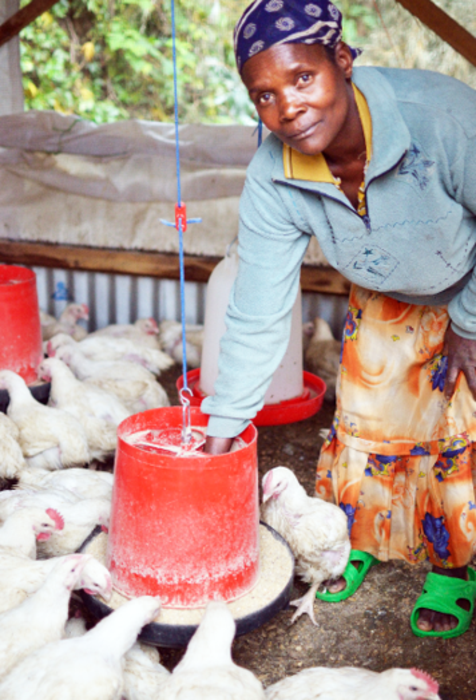
The pilot project employed a private extension model to train, supply resources for, and support 500 smallholder households to successfully produce broiler chickens to modern industry standards for consumption and market sale. Trained farmers raise broilers in their own bio-secure 100 sq. ft. coop, with 100 birds on a 45-day grow-out cycle. Through the provision of micro-loans for capital and recurring expenses and guaranteed broiler chicken buyback at the end of each grow-out cycle, the goal was to create a sustainable model for small-scale broiler production that can be scaled up throughout Rwanda and the surrounding region.
“Smallholders in Rwanda make up over 80% of farmers and cultivate less than 2.2 acres of land on average. Many farmers already raise chickens in traditional backyard settings, primarily for home consumption,” said Hans Goertz, the project administrator and co-author of the article. “In a densely populated, mountainous country such as Rwanda, intensifying poultry production presents an avenue for households to diversify and improve their income and nutrition.”
Currently, the Rwandan broiler industry consists of smallholders and large poultry operations. The smallholders operate most farms in Rwanda, but they are limited to low-intensity, village poultry production. Large operations and importers supply the commercial meat market in East Africa.
However, hybrid asset-building broiler operations are a third production model that provide an entry point for smallholders in the broiler industry. Integrating this method would allow the small operations to increase production and profitability.
To scale up this model, the researchers had several suggestions across the broiler value chain, including: reducing the recurring costs of production; providing value chain trainings; facilitating microfinancing; reducing post-harvest costs; increasing local demand for broiler meat; and strengthening policies in support of smallholders.
“Hybrid production models like the one described in this article provide a way for smallholder farmers to start broiler enterprises and compete with larger producers in the market,” Goertz said, “We hope that this body of research contributes to a more vibrant, inclusive broiler sector that provides economic opportunities and affordable animal protein for East African communities.”
Researchers on the project are Tom Gill, Smith Chair in International Sustainable Agriculture; Regis Nisengwe, Ph.D. candidate, Department of Forestry, Wildlife and Fisheries, UTIA; Hans Goertz, project development specialist, and David Ader, assistant director, both with the UTIA Smith International Center; Katie McGehee, director of the African Sustainable Agriculture Project (ASAP); Ritah Nshuti, chief operations officer, Zamura, Ltd.; Alon Gumisiriza, poultry technician manager, Zamura, Ltd.; Mike Smith, professor of animal science, UTIA (retired); and Emily Urban, graduate student, School of Integrative Plant Science Soil and Crop Sciences Section, Cornell University.
The full journal article, “Strengthening smallholder engagement and integration in the Rwandan commercial broiler value chain” was published October 8, 2021, in World’s Poultry Science Journal.
Through its mission of research, teaching and extension, the University of Tennessee Institute of Agriculture touches lives and provides Real. Life. Solutions. utia.tennessee.edu.
Journal
World s Poultry Science Journal
Article Title
Strengthening smallholder engagement and integration in the Rwandan commercial broiler value chain
Article Publication Date
8-Oct-2021