SAN ANTONIO — Oct. 26, 2021 — Connected and automated vehicle (CAV) technology developed by Southwest Research Institute to help passenger and fleet vehicles reduce energy consumption was recognized by R&D World as one of the 100 most significant innovations of 2021.
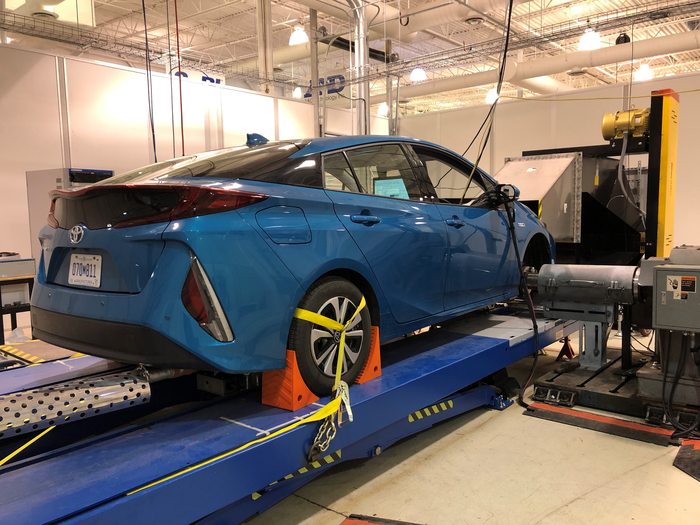
Credit: Southwest Research Institute
SAN ANTONIO — Oct. 26, 2021 — Connected and automated vehicle (CAV) technology developed by Southwest Research Institute to help passenger and fleet vehicles reduce energy consumption was recognized by R&D World as one of the 100 most significant innovations of 2021.
Developed in cooperation with the Advanced Research Projects Agency-Energy, Toyota and the University of Michigan, SwRI’s Eco-Mobility with Connected Powertrains delivered over 20% energy savings on a plug-in hybrid vehicle in real-world driving conditions by optimizing power management, routing and speed.
“Eco-Mobility with Connected Powertrains provides a breakthrough toward dramatically lowering automotive fuel consumption as government and industry seek scalable solutions to lower automotive carbon dioxide (CO2) emissions,” said Terry Alger, director of SwRI’s Automotive Propulsion Systems Department.
The technology features software and testing tools that lowered fuel consumption by optimizing power management in the hybrid-electric powertrain of a 2017 Toyota Prius Prime. The “connected powertrain” further improves efficiency via vehicle-to-vehicle (V2V) and vehicle-to-infrastructure (V2I) networks that communicate optimal routes and speed.
The research vehicle features an 8.8 kW-hr battery pack and on-board dedicated short-range communication (DSRC) radio for V2V and V2I communications. Algorithms optimize hybrid-electric performance through a novel strategy that improves management of power as it moves through the battery, electric motor, gasoline engine and other powertrain components.
“Most production hybrid vehicles use a charge-deplete then charge-sustain strategy for battery pack power management, which results in suboptimal efficiency depending on route,” said Sankar Rengarajan, manager of SwRI’s Powertrain Controls Section. “SwRI’s algorithms leverage route information to optimize power usage and fuel efficiency by adjusting the power-split between the battery/electric motor and the gasoline engine.”
SwRI developed the technology through initial funding from the U.S. Department of Energy Advanced Research Projects Agency-Energy (ARPA-E) NEXTCAR program, which uses connectivity and automation to improve vehicle energy efficiency. SwRI’s internal research and external client funding further developed capabilities.
“This connected powertrain technology does not require high levels of automation or redesign of powertrain systems,” said Scott Hotz, assistant director of SwRI’s Automotive Propulsion Systems Department. “The required connectivity already exists on some current production vehicles, and CAV networks will be ubiquitous in 5–10 years.”
In addition to Eco-Mobility with Connected Powertrains, SwRI-developed technologies Floodlight™ Non-Targeted Analysis System and Catalyzed Diesel Exhaust Fluid (Cat-DEF™) also won awards this year. The R&D 100 Awards are among the most prestigious innovation awards programs, honoring the top 100 revolutionary technologies each year since 1963. Recipients hail from research institutions, academic and government laboratories, Fortune 500 companies and smaller organizations. Since 1971, SwRI has won 50 R&D 100 Awards.
“We are committed to solving difficult technology challenges with innovative approaches,” said SwRI President and CEO Adam L. Hamilton, P.E. “I am honored that SwRI remains on the forefront of technological advancement. It is an incredible honor to be recognized for having three of the top 100 most significant innovations of the year.”
A leader in automotive engineering and intelligent systems, SwRI has several ongoing research initiatives to improve the efficiency and range of hybrid and electric vehicles in addition to lowering emissions of internal combustion engine vehicles.
For more information, visit https://www.swri.org/industry/automotive-software-electronics/connected-powertrain or https://www.swri.org/industries/battery-testing-research.