DURHAM, N.C. — We put “save the chimps” on t-shirts and posters. But you’ll never see anyone walking around in a shirt that says “save the chimpanzee lice.” People seem to be more aware of the plight of endangered gorillas than of the gorillas’ gut worms, or are understandably more enamored with mouse lemurs than their mites.
Credit: Courtesy of Marie-Claire Chelini and TriCEM
DURHAM, N.C. — We put “save the chimps” on t-shirts and posters. But you’ll never see anyone walking around in a shirt that says “save the chimpanzee lice.” People seem to be more aware of the plight of endangered gorillas than of the gorillas’ gut worms, or are understandably more enamored with mouse lemurs than their mites.
Our closest animal relatives face a precarious future: Half of the world’s roughly 500 primate species are at risk of extinction due to human activities such as hunting, trapping and deforestation. But the demise of the world’s threatened primates could trigger even more species extinctions for the parasites that lurk on and in them, according to a Duke University-led study.
“If all the primates that are threatened with extinction really do die out, they won’t be the only species that go extinct,” said first author James Herrera of the Duke Lemur Center. “It could also be twice that many parasites.”
“That’s a whole realm of biodiversity that could be going extinct without us even noticing,” Herrera said. “There’s so little that we know about what they do in the body, that we don’t even know what we’re losing.”
One previous study suggests that some 85% to 95% of the parasitic worms of animals aren’t even known to science yet, much less evaluated by the authoritative extinction ‘Red List’ kept by the International Union for Conservation of Nature (IUCN).
Herrera admits this may seem like an odd thing to get worked up about, given all our efforts to deworm and delouse ourselves and our pets. To most people, parasites are “something we want to eradicate, rather than conserve,” Herrera said.
The thought of alien creatures biting, wriggling, squirming, and nestling into the warm wet folds of the intestines makes most people shudder. But parasites don’t always cause noticeable symptoms or make their hosts sick, Herrera said. Parasites can even have some surprising benefits, such as when worms in the gut help the body ward off other infections, or keep autoimmune disorders in check.
To gauge the potential loss of biodiversity if primates go extinct, Herrera and Duke professors Charlie Nunn and James Moody used network analysis techniques to measure the potential ripple effects on the parasites that set up camp in or on primate bodies. Their work appeared Sept. 20 in the journal Philosophical Transactions B.
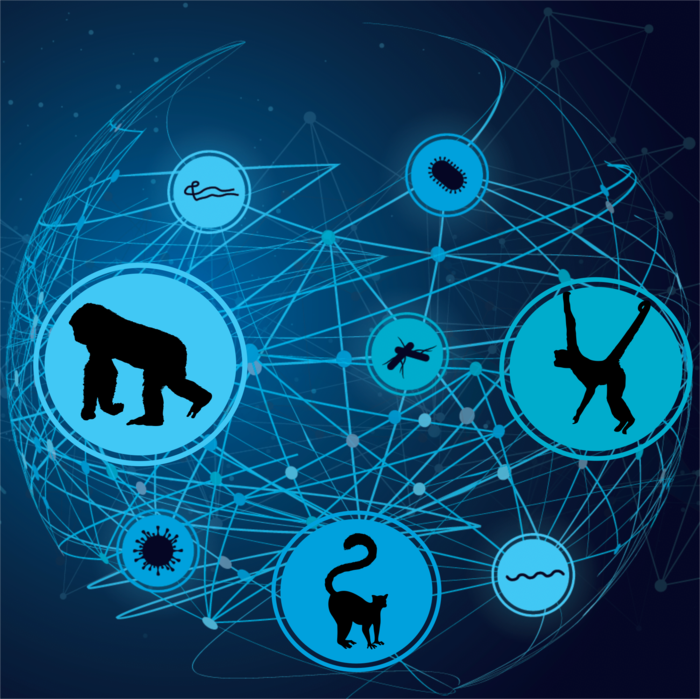
In their model, species are connected in complex webs of interactions involving 213 primates — monkeys, apes, lemurs and galagos — and 763 worms, mites, protists, and other parasites known to infect them. When one primate host disappears, the parasites connected to it can no longer depend on it for survival. Sever enough of these connections, and their loss sets off a deadly cascade where one extinction begets another.
It’s a bit like the classic kids’ game, KerPlunk, Herrera said. You have a clear tube filled with marbles, which are resting on top of a web of crisscrossing sticks. Removing one or two sticks — or in this case, primate hosts — from the network does little harm, because the marbles are still supported by the remaining sticks. But as the game goes on and fewer sticks remain, it gets harder to keep the marbles from crashing down.
Currently, 108 of the 213 primate species in their dataset are considered threatened by the IUCN. The team found that if all those species were to go kaput, an additional 250 parasites could be doomed as well, and that 176 of these parasite species have no other suitable hosts.
The extinction cascade will likely be worse in isolated places like the island of Madagascar, the study revealed. There, shrinking forests, illegal hunting and collection for the pet trade are pushing 95% of lemur species ever closer to the brink, and more than 60% of lemur parasites inhabit a single host.
For instance, at least two species of nematode worms depend on the aye-aye, a long-fingered, bushy-tailed lemur with beaver-like teeth. If the aye-aye dies out, so too will the worms it carries.
The researchers say they aren’t able to predict, from their analyses, how many of the parasites in their dataset could potentially avert extinction by jumping ship and adapting to new hosts that are more abundant. But some of the most notorious diseases in humans, such as malaria, AIDS caused by HIV and yellow fever, got their start in other primates before spilling over to people, for instance when we share a watering hole, or when we butcher them for meat.
“It’s not that hard to imagine,” Herrera said.
The study is part of a special issue of Philosophical Transactions B devoted to infectious disease macroecology.
This research was supported by grants from the National Institutes of Health (NIH R25HD079352), the National Science Foundation (DEB-0211908, EF-0723939/0904359, BCS-1355902) and Duke University.
CITATION: “Predictions of Primate–Parasite Coextinction,” James P. Herrera, James Moody and Charles L. Nunn. Philosophical Transactions B, Sept. 20, 2021. DOI: 10.1098/rstb.2020.0355
Journal
Philosophical Transactions of the Royal Society B Biological Sciences
DOI
10.1098/rstb.2020.0355
Method of Research
Computational simulation/modeling
Subject of Research
Animals
Article Title
Predictions of Primate–Parasite Coextinction
Article Publication Date
20-Sep-2021
COI Statement
This research was supported by grants from the National Institutes of Health (NIH R25HD079352), the National Science Foundation (DEB-0211908, EF-0723939/0904359, BCS-1355902) and Duke University.