BOSTON, MASS. (Sept. 15, 2021) – A new landmark study of over 300 sharks found that some species are extremely resilient to the stress of being caught and released in commercial longline fisheries while other species are much more likely to die.
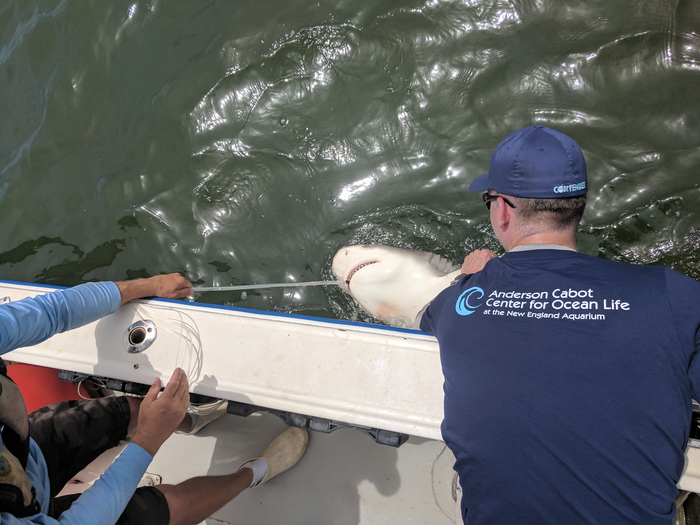
Credit: New England Aquarium
BOSTON, MASS. (Sept. 15, 2021) – A new landmark study of over 300 sharks found that some species are extremely resilient to the stress of being caught and released in commercial longline fisheries while other species are much more likely to die.
The five-year, multi-institutional collaborative study, led by the New England Aquarium and published in the scientific journal PLOS One, is notable for both its size and scope. “We set out to do what very few studies had done previously – put electronic tags on a large number of sharks and collect blood samples from the same animals that we tagged,” said Dr. Nick Whitney, Senior Scientist in the Aquarium’s Anderson Cabot Center for Ocean Life and lead author of the study. “We did this to get an idea of how well we could predict their fate based on stress indicators in their blood.”
The scientists placed tags called accelerometers, the same technology found in a Fitbit, on the fins of over 300 sharks from five different species to track their fine-scale movements and, most importantly, whether they lived or died after being caught on commercial longlines and released in the Gulf of Mexico and Florida Keys. The species included sandbar, blacktip, tiger, spinner, and bull sharks.
Although longline fishermen typically keep the sharks that they catch, some species must be released due to regulations. Such rules are only effective if the sharks actually survive after they are released, which is difficult to measure. “The assumption behind no-take regulations is that the shark will swim away and live out its normal life after it’s released, but we know that for some sharks, that’s not true,” said Whitney.
Some animals will die even after release due to stress or injuries sustained during the capture process. Findings of the study showed that for some shark species, like blacktip and spinner sharks, as many as 42 to 71 percent of sharks will die even after being released alive. Other sharks, like sandbar and tiger sharks, were much more resilient, with only 3 percent or less dying after release. This information is crucial to sustainably manage shark populations, as it shows that no-take regulations may be very effective for some species but less so for others.
“Sandbar sharks have been a prohibited species for most fisheries because they were found to be a severely overfished stock,” said Dr. Bob Hueter, co-author of the study, former Director of the Center for Shark Research at Mote Marine Laboratory, and Chief Scientist for OCEARCH. “Our data show that sandbar sharks generally survive catch-and-release in this fishery, so the rules requiring fishermen to release sandbar sharks have no doubt played an important role in this shark stock’s recovery.”
While many studies have measured blood stress values in captured sharks, and others have tagged sharks to tell whether they lived or died, very few previous studies had measured blood stress values in the same animals that they tagged, and none at this scale. A 2011 study led by Whitney used this same combination of techniques and found a very different result for blacktip sharks caught by recreational fishermen.
“We found around only 10 percent mortality in our previous study on blacktip sharks caught by rod and reel,” said Whitney. “In this latest study we found that 35 percent of blacktip sharks are dead by the time they’re caught and many more will die after release, producing total mortality of around 62 percent. This shows that bottom longlines are very hard on blacktip sharks, even when the live animals are returned to the water.”
Other institutions involved in the study were Newport Aquarium in Newport, Kentucky; Mote Marine Laboratory in Sarasota, Fla; as well as scientists from Murdoch University in Western Australia and the National Oceanic and Atmospheric Administration in Panama City, Fla.
A folder of photos and photo descriptions related to this study are available by clicking here.
###
Journal
PLoS ONE
DOI
10.1371/journal.pone.0255673
Method of Research
Observational study
Subject of Research
Animals
Article Title
Connecting post-release mortality to the physiological stress response of large coastal sharks in a commercial longline fishery
Article Publication Date
15-Sep-2021