• HOME
  • NEWS
  • EXPLORE
    • CAREER
      • Companies
      • Jobs
    • EVENTS
    • iGEM
      • News
      • Team
    • PHOTOS
    • VIDEO
    • WIKI
  • BLOG
  • COMMUNITY
    • FACEBOOK
    • INSTAGRAM
    • TWITTER
Sunday, June 28, 2026
BIOENGINEER.ORG
No Result
View All Result
  • Login
  • HOME
  • NEWS
  • EXPLORE
    • CAREER
      • Companies
      • Jobs
        • Lecturer
        • PhD Studentship
        • Postdoc
        • Research Assistant
    • EVENTS
    • iGEM
      • News
      • Team
    • PHOTOS
    • VIDEO
    • WIKI
  • BLOG
  • COMMUNITY
    • FACEBOOK
    • INSTAGRAM
    • TWITTER
  • HOME
  • NEWS
  • EXPLORE
    • CAREER
      • Companies
      • Jobs
        • Lecturer
        • PhD Studentship
        • Postdoc
        • Research Assistant
    • EVENTS
    • iGEM
      • News
      • Team
    • PHOTOS
    • VIDEO
    • WIKI
  • BLOG
  • COMMUNITY
    • FACEBOOK
    • INSTAGRAM
    • TWITTER
No Result
View All Result
Bioengineer.org
No Result
View All Result
Home NEWS Science News

Zero-dimensional molecular sieve membranes enhance gas separation selectivity

Bioengineer by Bioengineer
July 21, 2021
in Science News
Reading Time: 2 mins read
0
IMAGE
Share on FacebookShare on TwitterShare on LinkedinShare on RedditShare on Telegram

IMAGE

Credit: DICP

Classical molecular sieve membranes, with 3D microparticles and 2D nanosheets as primary building blocks, are promising in chemical separation.

Separation within such membranes relies on molecular movement and transport though their intrinsic or artificial nanopores. Since the weak connections by nature between the neighboring “bricks” usually result in intercrystalline gaps in membranes, the prevailing selectivity for classical molecular sieve membranes is moderate.

Recently, a research group led by Prof. YANG Weishen and Dr. BAN Yujie from the Dalian Institute of Chemical Physics (DICP) of the Chinese Academy of Sciences (CAS) proposed zero-dimensional molecular sieve membranes that could enhance the separation selectivity of hydrogen (H2) and carbon dioxide (CO2).

The study was published in Angewandte Chemie International Edition on July 16.

“Zero-dimensional molecules, as primary building blocks in the proposed membrane, have the potential to absolutely eliminate intercrystalline gaps in membranes,” said Dr. BAN.

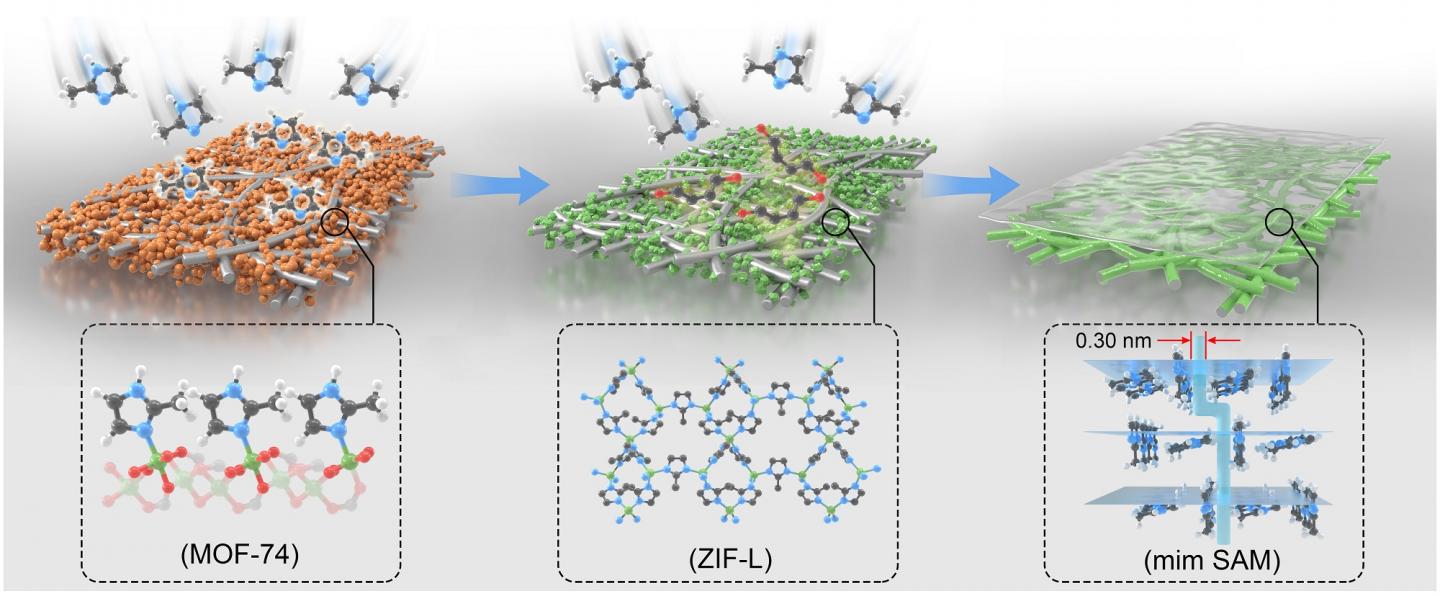
The researchers fabricated the zero-dimensional molecular sieve membrane by orderly assembling zero-dimensional 2-methylimidazole (mim) molecules into unprecedented supramolecule array membranes (SAMs) through solvent-free vapor processing on a metal-organic framework.

In SAMs, the “zero-dimensional building blocks” together with supramolecule interactions resulted in the absence of the intercrystalline gaps, which guaranteed an effective mass-transfer through intermolecular spacings instead of an undesirable leakage through non-selective gaps.

In contrast to the classical transport though nanopores of membranes, selective transport through the intermolecular spacing of mim (~0.30 nm) was realized within SAMs, yielding an extremely precise sieving of H2 from CO2. The H2/CO2 selectivity was one order of magnitude higher than selectivities of the state-of-the-art classical membranes.

“Our study opens the door to create a variety of SAMs to distinguish the subtle size/shape differences of a pair of gas molecules,” said Prof. YANG. “In the future, we will tailor the intermolecular spacing, control the assembly process, and enable a wide range of application of SAMs to energy-efficient chemical separation processes.”

###

The above work was supported by the National Natural Science Foundation of China and the Strategic Priority Research Program of CAS.

Media Contact
Jean Wang
[email protected]

Original Source

https://onlinelibrary.wiley.com/doi/10.1002/anie.202108185

Related Journal Article

http://dx.doi.org/10.1002/anie.202108185

Tags: Biomedical/Environmental/Chemical EngineeringIndustrial Engineering/ChemistryTechnology/Engineering/Computer Science
Share13Tweet8Share2ShareShareShare2

Related Posts

Tracking Lanthanide-Labeled Microplastics in Plants

June 25, 2026

POSTECH Researchers Slash Cost of Reconstituted Cell-Free Systems by 95%

June 25, 2026

AI and Physics Collaborate to Design Advanced Hydrogen Storage Materials

June 25, 2026

Natural Hallucinogens: Evolution’s Ecological Tools, Not Mere Chemical Byproducts

June 25, 2026
Please login to join discussion

POPULAR NEWS

  • Saying Goodbye to PGY-6: Pediatric Fellowship Realities

    103 shares
    Share 41 Tweet 26
  • Multi-Hospital Study Reveals Long Covid Burden Is Twice as High as Current Estimates

    92 shares
    Share 36 Tweet 23
  • Detection of EDCs in Breast Milk and Infant Urine Up to Six Months Highlights Early Exposure Risks

    77 shares
    Share 31 Tweet 19
  • New Drug Candidate Developed at McMaster Shows Potential for Treating Brain Cancer

    58 shares
    Share 23 Tweet 15

About

We bring you the latest biotechnology news from best research centers and universities around the world. Check our website.

Follow us

Recent News

Tracking Lanthanide-Labeled Microplastics in Plants

POSTECH Researchers Slash Cost of Reconstituted Cell-Free Systems by 95%

AI and Physics Collaborate to Design Advanced Hydrogen Storage Materials

Subscribe to Blog via Email

Success! An email was just sent to confirm your subscription. Please find the email now and click 'Confirm' to start subscribing.

Join 82 other subscribers
  • Contact Us

Bioengineer.org © Copyright 2023 All Rights Reserved.

Welcome Back!

Login to your account below

Forgotten Password?

Retrieve your password

Please enter your username or email address to reset your password.

Log In
No Result
View All Result
  • Homepages
    • Home Page 1
    • Home Page 2
  • News
  • National
  • Business
  • Health
  • Lifestyle
  • Science

Bioengineer.org © Copyright 2023 All Rights Reserved.