• HOME
  • NEWS
  • EXPLORE
    • CAREER
      • Companies
      • Jobs
    • EVENTS
    • iGEM
      • News
      • Team
    • PHOTOS
    • VIDEO
    • WIKI
  • BLOG
  • COMMUNITY
    • FACEBOOK
    • INSTAGRAM
    • TWITTER
Saturday, February 7, 2026
BIOENGINEER.ORG
No Result
View All Result
  • Login
  • HOME
  • NEWS
  • EXPLORE
    • CAREER
      • Companies
      • Jobs
        • Lecturer
        • PhD Studentship
        • Postdoc
        • Research Assistant
    • EVENTS
    • iGEM
      • News
      • Team
    • PHOTOS
    • VIDEO
    • WIKI
  • BLOG
  • COMMUNITY
    • FACEBOOK
    • INSTAGRAM
    • TWITTER
  • HOME
  • NEWS
  • EXPLORE
    • CAREER
      • Companies
      • Jobs
        • Lecturer
        • PhD Studentship
        • Postdoc
        • Research Assistant
    • EVENTS
    • iGEM
      • News
      • Team
    • PHOTOS
    • VIDEO
    • WIKI
  • BLOG
  • COMMUNITY
    • FACEBOOK
    • INSTAGRAM
    • TWITTER
No Result
View All Result
Bioengineer.org
No Result
View All Result
Home NEWS Science News Chemistry

Supermassive black holes put a brake on stellar births

Bioengineer by Bioengineer
July 20, 2021
in Chemistry
Reading Time: 2 mins read
0
IMAGE
Share on FacebookShare on TwitterShare on LinkedinShare on RedditShare on Telegram

IMAGE

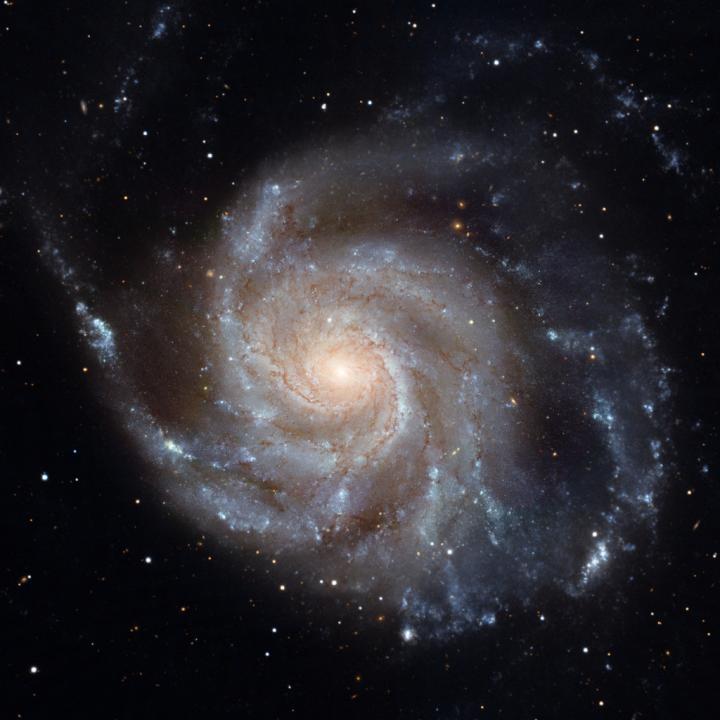
Credit: NASA, ESA, K. Kuntz (JHU), F. Bresolin (University of Hawaii), J. Trauger (Jet Propulsion Lab), J. Mould (NOAO), Y.-H. Chu (University of Illinois, Urbana), and STScI

Black holes with masses equivalent to millions of suns do put a brake on the birth of new stars, say astronomers. Using machine learning and three state of the art simulations to back up results from a large sky survey, the researchers resolve a 20-year long debate on the formation of stars. Joanna Piotrowska, a PhD student at the University of Cambridge, will present the new work today (Tuesday 20 July) at the virtual National Astronomy Meeting (NAM 2021).

Star formation in galaxies has long been a focal point of astronomy research. Decades of successful observations and theoretical modelling resulted in our good understanding of how gas collapses to form new stars both in and beyond our own Milky Way. However, thanks to all-sky observing programmes like the Sloan Digital Sky Survey (SDSS), astronomers realised that not all galaxies in the local Universe are actively star-forming – there exists an abundant population of “quiescent” objects which form stars at significantly lower rates.

The question of what stops star formation in galaxies remains the biggest unknown in our understanding of galaxy evolution, debated over the past 20 years. Piotrowska and her team set up an experiment to find out what might be responsible.

Using three state-of-the-art cosmological simulations – EAGLE, Illustris and IllustrisTNG – the astronomers investigated what we would expect to see in the real Universe as observed by the SDSS, when different physical processes were halting star formation in massive galaxies.

The astronomers applied a machine learning algorithm to classify galaxies into star-forming and quiescent, asking which of three parameters: the mass of the supermassive black holes found at the centre of galaxies (these monster objects have typically millions or even billions of times the mass of our Sun), the total mass of stars in the galaxy, or the mass of the dark matter halo around galaxies, best predicts how galaxies turn out.

These parameters then enabled the team to work out which physical process: energy injection by supermassive black holes, supernova explosions or shock heating of gas in massive halos is responsible for forcing galaxies into semi-retirement.

The new simulations predict the supermassive black hole mass as the most important factor in putting the brakes on star formation. Crucially, the simulation results match observations of the local Universe, adding weight to the researchers’ findings.

Piotrowska says: “It’s really exciting to see how the simulations predict exactly what we see in the real Universe. Supermassive black holes – objects with masses equivalent to millions or even billions of Suns – really do have a big effect on their surroundings. These monster objects force their host galaxies into a kind of semi-retirement from star formation.”

###

Media Contact
Robert Massey
[email protected]
Tags: AstronomyAstrophysicsSpace/Planetary ScienceStars/The Sun
Share13Tweet8Share2ShareShareShare2

Related Posts

blank

Breakthrough in Environmental Cleanup: Scientists Develop Solar-Activated Biochar for Faster Remediation

February 7, 2026
blank

Cutting Costs: Making Hydrogen Fuel Cells More Affordable

February 6, 2026

Scientists Develop Hand-Held “Levitating” Time Crystals

February 6, 2026

Observing a Key Green-Energy Catalyst Dissolve Atom by Atom

February 6, 2026
Please login to join discussion

POPULAR NEWS

  • Robotic Ureteral Reconstruction: A Novel Approach

    Robotic Ureteral Reconstruction: A Novel Approach

    82 shares
    Share 33 Tweet 21
  • Digital Privacy: Health Data Control in Incarceration

    63 shares
    Share 25 Tweet 16
  • Study Reveals Lipid Accumulation in ME/CFS Cells

    57 shares
    Share 23 Tweet 14
  • Breakthrough in RNA Research Accelerates Medical Innovations Timeline

    53 shares
    Share 21 Tweet 13

About

We bring you the latest biotechnology news from best research centers and universities around the world. Check our website.

Follow us

Recent News

Evaluating Pediatric Emergency Care Quality in Ethiopia

TPMT Expression Predictions Linked to Azathioprine Side Effects

Improving Dementia Care with Enhanced Activity Kits

Subscribe to Blog via Email

Success! An email was just sent to confirm your subscription. Please find the email now and click 'Confirm' to start subscribing.

Join 73 other subscribers
  • Contact Us

Bioengineer.org © Copyright 2023 All Rights Reserved.

Welcome Back!

Login to your account below

Forgotten Password?

Retrieve your password

Please enter your username or email address to reset your password.

Log In
No Result
View All Result
  • Homepages
    • Home Page 1
    • Home Page 2
  • News
  • National
  • Business
  • Health
  • Lifestyle
  • Science

Bioengineer.org © Copyright 2023 All Rights Reserved.