• HOME
  • NEWS
  • EXPLORE
    • CAREER
      • Companies
      • Jobs
    • EVENTS
    • iGEM
      • News
      • Team
    • PHOTOS
    • VIDEO
    • WIKI
  • BLOG
  • COMMUNITY
    • FACEBOOK
    • INSTAGRAM
    • TWITTER
Monday, December 8, 2025
BIOENGINEER.ORG
No Result
View All Result
  • Login
  • HOME
  • NEWS
  • EXPLORE
    • CAREER
      • Companies
      • Jobs
        • Lecturer
        • PhD Studentship
        • Postdoc
        • Research Assistant
    • EVENTS
    • iGEM
      • News
      • Team
    • PHOTOS
    • VIDEO
    • WIKI
  • BLOG
  • COMMUNITY
    • FACEBOOK
    • INSTAGRAM
    • TWITTER
  • HOME
  • NEWS
  • EXPLORE
    • CAREER
      • Companies
      • Jobs
        • Lecturer
        • PhD Studentship
        • Postdoc
        • Research Assistant
    • EVENTS
    • iGEM
      • News
      • Team
    • PHOTOS
    • VIDEO
    • WIKI
  • BLOG
  • COMMUNITY
    • FACEBOOK
    • INSTAGRAM
    • TWITTER
No Result
View All Result
Bioengineer.org
No Result
View All Result
Home NEWS Science News Chemistry

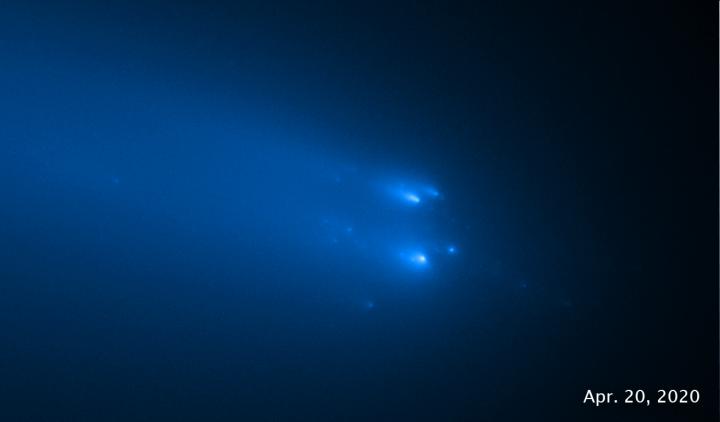
Tail without a comet: the dusty remains of Comet ATLAS

Bioengineer by Bioengineer
July 19, 2021
in Chemistry
Reading Time: 2 mins read
0
IMAGE
Share on FacebookShare on TwitterShare on LinkedinShare on RedditShare on Telegram

IMAGE

Credit: NASA / ESA / STScI / D. Jewitt (UCLA)

A serendipitous flythrough of the tail of a disintegrated comet has offered scientists a unique opportunity to study these remarkable structures, in new research presented today at the National Astronomy Meeting 2021.

Comet ATLAS fragmented just before its closest approach to the Sun last year, leaving its former tail trailing through space in the form of wispy clouds of dust and charged particles. The disintegration was observed by the Hubble Space Telescope in April 2020, but more recently the ESA spacecraft Solar Orbiter has flown close to the tail remnants in the course of its ongoing mission.

This lucky encounter has presented researchers with a unique opportunity to investigate the structure of an isolated cometary tail. Using combined measurements from all of Solar Orbiter’s in-situ instruments, the scientists have reconstructed the encounter with ATLAS’s tail. The resulting model indicates that the ambient interplanetary magnetic field carried by the solar wind ‘drapes’ around the comet, and surrounds a central tail region with a weaker magnetic field.

Comets are typically characterized by two separate tails; one is the well-known bright and curved dust tail, the other – typically fainter – is the ion tail. The ion tail originates from the interaction between the cometary gas and the surrounding solar wind, the hot gas of charged particles that constantly blows from the Sun and permeates the whole Solar System.

When the solar wind interacts with a solid obstacle, like a comet, its magnetic field is thought to bend and ‘drape’ around it. The simultaneous presence of magnetic field draping and cometary ions released by the melting of the icy nucleus then produces the characteristic second ion tail, which can extend for large distances downstream from the comet’s nucleus.

Lorenzo Matteini, a solar physicist at Imperial College London and leader of the work, says: “This is quite a unique event, and an exciting opportunity for us to study the makeup and structure of comet tails in unprecedented detail. Hopefully with the Parker Solar Probe and Solar Orbiter now orbiting the Sun closer than ever before, these events may become much more common in future!”

This is the first comet tail detection occurring so close to the Sun – well inside the orbit of Venus. It is also one of the very few cases where scientists have been able to make direct measurements from a fragmented comet. Data from this encounter is expected to contribute greatly to our understanding of the interaction of comets with the solar wind and the structure and formation of their ion tails.

###

Media Contact
Robert Massey
[email protected]

Tags: AstronomyAstrophysicsComets/AsteroidsSpace/Planetary Science
Share13Tweet8Share2ShareShareShare2

Related Posts

blank

Iridium Catalysis Enables Piperidine Synthesis from Pyridines

December 3, 2025
Neighboring Groups Speed Up Polymer Self-Deconstruction

Neighboring Groups Speed Up Polymer Self-Deconstruction

November 28, 2025

Activating Alcohols as Sulfonium Salts for Photocatalysis

November 26, 2025

Carbonate Ions Drive Water Ordering in COâ‚‚ Reduction

November 25, 2025
Please login to join discussion

POPULAR NEWS

  • New Research Unveils the Pathway for CEOs to Achieve Social Media Stardom

    New Research Unveils the Pathway for CEOs to Achieve Social Media Stardom

    204 shares
    Share 82 Tweet 51
  • Scientists Uncover Chameleon’s Telephone-Cord-Like Optic Nerves, A Feature Missed by Aristotle and Newton

    121 shares
    Share 48 Tweet 30
  • Neurological Impacts of COVID and MIS-C in Children

    107 shares
    Share 43 Tweet 27
  • MoCK2 Kinase Shapes Mitochondrial Dynamics in Rice Fungal Pathogen

    70 shares
    Share 28 Tweet 18

About

We bring you the latest biotechnology news from best research centers and universities around the world. Check our website.

Follow us

Recent News

Boosting Cancer Immunotherapy by Targeting DNA Repair

Evaluating eGFR Equations in Chinese Children

Metformin-Alogliptin Combo vs. Monotherapy in Diabetes

Subscribe to Blog via Email

Success! An email was just sent to confirm your subscription. Please find the email now and click 'Confirm' to start subscribing.

Join 69 other subscribers
  • Contact Us

Bioengineer.org © Copyright 2023 All Rights Reserved.

Welcome Back!

Login to your account below

Forgotten Password?

Retrieve your password

Please enter your username or email address to reset your password.

Log In
No Result
View All Result
  • Homepages
    • Home Page 1
    • Home Page 2
  • News
  • National
  • Business
  • Health
  • Lifestyle
  • Science

Bioengineer.org © Copyright 2023 All Rights Reserved.