• HOME
  • NEWS
  • EXPLORE
    • CAREER
      • Companies
      • Jobs
    • EVENTS
    • iGEM
      • News
      • Team
    • PHOTOS
    • VIDEO
    • WIKI
  • BLOG
  • COMMUNITY
    • FACEBOOK
    • INSTAGRAM
    • TWITTER
Wednesday, September 23, 2026
BIOENGINEER.ORG
No Result
View All Result
  • Login
  • HOME
  • NEWS
  • EXPLORE
    • CAREER
      • Companies
      • Jobs
        • Lecturer
        • PhD Studentship
        • Postdoc
        • Research Assistant
    • EVENTS
    • iGEM
      • News
      • Team
    • PHOTOS
    • VIDEO
    • WIKI
  • BLOG
  • COMMUNITY
    • FACEBOOK
    • INSTAGRAM
    • TWITTER
  • HOME
  • NEWS
  • EXPLORE
    • CAREER
      • Companies
      • Jobs
        • Lecturer
        • PhD Studentship
        • Postdoc
        • Research Assistant
    • EVENTS
    • iGEM
      • News
      • Team
    • PHOTOS
    • VIDEO
    • WIKI
  • BLOG
  • COMMUNITY
    • FACEBOOK
    • INSTAGRAM
    • TWITTER
No Result
View All Result
Bioengineer.org
No Result
View All Result
Home NEWS Science News Health

Limiting incident NA for efficient wavefront shaping through thin anisotropic scattering media

Bioengineer by Bioengineer
July 14, 2021
in Health
Reading Time: 2 mins read
0
IMAGE
Share on FacebookShare on TwitterShare on LinkedinShare on RedditShare on Telegram

IMAGE

Credit: UNIST

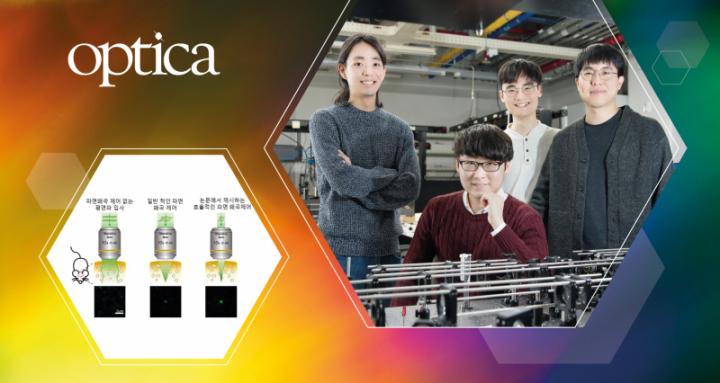
A team of researchers, affiliated with UNIST has succeeded in developing a new optical microscope technology, capable of deeper imaging beyond the biological tissues. This breakthrough has been led by Professor Jung-Hoon Park and his research team in the Department of Biomedical Engineering at UNIST.

Optical imaging technology has emerged as an essential research tool for biomedical studies due to its high resolution and good tomography capability. However, the limited penetration depth of the optical microscope makes it difficult to observe biological tissues of more than 100 μm thickness. This is because strong light scattering, caused by various components of biological tissues, notably lipids and proteins, makes the subject out of focus, which then causes image blurring.

In this study, the research team showed that for wavefront shaping in thin anisotropic scattering media, such as biological tissues, they can optimize the wavefront shaping quality by simply limiting the numerical aperture (NA) of the incident wavefront.

In addition, using the same number of controlled modes, and therefore the same wavefront measurement time, the research team demonstrated that the wavefront shaped focus peak to background ratio can be increased by a factor of 2.1 while the energy delivery throughput can be increased by a factor of 8.9 through 710 μm thick brain tissue by just limiting the incident NA.

The research team anticipates that the new approach can open new avenues in a variety of biomedical applications where energy delivery enhancement or high-resolution imaging/photostimulation is required in a limited decorrelation time window or in light-starved environments.

###

Their findings have been published in the April 2021 edition of Optica, an open-access journal that focuses on the rapid dissemination of high-impact results in all areas of optics and photonics. This study has been jointly carried out by Byungjae Hwang and Sangwon Lee in the Department of Biomedical Engineering at UNIST. It has also been carried out with the support of the National Research Foundation of Korea (NRF) and the TJ Park Foundation.

Journal Reference

Hyungwon Jin, Byungjae Hwang, Sangwon Lee, and Jung-Hoon Park, “Limiting the incident NA for efficient wavefront shaping through thin anisotropic scattering media,” Optica, (2021).

Media Contact
JooHyeon Heo
[email protected]

Original Source

http://news.unist.ac.kr/limiting-incident-na-for-efficient-wavefront-shaping-through-thin-anisotropic-scattering-media/

Tags: DiagnosticsMedicine/Health
Share13Tweet8Share2ShareShareShare2

Related Posts

Soft Robotic Sleeves Could Restore Bladder Control and End Catheter Dependence

September 23, 2026

How Daily Environmental Swings Shape the Brain: Inside the Day2Day Environment Study

September 23, 2026

School Program Boosts Sun-Safety Habits in High-Altitude Andean Teens

September 23, 2026

Swinging Blood Pressure May Silently Fuel Deadly Aneurysms, Giant Study Finds

September 23, 2026
Please login to join discussion

POPULAR NEWS

  • When Microbial Worlds Collide: Legacy and Constraints Shape the Rhizosphere

    29 shares
    Share 12 Tweet 7
  • Soft Robotic Sleeves Could Restore Bladder Control and End Catheter Dependence

    29 shares
    Share 12 Tweet 7
  • Mimicking Cell Membranes With Tiny Polymers to Regrow Blood Vessels

    29 shares
    Share 12 Tweet 7
  • How Daily Environmental Swings Shape the Brain: Inside the Day2Day Environment Study

    29 shares
    Share 12 Tweet 7

About

We bring you the latest biotechnology news from best research centers and universities around the world. Check our website.

Follow us

Recent News

When Microbial Worlds Collide: Legacy and Constraints Shape the Rhizosphere

Soft Robotic Sleeves Could Restore Bladder Control and End Catheter Dependence

Mimicking Cell Membranes With Tiny Polymers to Regrow Blood Vessels

Subscribe to Blog via Email

Enter your email address to subscribe to this blog and receive notifications of new posts by email.

Join 85 other subscribers
  • Contact Us

Bioengineer.org © Copyright 2023 All Rights Reserved.

Welcome Back!

Login to your account below

Forgotten Password?

Retrieve your password

Please enter your username or email address to reset your password.

Log In
No Result
View All Result
  • Homepages
    • Home Page 1
    • Home Page 2
  • News
  • National
  • Business
  • Health
  • Lifestyle
  • Science

Bioengineer.org © Copyright 2023 All Rights Reserved.