Scientists reveal the exact process behind the upkeep of one of the cellular components where
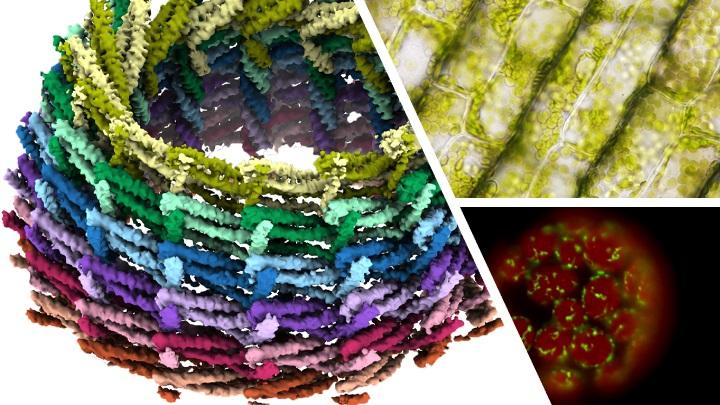
Credit: VIPP1 oligomer image from Ben Engel and this study in CellOther images from Wataru Sakamoto(Okayama University)
“All living beings, including us, depend on photosynthesis,” says Prof. Wataru Sakamoto of the Institute of Plant Science and Resources at Okayama University, Japan, as he begins to explain the core concepts behind a recent breakthrough in understanding plant physiology, which he was involved in. “Photosynthesis produces the energy needed to sustain plants and the oxygen we breathe. This reaction occurs in two steps, the first of which involves capturing light energy
and producing oxygen. This step takes place in a cell organelle in the plant cells called the chloroplast: specifically, in the membranes of one of its components, the thylakoid. The thylakoid membrane is unique to oxygen?producing organisms like plants and cyanobacteria,
and its role has been known for over 200 years. Yet, even today in the technology age, the precise mechanisms that that shape this structure are unknown to us.”
Now, Prof. Sakamoto and an international team of scientists have answered part of this question by focusing on a membrane remodeling protein, called VIPP1, which has been found to be involved in maintaining the integrity of the thylakoid membrane. Using high resolution imaging via cryo?electron microscopy, they’ve elucidated the mechanism by which this protein protects thylakoid membrane integrity. Their findings are published in the journal Cell.
Speaking of his motivation for being part of this study, Prof. Sakamoto says, “Chloroplasts in land plants are thought to have been derived from the endosymbiosis of cyanobacteria in plants 1.5 billion years ago. I was very fascinated by this during my college years and decided to study such organelles containing multiple membranes and their own DNA, like mitochondria and chloroplasts. In my laboratory, I have been working on VIPP1 since 2006, and have reported several of its important characteristics.”
In this study, what the scientists observed was remarkable. Three VIPP1 monomers ‘flex and interweave’ in a specific formation to create a nucleotide binding pocket. Nucleotide binding to specific layers of such interwoven monomers cause layer stacking that results in basketlike structures of different symmetries. A part of the monomer is an amphiphilic–structure containing both water?attracting and water?repelling portions–helix. Within the basket
structure, these helices are oriented such that their hydrophilic (water?attracting) portions face the outside of the basket and their hydrophobic (water?repelling) portions face the inside of the basket. The hydrophobic portions are also lipid (fat) attracting. Thylakoid membranes, like most cell membranes, are lipid membranes. The hydrophobic interior of the basket structure binds to the membrane and remodels it by increasing its curvature.
In their experiments, when the scientists added mutations to prevent the hydrophobic surfaces from forming, stress on the membrane from high intensity light caused the thylakoid membrane to swell up and get damaged. This damage did not occur in membranes which had access to VIPP1 oligomers with hydrophobic surfaces.
Dr. Sakamoto explains the importance of these results in the field of research: “Our study reports that the membrane?remodeling protein VIPP1 plays a critical role in maintaining thylakoid membranes. This protein appears to share a common structure with ESCRT?III, which
is important in membrane remodeling in humans and yeast, indicating that the mechanism at play here is a common mechanism regulating membrane integrity.” Further referring to more tangible potential practical applications, he says: “Thylakoid is key to photosynthesis. Understanding its structure in detail can help crop production and thus food security. For instance, improving thylakoid membrane longevity can improve crop productivity.” And of course, all things considered, this finding resolves a long?standing mystery in the biology underlying photosynthesis.
###
Media Contact
Wataru Sakamoto
[email protected]
Related Journal Article
http://dx.