The story of the Warli and the Waghoba
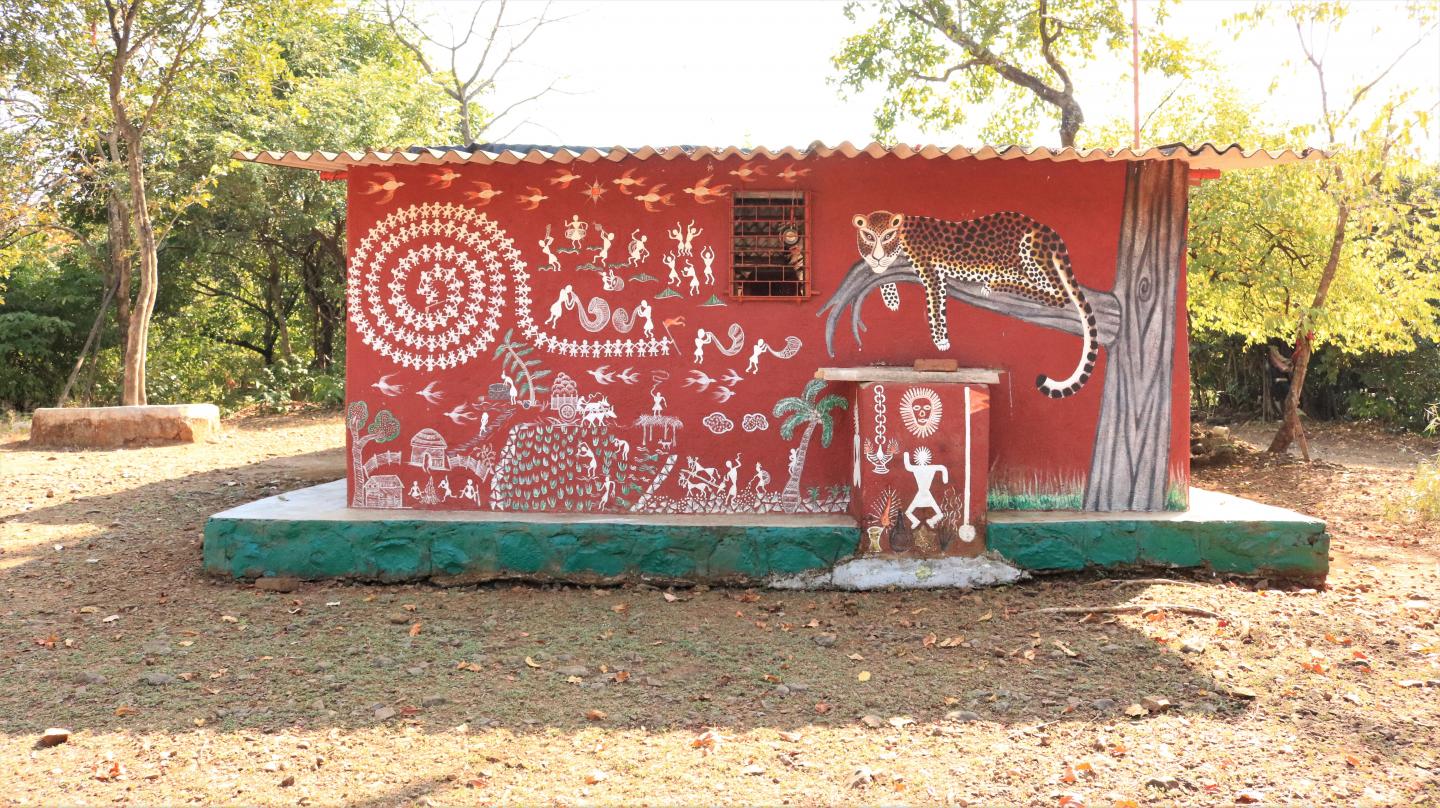
Credit: Ramya Nair
BENGALURU, India (July 8, 2021) – A new study led by WCS-India documents how a big cat deity worshipped by Indigenous Peoples facilitates coexistence between humans and leopards.
The study, published in a special issue of the journal Frontiers in Conservation Science: Human-Wildlife Dynamics called Understanding Coexistence with Wildlife documents how the Indigenous Warli people of Maharashtra, India, worship Waghoba, a leopard/tiger deity to gain protection from leopards, and how they have lived side-by-side with them for centuries (formerly tigers, too). The researchers have identified over 150 shrines dedicated to worshipping Waghoba. The researchers note that while there are still negative interactions with leopards such as livestock depredation, they are likely to be more accepted under the institution of Waghoba.
Warlis believe in a reciprocal relationship, where Waghoba will protect them from the negative impacts of sharing spaces with big cats if the people worship the deity and conduct the required rituals, especially at the annual festival of Waghbaras.
Researchers suggest that such relationships facilitate the sharing of spaces between humans and leopards that live in the landscape. In addition, the study addresses the ways in which the range of institutions and stakeholders in the landscape shape the institution of Waghoba and thereby contribute to the human-leopard relationship in the landscape.
Said the study’s lead author Ramya Nair of WCS India: “The main aim of the study is to diversify the way we understand and approach human-wildlife interactions. It does so by shedding light on how local institutions that contribute to co-existence are not devoid of conflict, but have a role in negotiating the conflicts that arise.”
Locally produced systems that address issues surrounding human-wildlife interactions may exist in several other cultures and landscapes. The authors note that while conservation interventions have shown a movement toward the inclusion and participation of local communities, we have to recognize that landscapes have a history before our own point of entry into them. This is relevant for present-day wildlife conservation because such traditional institutions are likely to act as tolerance-building mechanisms embedded within the local belief system. Further, it is vital that the dominant stakeholders outside of the Warli community (such as the Forest Department, conservation biologists, and other non-Warli residents who interact with leopards) are informed about and sensitive to these cultural representations because it is not just the biological animal that the Warlis predominantly deal with.
The study was conducted by researchers from WCS-India, NINA, Norway, Inland Norway University of Applied Sciences, Norway and supported by Wildlife Conservation Trust. Fieldwork was conducted across Mumbai Suburban, Palghar and Thane districts of Maharashtra in 2018-19. An ethnographic approach was taken to collect data wherein researchers conducted semi-structured interviews and conducted participant observation (particularly attending worship ceremonies) concurrent to documenting Waghoba shrines. Questions were asked to explore narratives on the role of Waghoba in the lives of the Warli, the history of Waghoba worship, associated festivals, rituals and traditions, and the ties between Waghoba and human-leopard interactions.
###
WCS (Wildlife Conservation Society)
MISSION: WCS saves wildlife and wild places worldwide through science, conservation action, education, and inspiring people to value nature. To achieve our mission, WCS, based at the Bronx Zoo, harnesses the power of its Global Conservation Program in nearly 60 nations and in all the world’s oceans and its five wildlife parks in New York City, visited by 4 million people annually. WCS combines its expertise in the field, zoos, and aquarium to achieve its conservation mission. Visit: newsroom.wcs.org Follow: @WCSNewsroom. For more information: 347-840-1242.
Media Contact
Stephen Sautner
[email protected]
Original Source
https:/
Related Journal Article
http://dx.