• HOME
  • NEWS
  • EXPLORE
    • CAREER
      • Companies
      • Jobs
    • EVENTS
    • iGEM
      • News
      • Team
    • PHOTOS
    • VIDEO
    • WIKI
  • BLOG
  • COMMUNITY
    • FACEBOOK
    • INSTAGRAM
    • TWITTER
Monday, April 13, 2026
BIOENGINEER.ORG
No Result
View All Result
  • Login
  • HOME
  • NEWS
  • EXPLORE
    • CAREER
      • Companies
      • Jobs
        • Lecturer
        • PhD Studentship
        • Postdoc
        • Research Assistant
    • EVENTS
    • iGEM
      • News
      • Team
    • PHOTOS
    • VIDEO
    • WIKI
  • BLOG
  • COMMUNITY
    • FACEBOOK
    • INSTAGRAM
    • TWITTER
  • HOME
  • NEWS
  • EXPLORE
    • CAREER
      • Companies
      • Jobs
        • Lecturer
        • PhD Studentship
        • Postdoc
        • Research Assistant
    • EVENTS
    • iGEM
      • News
      • Team
    • PHOTOS
    • VIDEO
    • WIKI
  • BLOG
  • COMMUNITY
    • FACEBOOK
    • INSTAGRAM
    • TWITTER
No Result
View All Result
Bioengineer.org
No Result
View All Result
Home NEWS Science News

NASA sees wind shear’s effects on Tropical Cyclone Yvette

Bioengineer by Bioengineer
December 23, 2016
in Science News
Reading Time: 1 min read
0
Share on FacebookShare on TwitterShare on LinkedinShare on RedditShare on Telegram
IMAGE

Credit: Credits: NASA Goddard MODIS Rapid Response Team

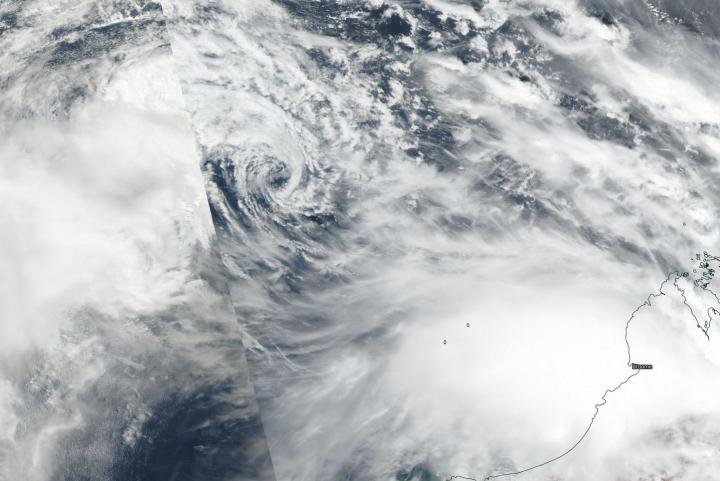
Tropical Storm Yvette was being battered by vertical wind shear when NASA-NOAA's Suomi NPP satellite passed over the Southern Indian Ocean.

On Dec. 23 the Visible Infrared Imaging Radiometer Suite (VIIRS) instrument aboard NASA-NOAA's Suomi NPP satellite provided a visible-light image of Tropical Cyclone Yvette that showed the bulk of clouds and thunderstorms were being pushed north and west of the center from vertical wind shear. The Joint Typhoon Warning Center noted that satellite imagery showed a fully-exposed, well-defined low-level circulation center displaced east of isolated, flaring convection and developing thunderstorms.

On Dec. 23 at 4 a.m. EST (0900 GMT) Yvette's maximum sustained winds had decreased to 40 mph (35 knots/64.2 kph). It was centered near 14.7 degrees south latitude and 116.2 degrees east longitude, about 365 nautical miles northwest of Port Hedland, Australia. Yvette was moving east-southeast at 10.3 mph (9 knots/16.6 kph).

For forecast updates from Australia's Bureau of Meteorology, visit: http://www.bom.gov.au/cyclone/index.shtml.

The storm will accelerate and make landfall on Christmas Day (GMT) south of Broome, Western Australia.

###

Media Contact

Rob Gutro
[email protected]
@NASAGoddard

http://www.nasa.gov/goddard

############

Story Source: Materials provided by Scienmag

Share12Tweet8Share2ShareShareShare2

Related Posts

Advancements in Large Language Models Boost Clinical Reasoning Performance

Advancements in Large Language Models Boost Clinical Reasoning Performance

April 13, 2026
One-Step Creation of SH2ISU1 Sweet Maize Using CRISPR/Cas9 Cytosine Base Editing

One-Step Creation of SH2ISU1 Sweet Maize Using CRISPR/Cas9 Cytosine Base Editing

April 13, 2026

New Collaboration Expands Scope of Pennington Generation Study

April 13, 2026

Breakthroughs in Precise Nanoscale Engineering of g-C₃N₄ Catalysts

April 13, 2026
Please login to join discussion

POPULAR NEWS

  • Scientists Investigate Possible Connection Between COVID-19 and Increased Lung Cancer Risk

    59 shares
    Share 24 Tweet 15
  • Boosting Breast Cancer Risk Prediction with Genetics

    47 shares
    Share 19 Tweet 12
  • Popular Anti-Aging Compound Linked to Damage in Corpus Callosum, Study Finds

    45 shares
    Share 18 Tweet 11
  • Imagine a Social Media Feed That Challenges Your Views Instead of Reinforcing Them

    1012 shares
    Share 400 Tweet 250

About

We bring you the latest biotechnology news from best research centers and universities around the world. Check our website.

Follow us

Recent News

Advancements in Large Language Models Boost Clinical Reasoning Performance

One-Step Creation of SH2ISU1 Sweet Maize Using CRISPR/Cas9 Cytosine Base Editing

New Collaboration Expands Scope of Pennington Generation Study

Subscribe to Blog via Email

Enter your email address to subscribe to this blog and receive notifications of new posts by email.

Join 79 other subscribers
  • Contact Us

Bioengineer.org © Copyright 2023 All Rights Reserved.

Welcome Back!

Login to your account below

Forgotten Password?

Retrieve your password

Please enter your username or email address to reset your password.

Log In
No Result
View All Result
  • Homepages
    • Home Page 1
    • Home Page 2
  • News
  • National
  • Business
  • Health
  • Lifestyle
  • Science

Bioengineer.org © Copyright 2023 All Rights Reserved.