Motions of a remarkable cosmic structure have been measured for the first time, using NASA’s Chandra X-ray Observatory. The blast wave and debris from an exploded star are seen moving away from the explosion site and colliding with a wall of surrounding gas.
Astronomers estimate that light from the supernova explosion reached Earth about 1,700 years ago, or when the Mayan empire was flourishing and the Jin dynasty ruled China. However, by cosmic standards the supernova remnant formed by the explosion, called MSH 15-52, is one of the youngest in the Milky Way galaxy. The explosion also created an ultra-dense, magnetized star called a pulsar, which then blew a bubble of energetic particles, an X-ray-emitting nebula.
Since the explosion the supernova remnant – made of debris from the shattered star, plus the explosion’s blast wave – and the X-ray nebula have been changing as they expand outward into space. Notably, the supernova remnant and X-ray nebula now resemble the shape of fingers and a palm.
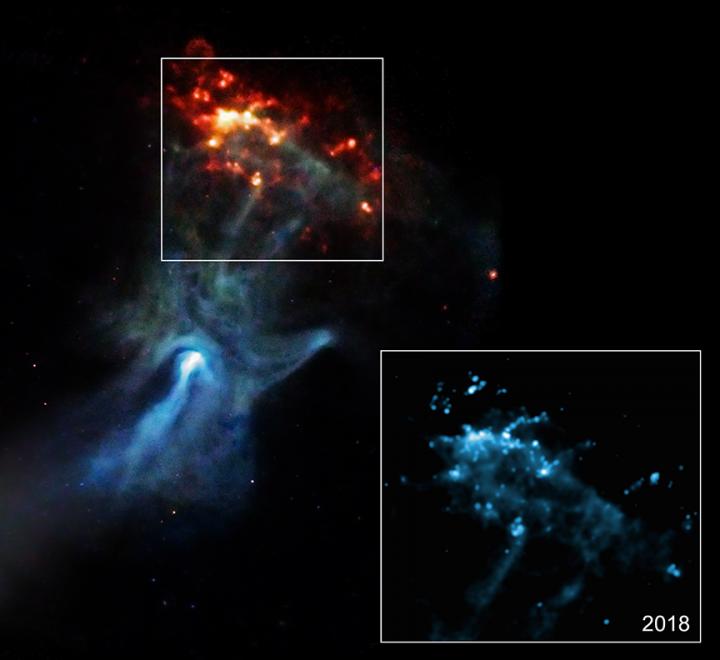
Previously, astronomers had released a full Chandra view of the “hand,” as shown in the main graphic. A new study is now reporting how quickly the supernova remnant associated with the hand is moving, as it strikes a cloud of gas called RCW 89. The inner edge of this cloud forms a gas wall located about 35 light-years from the center of the explosion.
To track the motion the team used Chandra data from 2004, 2008, and then a combined image from observations taken in late 2017 and early 2018. These three epochs are shown in the inset of the main graphic.
The rectangle (fixed in space) highlights the motion of the explosion’s blast wave, which is located near one of the fingertips. This feature is moving at almost 9 million miles per hour. The fixed squares enclose clumps of magnesium and neon that likely formed in the star before it exploded and shot into space once the star blew up. Some of this explosion debris is moving at even faster speeds of more than 11 million miles per hour. A color version of the 2018 image shows the fingers in blue and green and the clumps of magnesium and neon in red and yellow.
While these are startling high speeds, they actually represent a slowing down of the remnant. Researchers estimate that to reach the farthest edge of RCW 89, material would have to travel on average at almost 30 million miles per hour. This estimate is based on the age of the supernova remnant and the distance between the center of the explosion and RCW 89. This difference in speed implies that the material has passed through a low-density cavity of gas and then been significantly decelerated by running into RCW 89.
The exploded star likely lost part or all of its outer layer of hydrogen gas in a wind, forming such a cavity, before exploding, as did the star that exploded to form the well-known supernova remnant Cassiopeia A (Cas A), which is much younger at an age of about 350 years. About 30% of massive stars that collapse to form supernovas are of this type. The clumps of debris seen in the 1,700-year-old supernova remnant could be older versions of those seen in Cas A at optical wavelengths in terms of their initial speeds and densities. This means that these two objects may have the same underlying source for their explosions, which is likely related to how stars with stripped hydrogen layers explode. However, astronomers do not understand the details of this yet and will continue to study this possibility.
A paper describing these results appeared in the June 1, 2020, issue of The Astrophysical Journal Letters, and a preprint is available online. The authors of the study are Kazimierz Borkowski, Stephen Reynolds, and William Miltich, all of North Carolina State University in Raleigh.
###
NASA’s Marshall Space Flight Center manages the Chandra program. The Smithsonian Astrophysical Observatory’s Chandra X-ray Center controls science from Cambridge Massachusetts and flight operations from Burlington, Massachusetts.
Media Contact
Megan Watzke
mwatzke@cfa.harvard.edu
Original Source
https:/
Related Journal Article
http://dx.