• HOME
  • NEWS
  • EXPLORE
    • CAREER
      • Companies
      • Jobs
    • EVENTS
    • iGEM
      • News
      • Team
    • PHOTOS
    • VIDEO
    • WIKI
  • BLOG
  • COMMUNITY
    • FACEBOOK
    • INSTAGRAM
    • TWITTER
Saturday, February 7, 2026
BIOENGINEER.ORG
No Result
View All Result
  • Login
  • HOME
  • NEWS
  • EXPLORE
    • CAREER
      • Companies
      • Jobs
        • Lecturer
        • PhD Studentship
        • Postdoc
        • Research Assistant
    • EVENTS
    • iGEM
      • News
      • Team
    • PHOTOS
    • VIDEO
    • WIKI
  • BLOG
  • COMMUNITY
    • FACEBOOK
    • INSTAGRAM
    • TWITTER
  • HOME
  • NEWS
  • EXPLORE
    • CAREER
      • Companies
      • Jobs
        • Lecturer
        • PhD Studentship
        • Postdoc
        • Research Assistant
    • EVENTS
    • iGEM
      • News
      • Team
    • PHOTOS
    • VIDEO
    • WIKI
  • BLOG
  • COMMUNITY
    • FACEBOOK
    • INSTAGRAM
    • TWITTER
No Result
View All Result
Bioengineer.org
No Result
View All Result
Home NEWS Science News Biology

Mushroom growing out of fossilized ant reveals new genus and species of fungal parasite

Bioengineer by Bioengineer
September 6, 2025
in Biology
Reading Time: 2 mins read
0
IMAGE
Share on FacebookShare on TwitterShare on LinkedinShare on RedditShare on Telegram

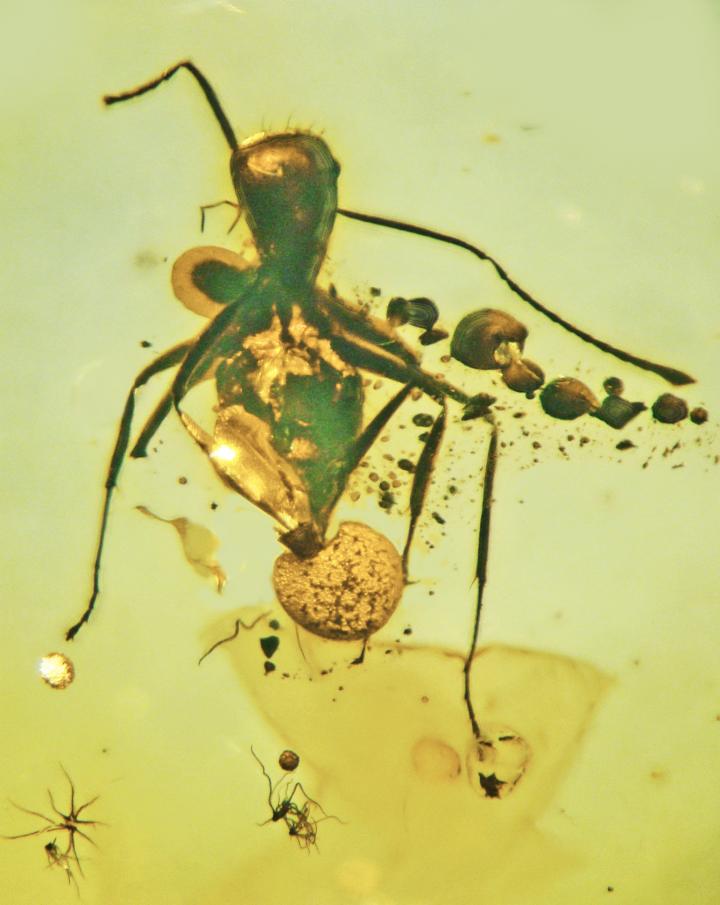
CORVALLIS, Ore. – Oregon State University research has identified the oldest known specimen of a fungus parasitizing an ant, and the fossil also represents a new fungal genus and species.

“It’s a mushroom growing out of a carpenter ant,” said OSU’s George Poinar Jr., an international expert in using plant and animal life forms preserved in amber to learn about the biology and ecology of the distant past.

A mushroom is the reproductive structure of many fungi, including the ones you find growing in your yard, and Poinar and a collaborator in France named their discovery Allocordyceps baltica. They found the new type of Ascomycota fungi in an ant preserved in 50-million-year-old amber from Europe’s Baltic region.

“Ants are hosts to a number of intriguing parasites, some of which modify the insects’ behavior to benefit the parasites’ development and dispersion,” said Poinar, who has a courtesy appointment in the OSU College of Science. “Ants of the tribe Camponotini, commonly known as carpenter ants, seem especially susceptible to fungal pathogens of the genus Ophiocordyceps, including one species that compels infected ants to bite into various erect plant parts just before they die.”

Doing so, he explains, puts the ants in a favorable position for allowing fungal spores to be released from cup-shaped ascomata – the fungi’s fruiting body -protruding from the ants’ head and neck. Carpenter ants usually make their nests in trees, rotting logs and stumps.

The new fungal genus and species shares certain features with Ophiocordyceps but also displays several developmental stages not previously reported, Poinar said. To name the genus, placed in the order Hypocreales, Poinar and fellow researcher Yves-Marie Maltier combined the Greek word for new – alloios – with the name of known genus Cordyceps.

“We can see a large, orange, cup-shaped ascoma with developing perithecia – flask-shaped structures that let the spores out – emerging from rectum of the ant,” Poinar said. “The vegetative part of the fungus is coming out of the abdomen and the base of the neck. We see freestanding fungal bodies also bearing what look like perithecia, and in addition we see what look like the sacs where spores develop. All of the stages, those attached to the ant and the freestanding ones, are of the same species.”

The fungus could not be placed in the known ant-infecting genus Ophiocordyceps because ascomata in those species usually come out the neck or head of an ant, Poinar said, and not the rectum.

“There is no doubt that Allocordyceps represents a fungal infection of a Camponotus ant,” he said. “This is the first fossil record of a member of the Hypocreales order emerging from the body of an ant. And as the earliest fossil record of fungal parasitism of ants, it can be used in future studies as a reference point regarding the origin of the fungus-ant association.”

###

Findings were published in Fungal Biology.

Media Contact
George Poinar Jr.
[email protected]

Original Source

https://beav.es/37f

Related Journal Article

http://dx.doi.org/10.1016/j.funbio.2021.06.002

Tags: Amber FossilAnt-Fungus CoevolutionArchaeologyAscomycota FungiBiologyCarpenter AntEntomologyFungal ParasiteMycologyOld WorldParasitology
Share13Tweet8Share2ShareShareShare2

Related Posts

Florida Cane Toad: Complex Spread and Selective Evolution

Florida Cane Toad: Complex Spread and Selective Evolution

February 7, 2026
New Study Uncovers Mechanism Behind Burn Pit Particulate Matter–Induced Lung Inflammation

New Study Uncovers Mechanism Behind Burn Pit Particulate Matter–Induced Lung Inflammation

February 6, 2026

DeepBlastoid: Advancing Automated and Efficient Evaluation of Human Blastoids with Deep Learning

February 6, 2026

Navigating the Gut: The Role of Formic Acid in the Microbiome

February 6, 2026
Please login to join discussion

POPULAR NEWS

  • Robotic Ureteral Reconstruction: A Novel Approach

    Robotic Ureteral Reconstruction: A Novel Approach

    82 shares
    Share 33 Tweet 21
  • Digital Privacy: Health Data Control in Incarceration

    63 shares
    Share 25 Tweet 16
  • Study Reveals Lipid Accumulation in ME/CFS Cells

    57 shares
    Share 23 Tweet 14
  • Breakthrough in RNA Research Accelerates Medical Innovations Timeline

    53 shares
    Share 21 Tweet 13

About

We bring you the latest biotechnology news from best research centers and universities around the world. Check our website.

Follow us

Recent News

Personalized Guide to Understanding and Reducing Chemicals

Inflammasome Protein ASC Drives Pancreatic Cancer Metabolism

Phage-Antibiotic Combo Beats Resistant Peritoneal Infection

Subscribe to Blog via Email

Enter your email address to subscribe to this blog and receive notifications of new posts by email.

Join 73 other subscribers
  • Contact Us

Bioengineer.org © Copyright 2023 All Rights Reserved.

Welcome Back!

Login to your account below

Forgotten Password?

Retrieve your password

Please enter your username or email address to reset your password.

Log In
No Result
View All Result
  • Homepages
    • Home Page 1
    • Home Page 2
  • News
  • National
  • Business
  • Health
  • Lifestyle
  • Science

Bioengineer.org © Copyright 2023 All Rights Reserved.