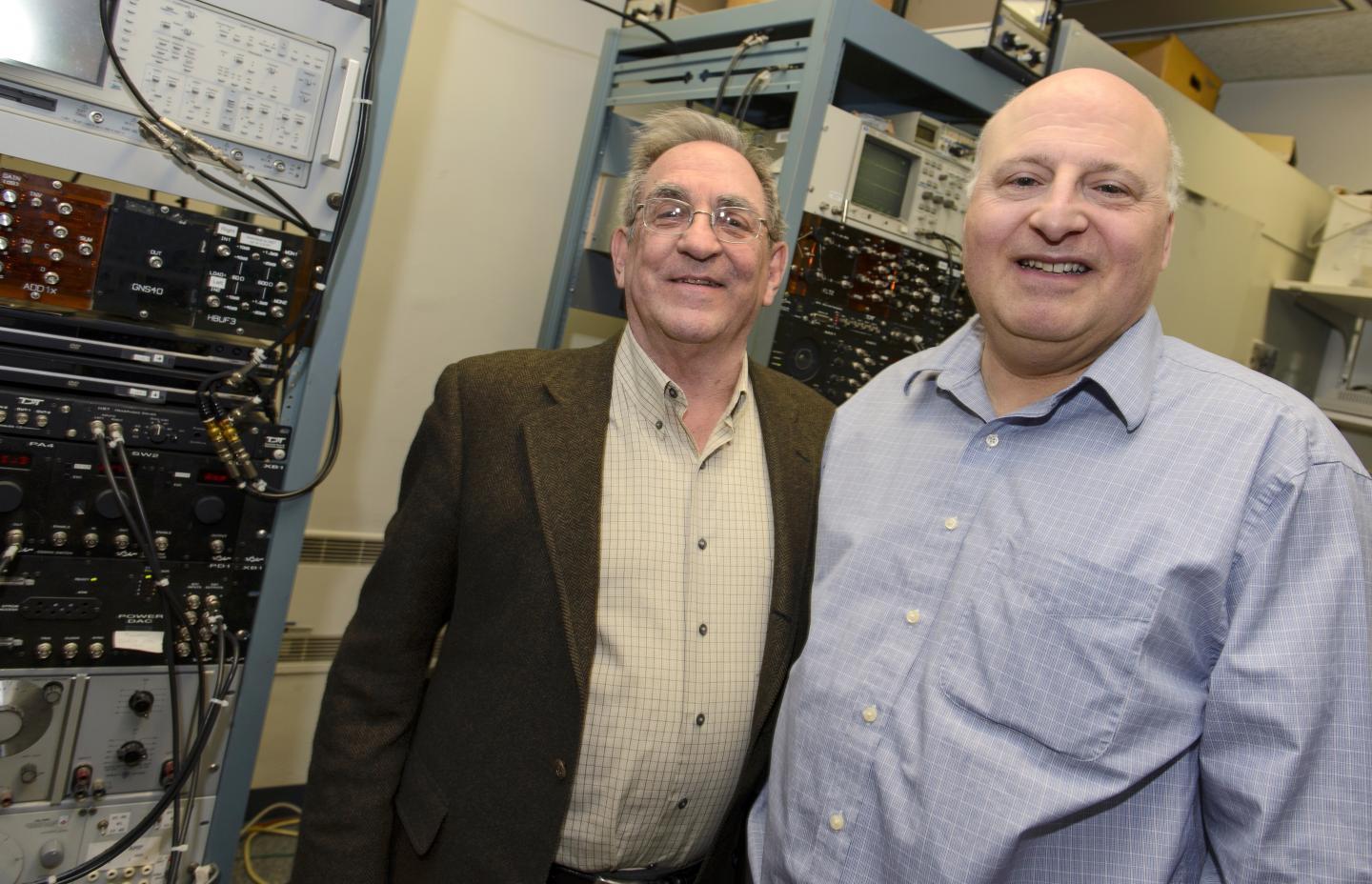
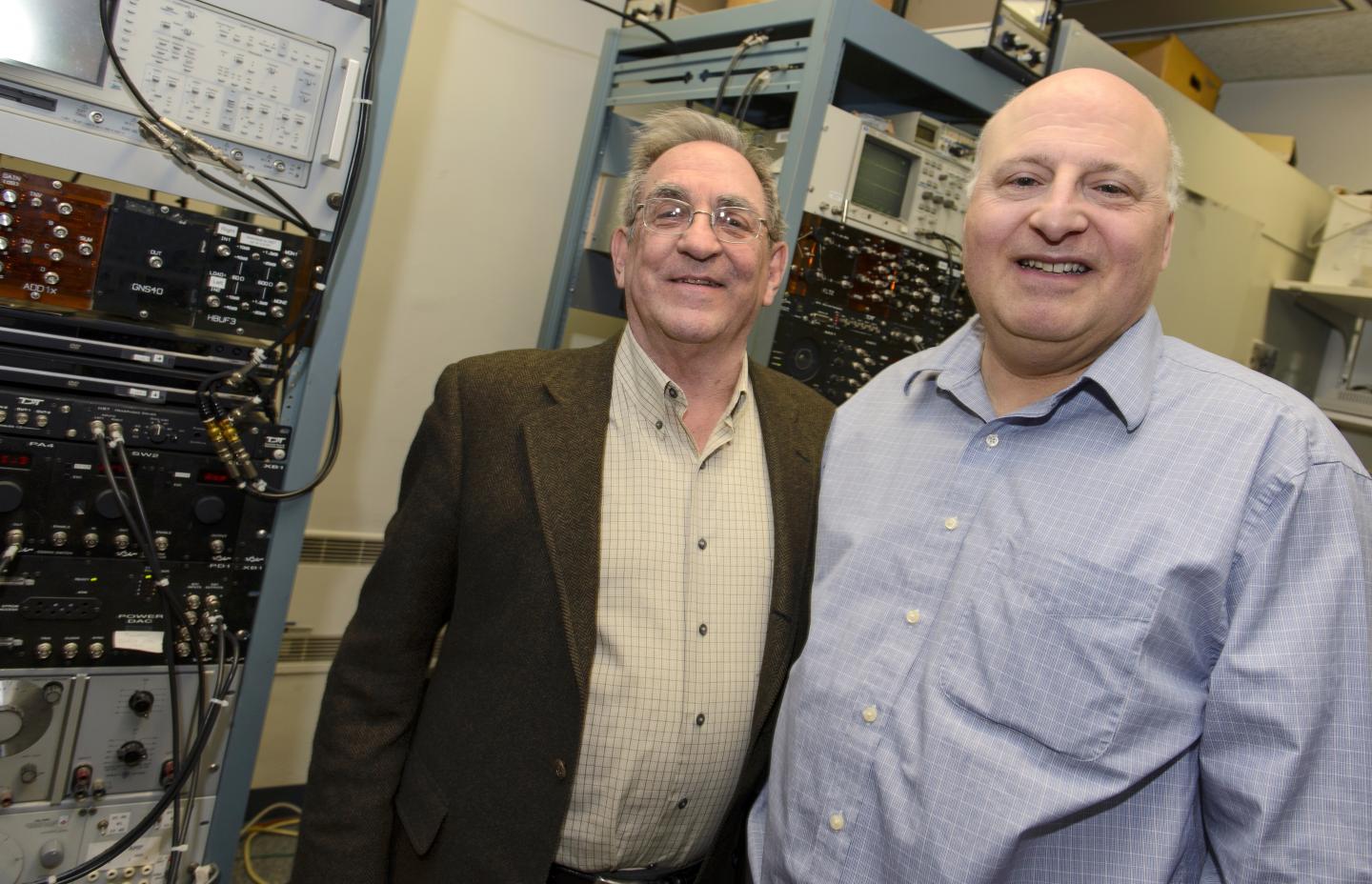
Credit: Janine Gelineau/UConn Health
Two researchers at UConn School of Medicine have developed a new hearing test that can identify hearing loss or deficits in some individuals considered to have normal or near-normal hearing in traditional tests.
Many adults report difficulties hearing in everyday situations, despite having their physicians or audiologists tell them that the results of their hearing tests are normal or near-normal.
"We now have a validated technique to identify 'hidden' hearing deficits that would likely go undetected with traditional audiograms," says Leslie R. Bernstein, professor of neuroscience and surgery at UConn, who conducted the study with Constantine Trahiotis, emeritus professor of neuroscience and surgery.
Their newly developed hearing test measures a person's ability to detect across-ears (binaural) changes in sounds presented at levels of loudness that are close to those experienced in normal conversations.
The binaural system plays a fundamental and predominant role in the ability to localize sounds, to understand conversation in places such as busy restaurants, and to attend to one of multiple, simultaneous sounds.
The researchers studied 31 adults ages 30 to 67 with normal or near-normal audiograms. They found that listeners who have essentially normal clinical hearing test results may exhibit substantial deficits in binaural processing. The results of the study have been published in the Journal of the Acoustic Society of America.
"Our study shows that our novel binaural hearing test can help early identify vulnerable populations of listeners, and perhaps help determine when critical interventions are warranted," says Trahiotis.
Bernstein and Trahiotis, who have been colleagues for nearly 40 years, including 29 at UConn School of Medicine, are widely considered to be at the forefront of binaural auditory research.
Bernstein notes that acquired hearing loss from excessive noise exposure has long been known to produce significant, and sometimes debilitating, hearing deficits. The new research suggests that hearing loss may be even more widespread than was once thought.
He says experts in the field, for example, used to think that post-concert hearing loss or ear ringing was only a temporary injury that went away. But this new, mounting evidence may change expert opinion.
Hearing problems pose substantial societal and economic problems for the approximately 15 percent of American adults who report some kind of trouble hearing. Worldwide, 360 million people have disabling hearing loss, with the World Health Organization projecting that 1.1 billion teenagers and young adults are at risk of hearing loss due to the lingering effects of excessive noise from personal audio devices and loud concerts.
"Our research team has been working hard to define what normal human hearing really is," says Trahiotis. "Greater understanding of normal hearing and the early detection of any underlying slight hearing deficits in supposed 'normal' listeners could help practitioners have a better chance of identifying ways to slow the progression of debilitating hearing loss in one's lifetime, and even possibly finding future ways to restore it."
The team's research is funded through a $1.5 million grant by the Office of Naval Research. The U.S. Navy has a keen interest in finding new ways to protect its workforce, some of whom are known to be at high risk of noise-induced hearing loss caused by exposure to excessively loud sounds.
###
Media Contact
Lauren Woods
[email protected]
860-987-2116
@UCToday
############
Story Source: Materials provided by Scienmag