• HOME
  • NEWS
  • EXPLORE
    • CAREER
      • Companies
      • Jobs
    • EVENTS
    • iGEM
      • News
      • Team
    • PHOTOS
    • VIDEO
    • WIKI
  • BLOG
  • COMMUNITY
    • FACEBOOK
    • INSTAGRAM
    • TWITTER
Thursday, March 26, 2026
BIOENGINEER.ORG
No Result
View All Result
  • Login
  • HOME
  • NEWS
  • EXPLORE
    • CAREER
      • Companies
      • Jobs
        • Lecturer
        • PhD Studentship
        • Postdoc
        • Research Assistant
    • EVENTS
    • iGEM
      • News
      • Team
    • PHOTOS
    • VIDEO
    • WIKI
  • BLOG
  • COMMUNITY
    • FACEBOOK
    • INSTAGRAM
    • TWITTER
  • HOME
  • NEWS
  • EXPLORE
    • CAREER
      • Companies
      • Jobs
        • Lecturer
        • PhD Studentship
        • Postdoc
        • Research Assistant
    • EVENTS
    • iGEM
      • News
      • Team
    • PHOTOS
    • VIDEO
    • WIKI
  • BLOG
  • COMMUNITY
    • FACEBOOK
    • INSTAGRAM
    • TWITTER
No Result
View All Result
Bioengineer.org
No Result
View All Result
Home NEWS Science News Chemistry

Scientists achieve ultra-fast optical orbiting of nanoparticles at subdiffraction scale

Bioengineer by Bioengineer
September 6, 2025
in Chemistry
Reading Time: 2 mins read
0
IMAGE
Share on FacebookShare on TwitterShare on LinkedinShare on RedditShare on Telegram

Is it possible to drive nanoparticles to orbit below the light diffraction limit using a Gaussian beam? A recent joint research project reported in Nature Communications says yes.

It is well known that light possesses not only energy but also momentum. When light irradiates an object, momentum is transferred to the object, thus generating light pressure on the object. At the microscopic scale, microparticles and nanoparticles (such as biocells and macromolecules) can be manipulated by the light force. Atoms can be cooled by light pressure to achieve atomic clocks, Bose-Einstein condensation, and so on.

In addition to the linear momentum of light being transferable, the angular momentum of light can also be transferred to an object, thus causing object rotation. Since the conversion of momentum is usually derived from the linear interaction between light and objects, the orbital rotation speed and orbital radius have so far been limited to no more than 100 Hz in water and no less than one micrometer, respectively.

Recently, however, a team led by Prof. JIANG Yuqiang from the Institute of Genetics and Developmental Biology of the Chinese Academy of Sciences, in collaboration with Prof. QIU Chengwei from the National University of Singapore, Prof. YANG Yuanjie from the University of Electronic Science and Technology of China, and Prof. XIAO Liantuan from Shanxi University, has overcome these limits.

Based on the nonlinear optical effect, the researchers have achieved an ultra-fast orbital rotation rate for nanoparticles at the subdiffraction scale.

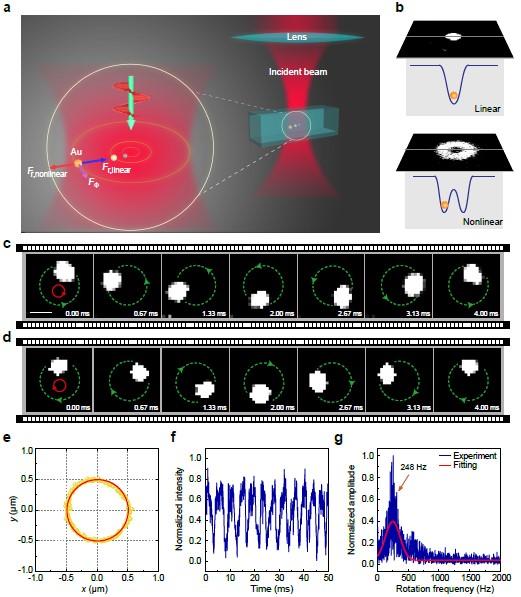
The researchers trapped gold nanoparticles using a circularly polarized NIR femtosecond laser beam with Gaussian mode. In the linear interaction regime, the trapped particles only spin in the beam center. In the nonlinear regime, however, an annular potential well can be formed by the effect of the “trap split,” and the tangential optical force enhanced by the nonlinear polarization between the femtosecond laser and gold nanoparticles causes the particles to orbit at an ultra-fast speed in the annular trap well.

As a result, the spin angular momentum of light is converted into the orbital angular momentum of particles with super high efficiency.

In this work, the minimum radius of rotation was about 70 nm, which is far below the diffraction limit; and the highest orbital rotation speed exceeded 1000 r/s, one order faster than previously reported speeds.

The study reveals a new mechanism of spin angular momentum conversion to orbital angular momentum, and provides a new method of light manipulation.

Since the orbital radius and orbital rotation speed can be controlled by adjusting the power of the femtosecond laser, the NA of the objective lens, and the material of the nanoparticles, it can be widely applied in various fields, such as optical micromachines, nanorheology, laser microfabrication, and so on.

###

Media Contact
JIANG Yuqiang
[email protected]

Related Journal Article

http://dx.doi.org/10.1038/s41467-021-24100-0

Tags: Angular momentum transferChemistry/Physics/Materials SciencesFemtosecond lasernanoparticlesOptical manipulationOpticsParticle PhysicsSubdiffraction scale
Share13Tweet8Share2ShareShareShare2

Related Posts

Isolated H2-Reduced Clusters Boost CO2-to-Methanol Catalysis

Isolated H2-Reduced Clusters Boost CO2-to-Methanol Catalysis

March 25, 2026
blank

Physicists Identify Electronic Drivers Behind Flat Band Quantum Materials

March 21, 2026

Würzburg Chemistry Professor Claudia Höbartner Receives Prestigious Honor

March 20, 2026

Scientists Reveal How Magnets Control Metamaterial Behavior

March 20, 2026
Please login to join discussion

POPULAR NEWS

  • blank

    Revolutionary AI Model Enhances Precision in Detecting Food Contamination

    96 shares
    Share 38 Tweet 24
  • Imagine a Social Media Feed That Challenges Your Views Instead of Reinforcing Them

    1003 shares
    Share 397 Tweet 248
  • Uncovering Functions of Cavernous Malformation Proteins in Organoids

    54 shares
    Share 22 Tweet 14
  • Promising Outcomes from First Clinical Trials of Gene Regulation in Epilepsy

    51 shares
    Share 20 Tweet 13

About

We bring you the latest biotechnology news from best research centers and universities around the world. Check our website.

Follow us

Recent News

In-Sensor Cryptography Links Physical Process to Digital Identity

Can Psychosocial Factors Influence Cancer Risk?

Depression Factors in Elderly: Pre vs. Post-COVID Analysis

Subscribe to Blog via Email

Success! An email was just sent to confirm your subscription. Please find the email now and click 'Confirm' to start subscribing.

Join 78 other subscribers
  • Contact Us

Bioengineer.org © Copyright 2023 All Rights Reserved.

Welcome Back!

Login to your account below

Forgotten Password?

Retrieve your password

Please enter your username or email address to reset your password.

Log In
No Result
View All Result
  • Homepages
    • Home Page 1
    • Home Page 2
  • News
  • National
  • Business
  • Health
  • Lifestyle
  • Science

Bioengineer.org © Copyright 2023 All Rights Reserved.