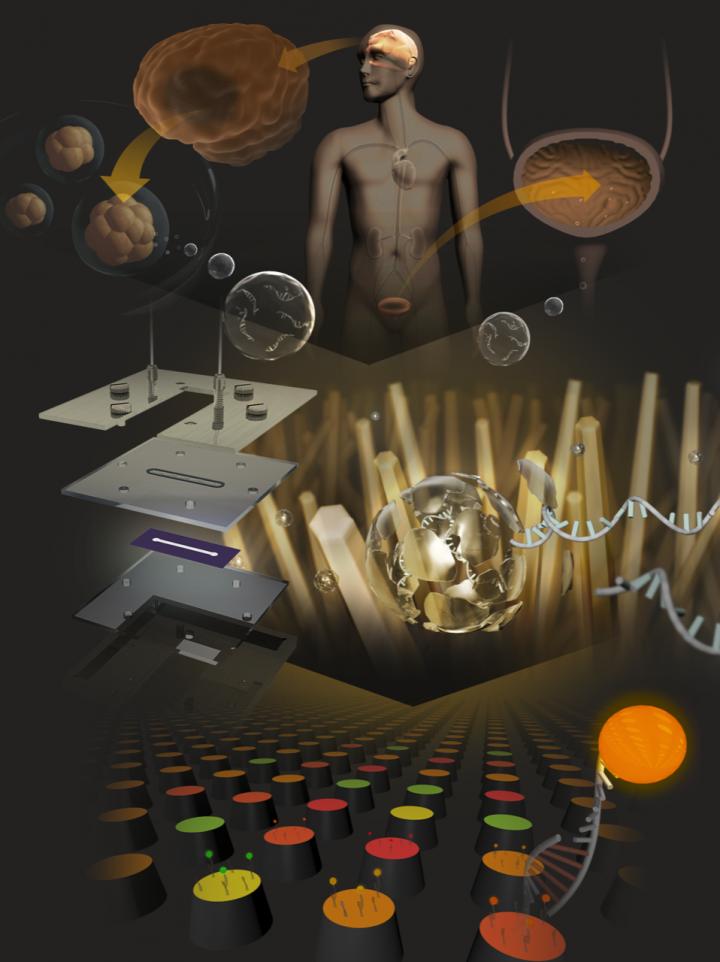
A recent study by Nagoya University researchers revealed that microRNAs in urine could be a promising biomarker to diagnose brain tumors. Their findings, published in the journal ACS Applied Materials & Interfaces, have indicated that regular urine tests could help early detection and treatment of brain tumors, possibly leading to improved patient survival.
Early diagnosis of brain tumors is often difficult, partly because most people undergo a brain CT or MRI scan only after the onset of neurological deficits, such as immobility of limbs, and incapability of speech. When brain tumors are detected by CT or MRI, in many cases, they have already grown too large to be fully removed, which could lower patients’ survival rate. From this perspective, accurate, easy, and inexpensive methods of early brain tumor detection are strongly desired.
As a diagnostic biomarker of cancerous tumors, microRNAs (tiny molecules of nucleic acid) have recently received considerable attention. MicroRNAs are secreted from various cells, and exist in a stable and undamaged condition within extracellular vesicles in biological fluids like blood and urine. Nagoya University researchers focused on microRNAs in urine as a biomarker of brain tumors. “Urine can be collected easily without putting a burden on the human body,” says Nagoya University Associate Professor Atsushi Natsume, a corresponding author of the study.
“Urine-based liquid biopsy hadn’t been fully investigated for patients with brain tumors, because none of the conventional methodologies can extract microRNAs from urine efficiently in terms of varieties and quantities. So, we decided to develop a device capable of doing it.”
The new device they developed is equipped with 100 million zinc oxide nanowires, which can be sterilized and mass-produced, and is therefore suitable for actual medical use. The device can extract a significantly greater variety and quantity of microRNAs from only a milliliter of urine compared to conventional methods.
Their analysis of microRNAs collected using the device from the urine of patients with brain tumors and non-cancer individuals revealed that many microRNAs derived from brain tumors actually exist in urine in a stable condition.
Next, the researchers examined whether urinary microRNAs can serve as a biomarker of brain tumors, using their diagnostic model based on the expression of microRNAs in urine samples from patients with brain tumors and non-cancer individuals. The results showed that the model can distinguish the patients from non-cancer individuals at a sensitivity of 100% and a specificity of 97%, regardless of the malignancy and size of tumors. The researchers thus concluded that microRNAs in urine is a promising biomarker of brain tumors.
The researchers hope that their findings will contribute to early diagnosis of aggressive types of brain cancer, like glioblastomas, as well as other types of cancer. Dr. Natsume says, “In the future, by a combination of artificial intelligence and telemedicine, people will be able to know the presence of cancer, whereas doctors will be able to know the status of cancer patients just with a small amount of their daily urine.”
###
The study, ” Urinary MicroRNA-based Diagnostic Model for Central Nervous System Tumors Using Nanowire Scaffolds,” was published online in the journal ACS applied Materials & Interfaces on April 1, 2021 at DOI: 10.1021/acsami.1c01754.
About Nagoya University, Japan
Nagoya University has a history of about 150 years, with its roots in a temporary medical school and hospital established in 1871, and was formally instituted as the last Imperial University of Japan in 1939. Although modest in size compared to the largest universities in Japan, Nagoya University has been pursuing excellence since its founding. Six of the 18 Japanese Nobel Prize-winners since 2000 did all or part of their Nobel Prize-winning work at Nagoya University: four in Physics – Toshihide Maskawa and Makoto Kobayashi in 2008, and Isamu Akasaki and Hiroshi Amano in 2014; and two in Chemistry – Ryoji Noyori in 2001 and Osamu Shimomura in 2008. In mathematics, Shigefumi Mori did his Fields Medal-winning work at the University. A number of other important discoveries have also been made at the University, including the Okazaki DNA Fragments by Reiji and Tsuneko Okazaki in the 1960s; and depletion forces by Sho Asakura and Fumio Oosawa in 1954.
Website: http://en.
Media Contact
Atsushi Natsume
[email protected]
Original Source
https:/
Related Journal Article
http://dx.