• HOME
  • NEWS
  • EXPLORE
    • CAREER
      • Companies
      • Jobs
    • EVENTS
    • iGEM
      • News
      • Team
    • PHOTOS
    • VIDEO
    • WIKI
  • BLOG
  • COMMUNITY
    • FACEBOOK
    • INSTAGRAM
    • TWITTER
Monday, June 29, 2026
BIOENGINEER.ORG
No Result
View All Result
  • Login
  • HOME
  • NEWS
  • EXPLORE
    • CAREER
      • Companies
      • Jobs
        • Lecturer
        • PhD Studentship
        • Postdoc
        • Research Assistant
    • EVENTS
    • iGEM
      • News
      • Team
    • PHOTOS
    • VIDEO
    • WIKI
  • BLOG
  • COMMUNITY
    • FACEBOOK
    • INSTAGRAM
    • TWITTER
  • HOME
  • NEWS
  • EXPLORE
    • CAREER
      • Companies
      • Jobs
        • Lecturer
        • PhD Studentship
        • Postdoc
        • Research Assistant
    • EVENTS
    • iGEM
      • News
      • Team
    • PHOTOS
    • VIDEO
    • WIKI
  • BLOG
  • COMMUNITY
    • FACEBOOK
    • INSTAGRAM
    • TWITTER
No Result
View All Result
Bioengineer.org
No Result
View All Result
Home NEWS Science News

Damage control: Plants juggle genome maintenance and growth by being organized

Bioengineer by Bioengineer
September 6, 2025
in Science News
Reading Time: 2 mins read
0
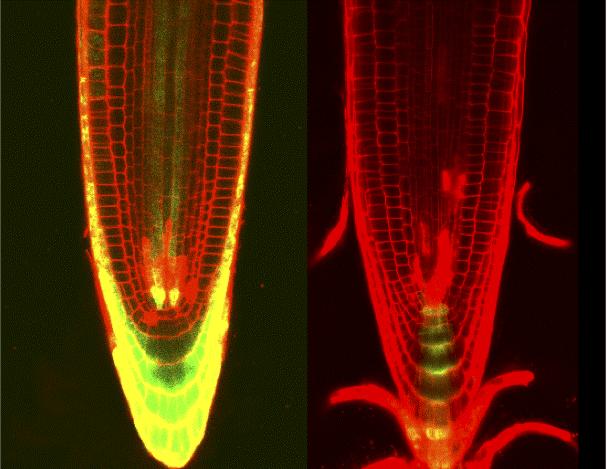
IMAGE
Share on FacebookShare on TwitterShare on LinkedinShare on RedditShare on Telegram

Researchers from Nara Institute of Science and Technology find that control of the plant hormones cytokinin and auxin help damaged plants to minimize cell death while maintaining their genomes and organ development

Ikoma, Japan – Humans pride themselves on being able to multitask, especially under pressure. But it turns out that we aren’t the only ones who are organized: researchers from Japan have discovered that plants balance genome maintenance with organ growth by organizing different responses to DNA damage.

In a study published in Science Advances, a research team led by Nara Institute of Science and Technology has revealed that plants use combined control of the plant hormones cytokinin and auxin to organize DNA damage responses while maintaining growth.

Plants are highly adaptable organisms that never stop growing, thanks largely to the functions carried out by their roots. Because of the essential role that roots play in plant growth, root development is highly responsive to fluctuating conditions underground, including environmental stresses. These stresses tend to limit root growth, and can damage DNA.

“Plants actively respond to DNA damage, and these responses are controlled by the cell cycle checkpoint mechanism,” says project leader Masaaki Umeda. “The cell cycle is stopped at a certain stage so that DNA can be repaired, or in extreme cases, cell death initiated. What we wanted to know was how the DNA damage responses are organized to allow continuous root growth.”

Unlike animal cells, plant cells aren’t mobile, so plants can’t replace dead cells with surrounding living cells. To simultaneously maintain their genomes and allow organ development, plants initiate different DNA damage responses that are dependent on the different types of cells in tissues.

“We found that the combined control of two plant hormones, cytokinin and auxin, organizes different DNA damage responses at the cost of minimized cell death,” explains first author Naoki Takahashi. “This is a sophisticated way to retain stem cells while maintaining their genomes in damaged plants.”

A decrease in auxin triggers stem cell death and stops the cell cycle at the G2 phase, while increased cytokinin signals support early endoreplication – a cell cycle variant where the genome is duplicated without cell division.

###

Resource

Title: Alterations in hormonal signals spatially coordinate distinct responses to DNA double-strand breaks in Arabidopsis roots

Authors: Naoki Takahashi, Soichi Inagaki, Kohei Nishimura, Hitoshi Sakakibara, Ioanna Antoniadi, Michal Karady, Karin Ljung & Masaaki Umeda

Journal: Science Advances

Information about project leader Umeda’s lab can be found at the following website: https://bsw3.naist.jp/eng/courses/courses105.html

Media Contact
Takahito Shikano
[email protected]
Tags: BiologyCell BiologyDevelopmental/Reproductive BiologyGeneticsPhysiologyPlant Sciences
Share12Tweet8Share2ShareShareShare2

Related Posts

Tracking Lanthanide-Labeled Microplastics in Plants

June 25, 2026

POSTECH Researchers Slash Cost of Reconstituted Cell-Free Systems by 95%

June 25, 2026

AI and Physics Collaborate to Design Advanced Hydrogen Storage Materials

June 25, 2026

Natural Hallucinogens: Evolution’s Ecological Tools, Not Mere Chemical Byproducts

June 25, 2026
Please login to join discussion

POPULAR NEWS

  • Saying Goodbye to PGY-6: Pediatric Fellowship Realities

    103 shares
    Share 41 Tweet 26
  • Multi-Hospital Study Reveals Long Covid Burden Is Twice as High as Current Estimates

    92 shares
    Share 36 Tweet 23
  • Detection of EDCs in Breast Milk and Infant Urine Up to Six Months Highlights Early Exposure Risks

    77 shares
    Share 31 Tweet 19
  • New Drug Candidate Developed at McMaster Shows Potential for Treating Brain Cancer

    58 shares
    Share 23 Tweet 15

About

We bring you the latest biotechnology news from best research centers and universities around the world. Check our website.

Follow us

Recent News

Tracking Lanthanide-Labeled Microplastics in Plants

POSTECH Researchers Slash Cost of Reconstituted Cell-Free Systems by 95%

AI and Physics Collaborate to Design Advanced Hydrogen Storage Materials

Subscribe to Blog via Email

Success! An email was just sent to confirm your subscription. Please find the email now and click 'Confirm' to start subscribing.

Join 82 other subscribers
  • Contact Us

Bioengineer.org © Copyright 2023 All Rights Reserved.

Welcome Back!

Login to your account below

Forgotten Password?

Retrieve your password

Please enter your username or email address to reset your password.

Log In
No Result
View All Result
  • Homepages
    • Home Page 1
    • Home Page 2
  • News
  • National
  • Business
  • Health
  • Lifestyle
  • Science

Bioengineer.org © Copyright 2023 All Rights Reserved.