Credit: Adapted from ACS Applied Materials & Interfaces 2021, DOI: 10.1021/acsami.1c04911
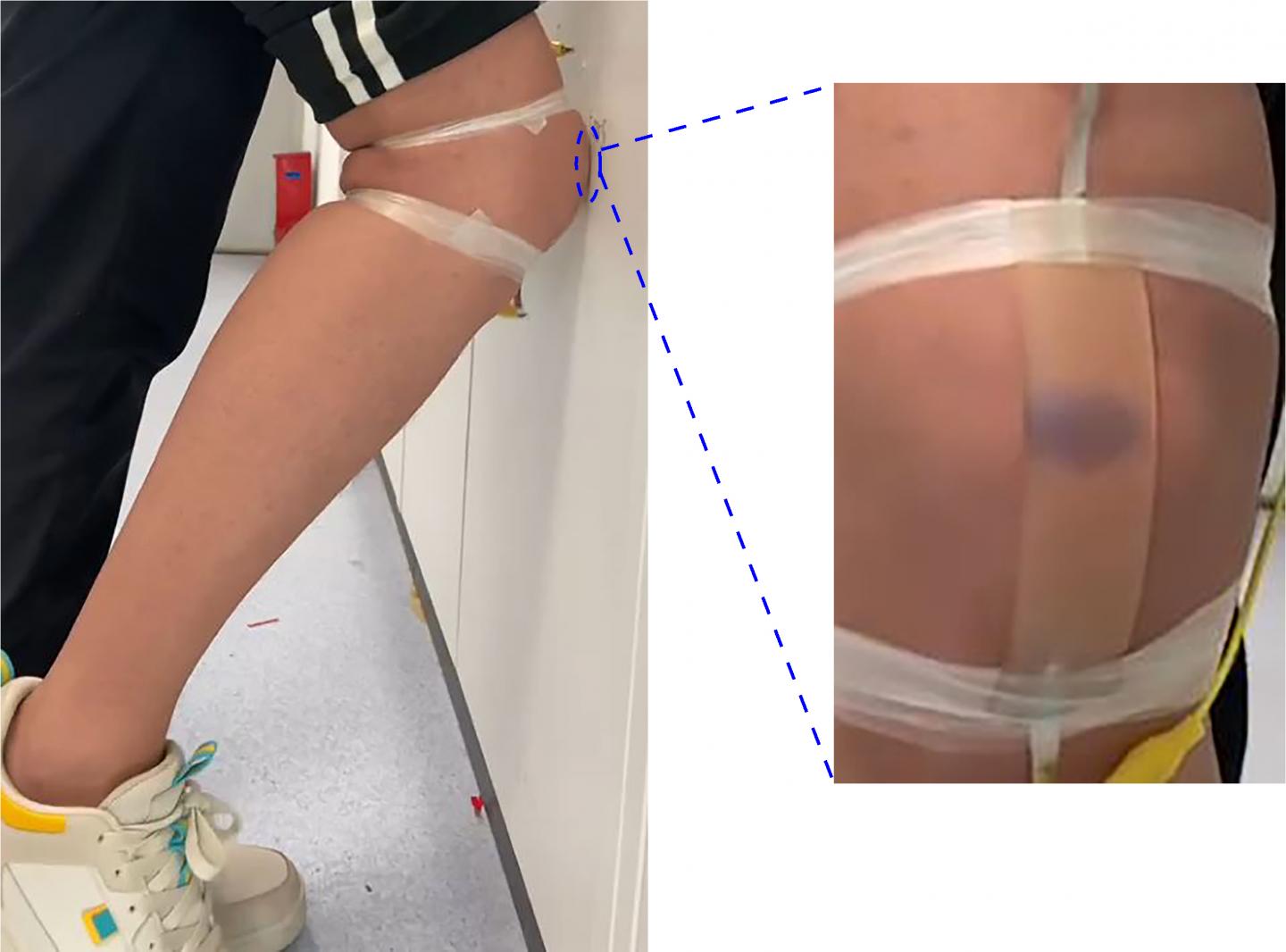
When someone bumps their elbow against a wall, they not only feel pain but also might experience bruising. Robots and prosthetic limbs don’t have these warning signs, which could lead to further injury. Now, researchers reporting in ACS Applied Materials & Interfaces have developed an artificial skin that senses force through ionic signals and also changes color from yellow to a bruise-like purple, providing a visual cue that damage has occurred.
Scientists have developed many different types of electronic skins, or e-skins, that can sense stimuli through electron transmission. However, these electrical conductors are not always biocompatible, which could limit their use in some types of prosthetics. In contrast, ionic skins, or I-skins, use ions as charge carriers, similar to human skin. These ionically conductive hydrogels have superior transparency, stretchability and biocompatibility compared with e-skins. Qi Zhang, Shiping Zhu and colleagues wanted to develop an I-skin that, in addition to registering changes in electrical signal with an applied force, could also change color to mimic human bruising.
The researchers made an ionic organohydrogel that contained a molecule, called spiropyran, that changes color from pale yellow to bluish-purple under mechanical stress. In testing, the gel showed changes in color and electrical conductivity when stretched or compressed, and the purple color remained for 2-5 hours before fading back to yellow. Then, the team taped the I-skin to different body parts of volunteers, such as the finger, hand and knee. Bending or stretching caused a change in the electrical signal but not bruising, just like human skin. However, forceful and repeated pressing, hitting and pinching produced a color change. The I-skin, which responds like human skin in terms of electrical and optical signaling, opens up new opportunities for detecting damage in prosthetic devices and robotics, the researchers say.
###
The authors acknowledge funding from the National Natural Science Foundation of China, the Program for Guangdong Introducing Innovative and Entrepreneurial Teams, Shenzhen Science and Technology Program, 2019 Special Program for Central Government Guiding Local Science and Technology Development: Environmental Purification Functional Materials Research Platform, Shenzhen Key Laboratory of Advanced Materials Product Engineering and the CUHK-Shenzhen Presidential Fund.
The abstract that accompanies this paper is available here.
The American Chemical Society (ACS) is a nonprofit organization chartered by the U.S. Congress. ACS’ mission is to advance the broader chemistry enterprise and its practitioners for the benefit of Earth and all its people. The Society is a global leader in promoting excellence in science education and providing access to chemistry-related information and research through its multiple research solutions, peer-reviewed journals, scientific conferences, eBooks and weekly news periodical Chemical & Engineering News. ACS journals are among the most cited, most trusted and most read within the scientific literature; however, ACS itself does not conduct chemical research. As a leader in scientific information solutions, its CAS division partners with global innovators to accelerate breakthroughs by curating, connecting and analyzing the world’s scientific knowledge. ACS’ main offices are in Washington, D.C., and Columbus, Ohio.
To automatically receive news releases from the American Chemical Society, contact [email protected].
Follow us: Twitter | Facebook
Media Contact
Katie Cottingham
[email protected]